



|
Getting your Trinity Audio player ready...
|
By: Fern Sidman
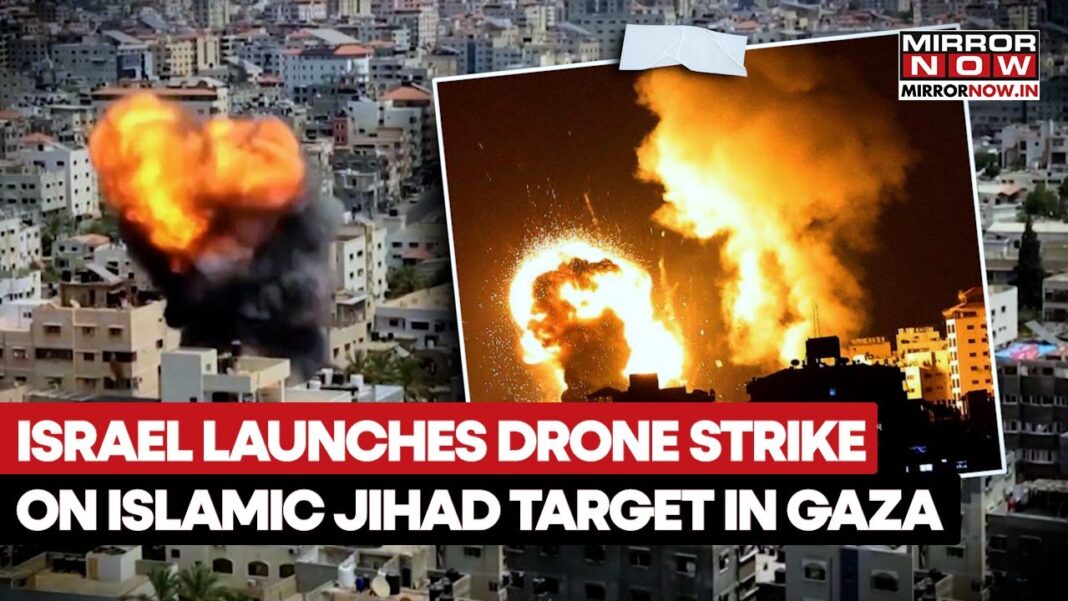
In a move that drew attention to the fragility of the ongoing ceasefire between Israel and Hamas, the Israel Defense Forces (IDF) on Saturday conducted a targeted drone strike in central Gaza, killing an Islamic Jihad operative who, according to military intelligence, was actively preparing to attack Israeli troops stationed along the border. The operation, confirmed by Israeli military officials and reported by VIN News, marks one of the most significant escalations since the U.S.-brokered truce came into effect earlier this year.
According to a report that appeared on Saturday evening at VIN News, the strike occurred near the city of Deir al-Balah, a region that has seen intermittent clashes and reconnaissance operations despite the nominal ceasefire. The IDF identified the target as a senior field operative affiliated with Palestinian Islamic Jihad (PIJ)—a militant faction that has continued sporadic rocket attacks and ambush attempts even after publicly agreeing to uphold the truce. The suspect, according to Israeli officials, was “actively engaged in operational planning” to target Israeli patrols operating near the Gaza periphery fence.
While the IDF did not disclose the individual’s name, VIN News reported that local Palestinian media circulated images of a charred vehicle engulfed in flames, consistent with the aftermath of an aerial drone strike. Medical sources in Gaza told Reuters that four individuals were wounded, with no immediate confirmation of fatalities. The Islamic Jihad organization has not yet commented on Israel’s claims, fueling speculation that the wounded may include the intended target.
As the VIN News report highlighted, Saturday’s operation reflects Israel’s “zero-tolerance” counterterrorism doctrine, which allows for immediate, intelligence-driven action against operatives suspected of plotting attacks, regardless of the ceasefire’s terms. Israeli defense officials, speaking to VIN News on condition of anonymity, stressed that the strike was “surgical” and aimed at neutralizing an imminent threat.
“We are operating within a ceasefire, not surrender,” one IDF source told VIN News. “When we identify those preparing to harm Israeli soldiers or civilians, we will act preemptively and decisively.”
The strike comes amid growing accusations from both sides of violating the tenuous U.S.-backed truce, which has held—albeit tenuously—for several months since its negotiation in early spring. The agreement, mediated by Washington and Cairo, sought to halt active hostilities after more than two years of relentless conflict following the October 7, 2023 Hamas-led massacre in southern Israel, which left over 1,200 Israelis dead and more than 250 kidnapped into Gaza.
Although large-scale combat operations have subsided, VIN News has documented frequent exchanges of fire, infiltration attempts, and retaliatory actions that have undermined the ceasefire’s credibility. Saturday’s incident is only the latest in a series of limited Israeli counterstrikes carried out in response to what the IDF describes as “terrorist preparations” along the Gaza border.
Shortly after the targeted strike, witnesses in Gaza City reported tank shelling in the eastern neighborhoods of the enclave’s largest urban center. According to the report at VIN News, Israeli armored units stationed near the Shuja’iyya sector opened fire following what military sources described as “suspicious movement” near a security buffer zone.
The IDF declined to comment on the reports, telling VIN News only that “operational assessments are ongoing.” Gaza residents told international reporters that several shells landed near residential buildings, causing panic but no confirmed casualties. The incident further fueled Palestinian claims that Israel is using the ceasefire as cover for “continued aggression,” a charge Israeli officials reject as propaganda.
In a related development, VIN News reported that Israel has granted Egyptian officials permission to enter Gaza to assist in locating the bodies of Israeli hostages believed to have been killed during the 2023 Hamas onslaught. The move represents a rare gesture of trust toward Cairo, which has acted as a key intermediary in truce negotiations and humanitarian arrangements throughout the conflict.
Israeli media, cited in the VIN News report, noted that this marks the first time since the ceasefire’s implementation that foreign officials have been allowed to conduct recovery operations inside the Gaza Strip. The decision reportedly came after weeks of behind-the-scenes coordination between the Israeli Prime Minister’s Office, the Defense Ministry, and Egyptian intelligence services.
Though Israel’s government has not formally confirmed the reports, the VIN News report stated that the objective of the Egyptian mission is to locate the remains of at least 18 hostages still believed to be in Gaza, including both civilians and soldiers. These individuals were among the hundreds abducted during Hamas’s cross-border assault on southern Israeli communities nearly two years ago.
Hamas has maintained that all living hostages have been released under previous stages of the ceasefire agreement, while Israel contends that “dozens remain unaccounted for”, including several whose presumed deaths have not been verified.
“The humanitarian dimensions of this issue remain central to our national priorities,” an Israeli security official told VIN News. “The return of every hostage—living or deceased—is a sacred duty for the State of Israel.”
The U.S.-mediated truce, backed by both Egypt and Qatar, was hailed as a diplomatic breakthrough when it first came into force, offering a glimmer of hope after years of bloodshed. Yet as VIN News has reported, the ceasefire’s durability is being tested by recurring violations and deep mistrust between the combatants.
Israel accuses Hamas and Islamic Jihad of exploiting the lull to regroup militarily—repairing tunnels, replenishing rocket arsenals, and reestablishing command posts in Gaza’s urban sectors. Hamas, in turn, claims that Israel’s reconnaissance flights, targeted raids, and periodic artillery fire constitute “systematic breaches” of the truce.
Security analysts interviewed by VIN News say the pattern suggests a “cold ceasefire” rather than a genuine peace. The arrangement has reduced open warfare but left the fundamental conflict unresolved, with neither side willing to make the political compromises necessary for a long-term settlement.
“This is a managed hostility, not a resolution,” said military analyst Ron Ben-David. “Both Israel and Hamas are playing a strategic waiting game—testing boundaries while avoiding an all-out return to war.”
The Trump administration, which played a pivotal role in brokering the ceasefire, is now facing growing frustration as ceasefire breaches mount. According to the VIN News report, Washington continues to urge restraint on both sides, warning that even limited Israeli strikes risk inflaming regional tensions at a time when the U.S. is seeking to stabilize relations between Israel and Arab states under its broader Middle East security framework.
At the same time, Israeli officials argue that the United States and Egypt must hold Hamas accountable for its repeated provocations, including the firing of rockets from southern Gaza last month and the continued glorification of terrorist operatives through state-run media outlets.
“A ceasefire cannot coexist with terror recruitment,” an Israeli diplomat told VIN News. “If Hamas wants peace, it must disarm, and it must end its coordination with Islamic Jihad.”
Saturday’s strike serves as a stark reminder of how precarious the situation remains in Gaza. Despite the ceasefire’s political framework, both sides continue to operate under a mutual posture of suspicion and readiness. As the VIN News report observed, each violation—no matter how minor—chips away at the truce’s credibility and risks plunging the region back into open conflict.
For now, the IDF appears determined to maintain operational freedom while avoiding large-scale escalation. Yet the deeper issues—the return of hostages, the disarmament of militant factions, and the reconstruction of Gaza under international oversight—remain unresolved.
As the VIN News report noted, the truce is “a pause, not peace”—a fragile arrangement sustained by diplomacy, deterrence, and the hope that exhaustion may, for a time, succeed where politics has failed.
