



|
Getting your Trinity Audio player ready...
|
By: Fern Sidman
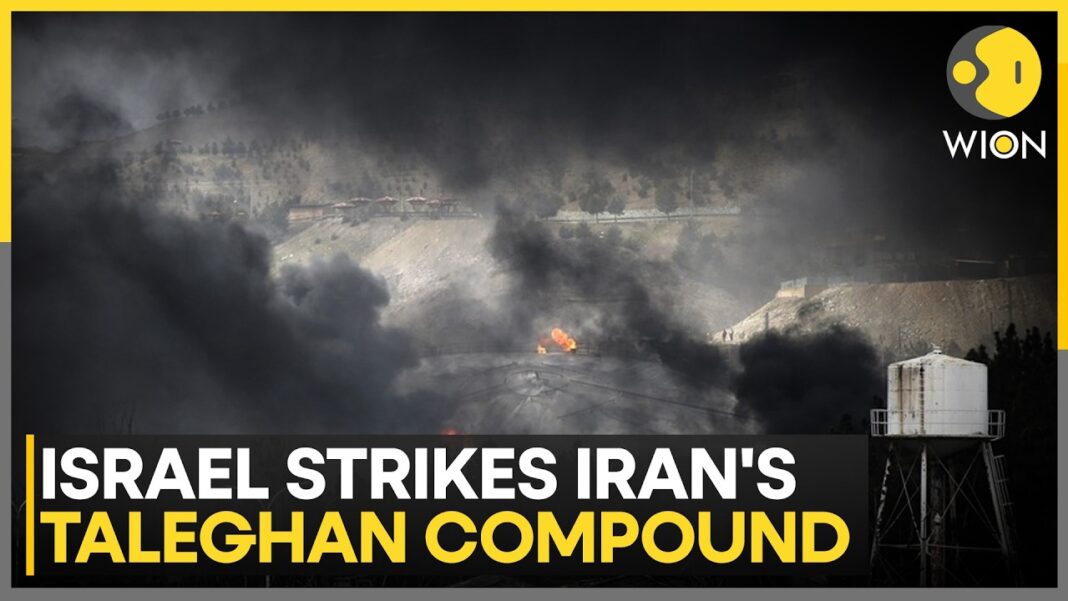
In a significant escalation of the ongoing confrontation between Israel and the Islamic Republic of Iran, the Israeli Air Force (IAF) has carried out a precise and strategically consequential strike on a nuclear-related facility within the Iranian capital. The operation targeted the Taleghan compound, a site long associated with Tehran’s clandestine efforts to develop technologies essential for nuclear weapons production.
The strike, conducted as part of Operation Rising Lion, represents the latest phase in Israel’s intensifying campaign to dismantle Iran’s nuclear infrastructure and prevent the regime from advancing toward the acquisition of atomic weapons. According to military officials, the attack was carried out on the basis of highly accurate intelligence gathered by the Israel Defense Forces (IDF).
Reports cited by Israel National News on Thursday indicate that the compound had been utilized in recent years for advanced explosives research and other sensitive experiments linked to Iran’s historic AMAD Project, the covert nuclear weapons development program pursued by Tehran during the early 2000s.
Israeli defense officials described the strike as part of a broader strategic effort aimed at eliminating what they characterize as an “emerging existential threat” to the State of Israel.
The Taleghan compound, located within the Tehran region, has long been suspected by international observers and intelligence agencies of playing a role in Iran’s nuclear weapons research. Although the Iranian government has consistently maintained that its nuclear activities are intended solely for peaceful purposes, Israeli officials and many Western governments argue that the regime has repeatedly concealed military dimensions of its atomic program.
According to the information provided in the Israel National News report, the compound had been used in recent years to develop advanced explosive systems and conduct experiments related to the detonation mechanisms necessary for nuclear warheads. Such research is considered a critical component in transforming enriched nuclear material into an operational weapon.
Military analysts note that modern nuclear weapons rely on highly sophisticated explosive configurations designed to compress fissile material to the point of supercriticality. Facilities like the Taleghan compound are therefore regarded as key nodes within a broader nuclear weapons development network.
The Israeli strike was intended to disrupt these capabilities before they could mature further.
The Taleghan site’s historical significance stems largely from its connection to Iran’s AMAD Project, a covert program that Western intelligence agencies believe was dedicated to developing nuclear weapons prior to its official suspension in the early 2000s. Although Tehran claims that the project was terminated, Israeli intelligence officials have long argued that elements of the program continued under new organizational structures.
According to the Israel National News report, the compound’s recent activities suggest that the regime had resumed certain research efforts associated with weapons design. The AMAD program originally involved extensive experimentation in high-explosive technologies, neutron initiators, and other components necessary for constructing a nuclear device.
Experts believe that much of this work was relocated or dispersed after international scrutiny intensified, making sites like Taleghan especially significant as potential centers for continued research.
The strike on the Taleghan compound is one of several operations conducted under Operation Rising Lion, Israel’s ongoing military campaign targeting Iran’s nuclear infrastructure and associated research facilities.
As Israel National News has reported, the IDF has undertaken a methodical strategy designed to degrade both the physical infrastructure and the scientific expertise supporting Tehran’s nuclear ambitions. Rather than focusing exclusively on enrichment facilities or missile launch systems, Israeli planners have expanded the campaign to include knowledge centers, laboratories, and research hubs involved in weapons development.
By targeting the intellectual and technological foundations of the program, Israeli officials hope to slow or halt Iran’s progress toward a deployable nuclear weapon. “During Operation Rising Lion,” the IDF stated in an official announcement cited by Israel National News, “the military has operated systematically against knowledge centers and infrastructure related to the Iranian nuclear weapon program in order to eliminate the emerging existential threat to the State of Israel.”
Despite the damage inflicted by previous strikes, Israeli intelligence officials say that the Iranian regime has attempted to rehabilitate several nuclear-related facilities. According to the information contained in the Israel National News report, the IDF recently detected efforts by Iranian engineers to restore activity at the Taleghan compound after it had previously been targeted during an October 2024 strike.
The discovery prompted Israeli planners to conduct a new operation aimed at preventing the site from returning to operational status. “The Iranian regime has continued efforts to advance and develop capabilities required for the development of a nuclear weapon,” the IDF said in a statement quoted by Israel National News.
This pattern of reconstruction and renewed targeting highlights the persistent cat-and-mouse dynamic between Iranian nuclear engineers and Israeli intelligence services.
The attack on the Taleghan compound follows another major Israeli operation earlier this month.
On March 3, 2026, Israeli aircraft struck the Minzadehei compound, another facility believed to be linked to Iran’s nuclear weapons program. According to coverage cited by Israel National News, that strike targeted laboratories and equipment suspected of supporting advanced research related to nuclear weapons development. Together, the strikes form part of a broader pattern of operations aimed at degrading Iran’s nuclear capabilities across multiple sites.
Israeli officials say the campaign is designed not merely to destroy individual facilities but to disrupt the entire ecosystem supporting Iran’s nuclear ambitions.
The latest strike underscores the continuing volatility of the confrontation between Israel and Iran. For Israel, the prospect of a nuclear-armed Iranian regime has long been viewed as an unacceptable threat. Israeli leaders have repeatedly warned that Tehran’s leadership, which frequently calls for the destruction of the Jewish state, cannot be allowed to acquire atomic weapons.
From this perspective, preemptive action against nuclear infrastructure is considered a matter of national survival. Iran, however, views such strikes as acts of aggression and has vowed to retaliate. The cycle of attack and counterattack has fueled concerns among international observers that the conflict could expand into a broader regional war.
Although the current wave of strikes has brought the conflict into the open, the confrontation between Israel and Iran has been unfolding for years through a shadow war involving cyberattacks, covert operations, and targeted assassinations of nuclear scientists. The latest airstrikes represent a dramatic escalation of that long-running struggle.
Israeli officials believe that sustained pressure on Iran’s nuclear infrastructure is necessary to prevent the regime from crossing the threshold into nuclear weapons capability. Despite the significant damage inflicted so far, military analysts caution that Iran’s nuclear program is complex and dispersed. Facilities are scattered across multiple locations, some deeply buried or concealed within civilian infrastructure. As a result, eliminating the program entirely may prove difficult.
The strike on the Taleghan compound illustrates the high stakes surrounding Iran’s nuclear ambitions. For Israel, the issue is framed as an existential threat that must be confronted decisively. For Iran, the nuclear program has become a symbol of technological prestige and strategic deterrence. This clash of perspectives has made the dispute one of the most enduring and dangerous conflicts in modern geopolitics.
As Israel National News has emphasized in its coverage, the IDF’s latest operation represents another step in Israel’s determination to prevent Tehran from achieving nuclear weapons capability. Whether the campaign ultimately succeeds in permanently halting Iran’s nuclear ambitions—or instead intensifies an already volatile confrontation—remains an open question.
For now, however, the message from Jerusalem appears unmistakable: Israel intends to continue striking wherever it believes the foundations of Iran’s nuclear program remain intact.
