



|
Getting your Trinity Audio player ready...
|
By: Fern Sidman
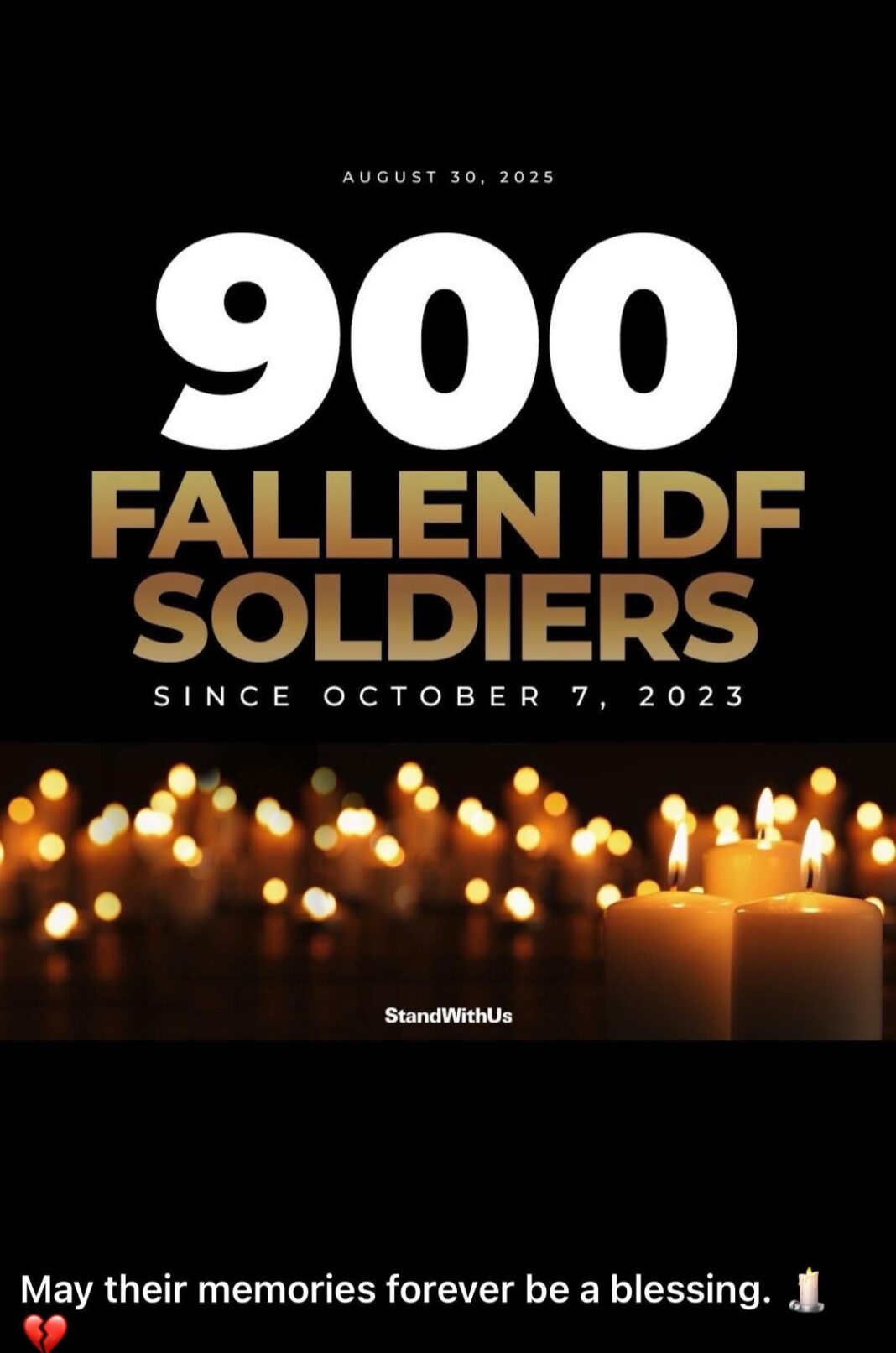
Israel stands at a solemn threshold. Nearly 700 days since the war began, the country continues to bear the weight of sacrifice and loss, as the Israel Defense Forces (IDF) confirm that 900 of its soldiers have fallen in combat, counterterrorism missions, and defensive operations across multiple fronts. The figure represents not only the largest wartime loss in a generation but also a reminder of the immense courage, endurance, and humanity of Israel’s sons and daughters in uniform.
The fallen were not just soldiers—they were fathers, mothers, sons, daughters, siblings, and friends. They were the face of a people united in defense of their homeland. Each number hides a story of valor, of quiet devotion to country, and of families left behind who now embody both grief and resilience.
The Breakdown of Loss
The statistics themselves tell the story of a multifront war unlike any Israel has faced in decades:
329 heroes fell during the desperate defensive battles of October 7, when Hamas launched its brutal surprise attack. Their sacrifice blunted the initial wave of terror and gave Israel precious time to regroup and respond.
456 soldiers were lost in the subsequent ground maneuver in Gaza, a campaign waged in dense urban battlefields where every street corner could conceal ambushes and every tunnel could hide explosives.
50 lives were given in the ground maneuver in Lebanon, where Hezbollah’s arsenal and guerilla tactics presented relentless dangers.
34 soldiers perished in Israel’s northern regions during defensive engagements with Hezbollah, holding the line for vulnerable towns and kibbutzim under rocket fire.
16 fell in Judea and Samaria, facing down terror attacks and armed clashes that threatened civilians on a near-daily basis.
2 were killed by UAVs launched from militias in Iraq, a stark reminder of the regional scope of threats Israel faces.
1 fell from an Iranian missile strike during Operation “With a Lion’s Heart,” underscoring Tehran’s role in fanning the flames of conflict.
12 more lost their lives in additional incidents and operational accidents, tragedies that highlight the unforgiving nature of military service even outside the battlefield.
Behind every number stands a family changed forever—and a nation that bends but does not break.
Families Carrying the Burden of Heroism
The loss reverberates most painfully in the homes left silent by their absence.
Since the war began:
203 IDF widows have entered the circle of bereavement. Young spouses, many raising children, now bear the heavy mantle of grief while carrying forward the legacy of their loved ones.
563 IDF orphans will grow up without a parent, each milestone shadowed by sacrifice.
In total, more than 7,000 Israelis now belong to the extended family of the bereaved—a family bound not by choice but by the collective burden of loss.
For Israelis, the concept of achdut—unity—is not abstract. It is visible in the way communities rally around these families. Widows are surrounded by support networks ensuring they are never left alone on Shabbat. Orphans are embraced by their schools, their communities, and countless volunteers. In Israel, the fallen do not leave behind only their biological family; they leave behind an entire nation that vows to remember them.
The Heroism of the IDF
The Israel Defense Forces are more than a military institution; they are the beating heart of national survival. Each fallen soldier represents the frontline of Jewish continuity in the ancestral homeland. From elite commando units storming Hamas strongholds to reservists who left behind businesses, classrooms, and families to defend their country, the IDF embodies Israel’s resilience.
As Israel National News has often underscored, the IDF is unique in its ethos: a citizen army where every soldier is also a neighbor, a classmate, or a coworker. In Israel, the distance between the battlefield and civilian life is virtually nonexistent. This closeness makes the sacrifice even more profound, for each funeral echoes not only in one family but across an entire community.
A Nation Living with Loss
Israel’s collective consciousness is shaped by its wars and its warriors. Nearly every citizen has stood at a military funeral or sat shiva with a bereaved family. The grief is national, but so too is the pride.
Public ceremonies are filled with both tears and song. On Mount Herzl, where many of the fallen rest, families come not only to weep but to speak of their loved ones’ bravery. Schools tell the stories of graduates who died in service. Synagogues light candles for local heroes. In cafés and buses, conversations often drift to memories of someone’s cousin, neighbor, or childhood friend who is among the fallen.
As the war nears its 700th day, Israelis live in duality—going about daily routines while carrying the knowledge that young men and women are risking everything to ensure those routines continue. The sight of soldiers boarding buses in uniform is met with gratitude, respect, and whispered blessings of “shmor aleichem”—“may you be protected.”
The Cost of Courage
War has exacted a devastating price on Israel, but the IDF has prevented a greater catastrophe. Without their sacrifices, the horrors of October 7 could have spread unchecked across southern Israel. Without their vigilance in the north, Hezbollah’s rockets could have paralyzed the Galilee. Without their determination in Gaza, Hamas tunnels and arsenals would still be poised for new massacres.
Prime Minister Benjamin Netanyahu has said repeatedly that Israel’s fight is not only for its own survival but also for the defense of Western civilization against barbarism. That lofty ideal is carried on the shoulders of the 900 fallen. They died not only protecting Israel but also standing on the front line of a global struggle against terror.
The Ripple Effect on Israeli Society
The impact of such loss reaches far beyond the bereaved families. Israeli society itself carries the scars. The economy is strained by prolonged reserve call-ups, schools and universities adapt to the absence of students and teachers who serve, and workplaces leave seats empty for employees who never return.
Yet, amid the sorrow, Israeli resilience shines. National service, both military and civilian, is viewed as a sacred duty, and recruitment levels remain high despite the risks. Stories abound of siblings of the fallen volunteering for elite units in honor of those they lost. Communities have established scholarships and memorial projects to ensure the legacy of the fallen lives on through education, research, and cultural initiatives.
This resilience is part of Israel’s DNA: a society built in the shadow of the Holocaust and tempered by decades of wars and terror. Israelis do not glorify war, but they sanctify the memory of those who fight it on their behalf.
The Eternal Bond
In Jewish tradition, those who fall defending the people of Israel are remembered as kedoshim—holy ones. Their names are recited in prayers, etched in stone memorials, and woven into the national story. The IDF, as Israel National News frequently emphasizes, is not just defending borders; it is guarding the very continuity of Jewish life in the land of Israel.
The 900 fallen are now part of that sacred chain. Their stories will be told in classrooms, their photos displayed in military bases, their bravery remembered in every candle lit on Yom HaZikaron.
Looking Ahead
As Israel approaches 700 days of conflict, uncertainty lingers. Hamas remains entrenched in Gaza. Hezbollah continues to menace the north. Iranian-backed militias launch drones from afar. The path forward is fraught with danger, but also illuminated by the legacy of those who gave everything.
For the families of the fallen, the war will never end. For Israel, their sacrifice demands both remembrance and perseverance. And for the world, their courage is a reminder that the defense of freedom and human dignity often falls upon the shoulders of the few who are willing to stand against darkness.
Nine hundred lives lost. Two hundred widows. Five hundred sixty-three orphans. More than seven thousand grieving relatives. These are not just statistics; they are the human cost of Israel’s battle for survival.
Yet amid the grief, there is also profound pride. The men and women of the Israel Defense Forces have shown the world what heroism looks like: unwavering courage in the face of terror, love of country above self, and the ultimate sacrifice for the safety of the Jewish people and the freedom of Israel.
Their memory will forever be a blessing, and their legacy a guiding light for a nation that endures because of their valor.

THE STRENGTH OF AM YISRAEL IS IN THE HEROIC BRAVE AND DEDICATED SOLDIERS OF THE IDF THAT HAVE GIVEN SO MUCH FOR OUR NATION. MAY THEIR MEMORIES BE FOR A BLESSING. WE PRAY THAT THEIR FAMILIES ARE COMFORTED AND BLESSED FOR THE SACRIFICE THEY ENDURE.