



|
Getting your Trinity Audio player ready...
|
Iranian Cluster Missile Strike Wounds Civilians in Tel Aviv & Petah Tikva as MDA Crews Race to Rescue Victims
By: Yisroel David
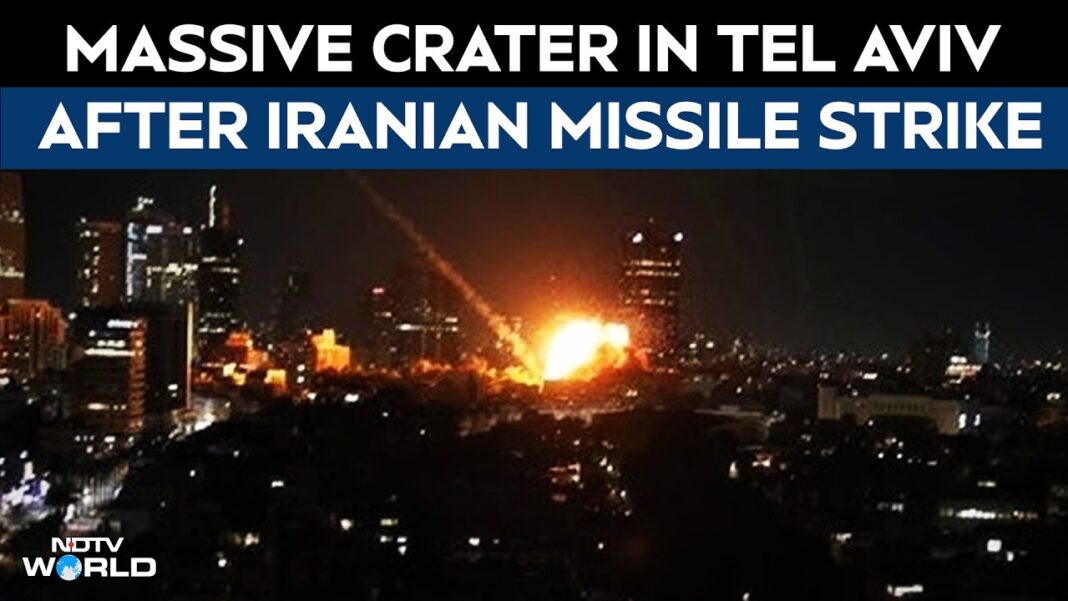
Central Israel was once again thrust into the front lines of the escalating regional conflict as an Iranian missile barrage employing cluster-type munitions struck the metropolitan area on Sunday. injuring several civilians and causing structural damage to buildings in Tel Aviv and nearby Petah Tikva. Emergency responders, including teams from Magen David Adom (MDA), the country’s national emergency medical service, rushed to the affected sites to treat victims and conduct search-and-rescue operations amid fears that additional casualties could be trapped beneath debris.
According to a report on Sunday by Israel National News, the latest barrage from Iran involved a missile believed to carry cluster-style submunitions, a type of weapon designed to disperse multiple explosive fragments over a wide area. Such munitions dramatically increase the risk to civilians because they scatter explosive components across neighborhoods, streets, and open spaces, making it difficult for residents to avoid harm even if they manage to reach shelter.
Emergency medical teams arriving at the impact locations in Tel Aviv found a man suffering from severe injuries caused by shrapnel. Paramedics provided immediate treatment at the scene before transferring the victim to Ichilov Medical Center, one of Israel’s leading hospitals. Doctors at the hospital’s emergency department reported that the man, believed to be around 40 years old, sustained a serious neck injury and was placed in the trauma unit for urgent medical care.
At the same time, medical teams were dispatched to Petah Tikva, another city in central Israel located just east of Tel Aviv, where two additional individuals were injured in the same barrage. According to the information provided in the Israel National News report, one of those victims was listed in moderate condition while the other sustained relatively minor injuries.
The attack unfolded during a tense period in which air-raid sirens sounded across several regions of central Israel, sending residents scrambling to shelters and protected spaces. Moments later, explosions echoed through the densely populated urban corridor, prompting emergency services to mobilize rapidly.
Senior MDA medic Yehezkel Goldreich, among the first responders to arrive at the Tel Aviv scene, recounted the chaotic moments following the strike. His testimony, cited by Israel National News, illustrates the suddenness with which the attack unfolded and the fear experienced by civilians caught in the open.
“I was in a park near the crash site when suddenly alarms sounded, and shortly afterwards a loud explosion was heard,” Goldreich said. “I noticed a lot of smoke rising from the impact area, and I rushed to scan the area.”
Goldreich described encountering civilians who were visibly shaken and disoriented by the blast. Some had thrown themselves to the ground in an attempt to avoid flying debris, while others ran toward emergency personnel seeking assistance.
“There, I found terrified people lying on the grass,” he continued. “Among them was a man about 40 years old who suffered a serious injury from shrapnel. I gave him initial medical treatment on the spot.”
After stabilizing the wounded man, Goldreich coordinated with additional MDA teams that arrived shortly afterward. Together they evacuated the victim to the hospital where physicians began intensive treatment.
Emergency responders emphasized that rapid medical intervention likely played a crucial role in preventing further deterioration of the victim’s condition.
Meanwhile, firefighters and rescue workers were dispatched to examine several impact sites where damage had been reported. According to the Israeli Fire and Rescue Authority, one location appeared to involve a partial building collapse, possibly triggered by one of the cluster munitions detonating near the structure.
Authorities said that rescuers were carefully searching the rubble to ensure that no additional victims remained trapped beneath debris. The presence of unexploded submunitions scattered across the area complicated these efforts, requiring specialized teams to inspect the site before rescue operations could proceed safely.
Officials from the Israel Police also moved quickly to cordon off the affected neighborhoods. Law enforcement personnel established security perimeters around the impact zones in order to protect civilians from unexploded ordnance and to allow emergency crews to carry out their work without interference.
“The forces are currently working to isolate the impact sites,” police officials said in a statement referenced by Israel National News, noting that investigators were also collecting evidence to determine the precise nature of the weapons used in the attack.
At the national level, the Israel Defense Forces confirmed that Home Front Command search-and-rescue units had been deployed to assist emergency responders. According to the military statement, these teams were operating alongside civilian emergency services to evaluate structural damage and locate any additional casualties.
“Home Front Command search and rescue forces, together with emergency teams, are currently operating at the impact sites in central Israel,” the military said. “The circumstances of the impact are under review.”
The missile barrage represented the latest in a series of Iranian attacks targeting Israeli population centers as part of the broader regional conflict. Over recent weeks, Iranian forces have launched waves of missiles and drones toward Israel, many of which have been intercepted by the country’s multilayered air defense systems.
However, military officials acknowledge that even highly effective missile defense networks cannot intercept every projectile. In the case of cluster-type warheads, the danger can increase even when the main missile body is intercepted because the fragmentation may still scatter explosive debris across wide areas.
Analysts cited by Israel National News note that the use of cluster-style munitions raises additional humanitarian concerns because of their indiscriminate nature. Once deployed, the smaller bomblets can detonate unpredictably and sometimes remain unexploded, posing a hazard long after the initial strike.
For residents of central Israel, the attack served as another reminder of the unpredictable nature of the conflict and the constant vigilance required during periods of heightened tension.
Witnesses near the Tel Aviv impact site described scenes of confusion and panic as the sirens sounded. Families rushed to public shelters, drivers abandoned their vehicles in traffic, and pedestrians sought cover wherever they could find it.
Despite the fear generated by the explosions, emergency officials emphasized that Israel’s civil defense infrastructure once again played a critical role in preventing a larger loss of life. The rapid activation of warning systems and the availability of shelters allowed many residents to protect themselves before the missiles struck.
Nevertheless, authorities warned that the threat remains ongoing. Military analysts expect Iran to continue launching missile barrages as part of its broader confrontation with Israel and its allies.
As Israel National News has reported, Israeli defense officials have vowed to respond forcefully to attacks targeting civilian areas. Government leaders have repeatedly stated that the protection of Israel’s population remains the highest priority.
In the immediate aftermath of the latest barrage, the focus remained on rescuing victims, securing impact zones, and ensuring that no unexploded ordnance posed further danger to the public.
For the injured victims now recovering in hospital and the civilians who experienced the blast firsthand, the events of the day offered a stark illustration of the war’s human cost.
While the broader strategic contest between nations unfolds in military briefings and diplomatic statements, the aftermath of each missile strike continues to be measured in the lives disrupted, the communities shaken, and the relentless efforts of emergency responders working to save those caught in the crossfire. (Additional reporting by Fern Sidman)
