



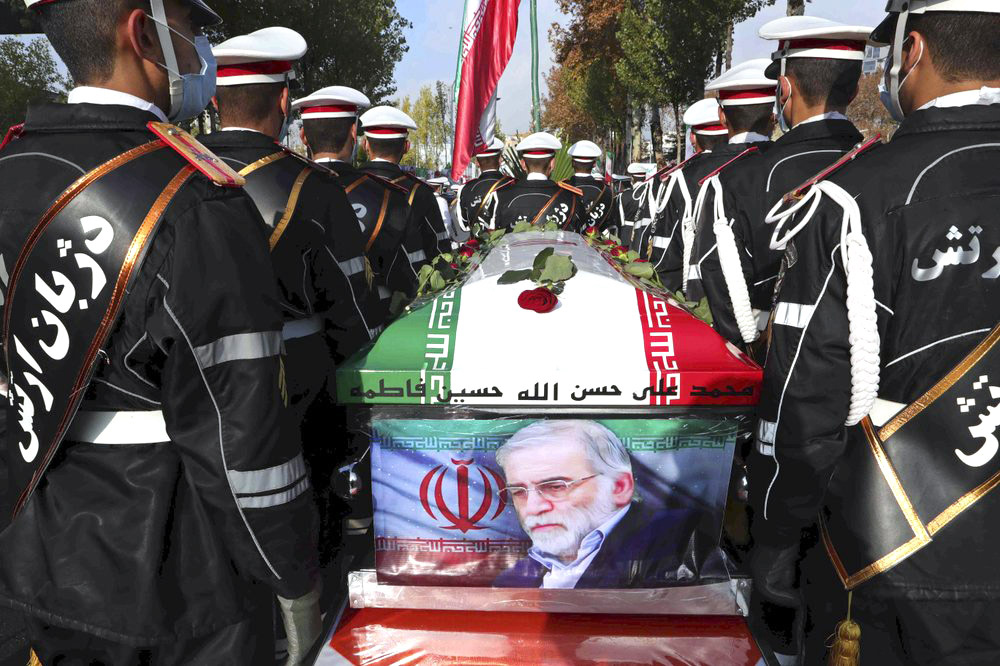
Attack carried out by remote-controlled machine gun equipped with an intelligent satellite system
Edited by: TJVNews.com
Reports by Iran’s state media that their top nuclear scientist had been gunned down in late 2020 by a remote-controlled robotic assassin where initially viewed with skepticism, according to a report by Josh Plank on the World Israel News web site. However, the New York Times reported Saturday that Mohsen Fakhrizadeh was indeed assassinated in late November by a killer robot.
The Times revealed new details of the targeted assassination that were gathered from interviews with Israeli, American, and Iranian officials, including “two intelligence officials familiar with the details of the planning and execution of the operation.”
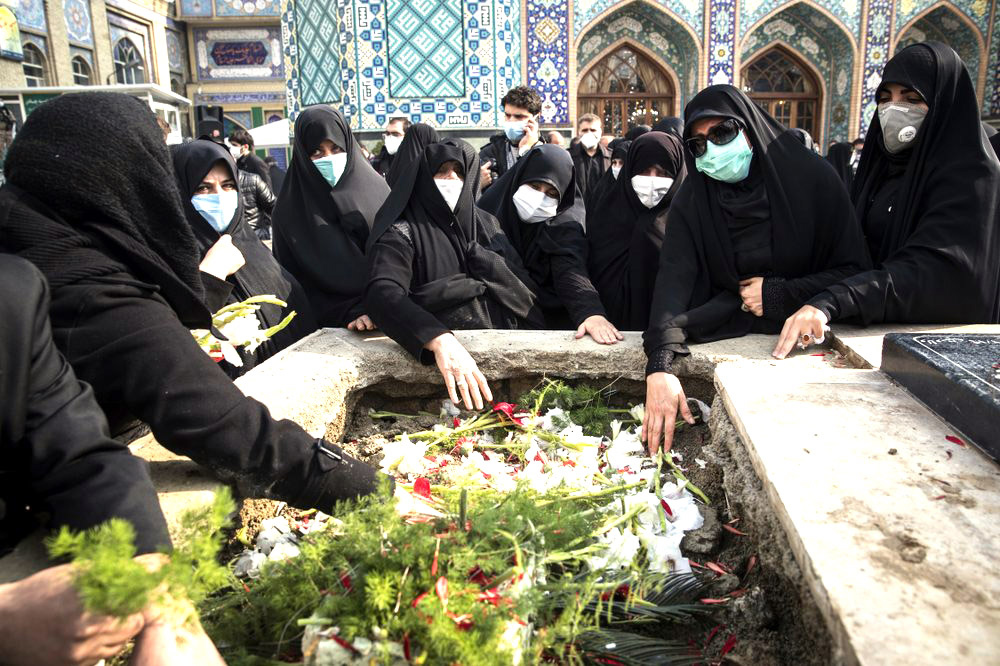
Convinced that Fakhrizadeh was leading Iran’s efforts to build a nuclear bomb, Israel had planned to target him for assassination for at least 14 years, as was reported by the Times but there had been so many threats and plots that he no longer paid them much attention.
According to the report, Israel’s Mossad carried out the operation using a special model of the Belgian-made FN MAG 7.62mm machine gun attached to an advanced robotic apparatus, as was indicated in the WIN report.
The high-tech killing machine, composed of approximately one ton of equipment including artificial intelligence and multiple-camera eyes, was smuggled into Iran piece by piece.
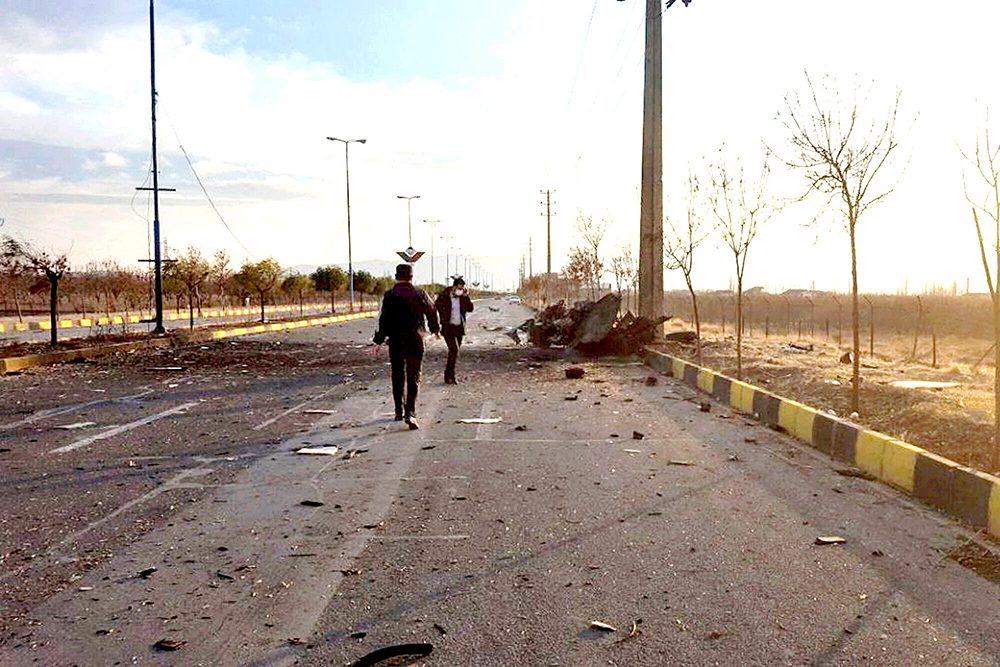
WIN reported that it was designed to fit into the bed of a Nissan Zamyad pickup truck. The truck was packed with enough explosives to self-destruct after the mission.
The weapon was operated via satellite from an undisclosed location over 1,000 miles away, according to the WIN report.
On November 27th of last year, Fakhrizadeh and his wife were traveling in their Nissan Teana sedan from their vacation home on the Caspian Sea to their country house in Absard, east of Tehran, accompanied by a security team in three additional vehicles.
The convoy first passed a fake disabled car about three quarters of a mile from the killer robot. The car contained a hidden camera which allowed the Mossad to identify Fakhrizadeh in the driver’s seat, according to the WIN report.
As Fakhrizadeh approached a blue Nissan Zamyad pickup truck parked on the side of the road, machine gun fire ripped into his vehicle.
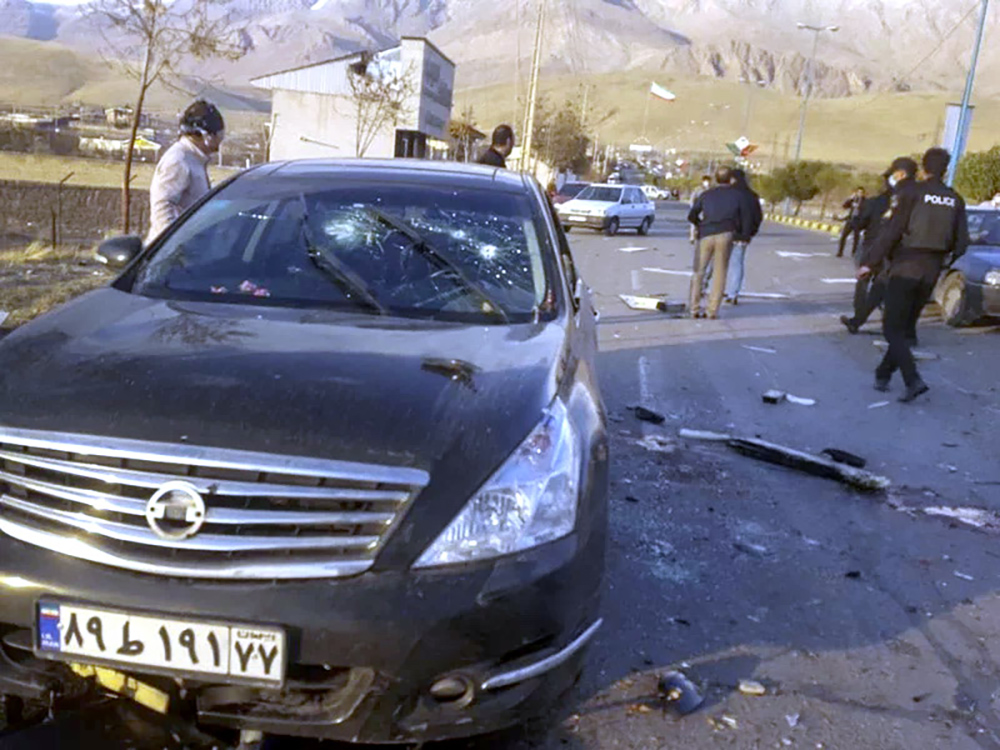
WIN reported that the scientist stopped his car, and another burst of gunfire hit the windshield, wounding him in the shoulder.
Fakhrizadeh then exited the vehicle and took cover behind the open door, where three more bullets tore into his spine.
A confused bodyguard looked around for the shooter while Fakhrizadeh’s wife comforted her dying husband. Then the pickup truck exploded.
According to the report, the explosion was the only part of the operation that did not go as planned. Instead of completely destroying the killer robot, the bomb hurled most of the system into the air, as was reported by WIN.
The robot fell to ground, damaged beyond repair but still identifiable.
The Times reported that since 2007, “Israeli agents had assassinated five Iranian nuclear scientists and wounded another. Most of the scientists worked directly for Fakhrizadeh on what Israeli intelligence officials said was a covert program to build a nuclear warhead, including overcoming the substantial technical challenges of making one small enough to fit atop one of Iran’s long-range missiles.”
Israeli agents had also killed the Iranian general in charge of missile development and 16 members of his team.
In 2009, an Israeli hit team had planned to assassinate Fakhrizadeh in Tehran, according to the Times article, however, the plan was scrapped at the last minute.
The Times reported that “several Iranian news organizations reported that the assassin was a killer robot, and that the entire operation was conducted by remote control. These reports directly contradicted the supposedly eyewitness accounts of a gun battle between teams of assassins and bodyguards and reports that some of the assassins had been arrested or killed.”
A former senior Israel Defense Forces Military Intelligence analyst specialization in weapons of mass destruction and its proliferation told JNS in the aftermath of the assassination that Fakhrizadeh was being “reserved” by the Iranian regime for the day that Iran’s nuclear program would enter a new stage.
“Throughout the entire time, Fakhrizadeh was responsible, in the language of physicists who deal with these issues, for weaponization,” said Lt. Col. (res.) Dr. Raphael Ofek, of the Begin-Sadat Center for Strategic Studies. “Among other things, he even arrived as an invited guest to North Korea’s third nuclear weapons test in 2013.”
“As soon as there is sufficient fissionable material ready for a bomb, that’s where his role came in,” added Ofek.
JNS reported that in 1998, Fakhrizadeh took over the Physics Research Center (known by its acronym, PHRC) of Iran, which became known as the Amad program, described in 2018 by former Israeli Prime Minister Benjamin Netanyahu as “a comprehensive program to design, build and test nuclear weapons.”
Netanyahu made the comments while unveiling a cache of files, which came to be known as the nuclear archive, and which was extracted by Israel’s Mossad intelligence agency from a Tehran warehouse.
“After taking over, apparently in 1998, he was head of the Amad program throughout the subsequent years,” said Ofek.
He recalled how, in 2015, before the JCPOA was signed, the IAEA had attempted to interview all of the Iranians involved in the Amad program, and how the Iranian regime had refused to allow Fakhrizadeh to be interviewed. “In short, he is considered a mysterious man,” said Ofek.
AP reported that analysts have compared Fakhrizadeh to being on par with Robert Oppenheimer, the scientist who led America’s Manhattan Project in World War II that created the atom bomb.
“In the field of nuclear and nanotechnology and biochemical war, Mr. Fakhrizadeh was a character on par with Qassim Suleimani but in a totally covert way,” Gheish Ghoreishi, who has advised Iran’s Foreign Ministry on Arab affairs, said in an interview with the Times.
He earned a Ph.D. in nuclear physics from Isfahan University of Technology with a dissertation on “identifying neutrons,” according to Ali Akbar Salehi, the former head of Iran’s Atomic Energy Agency and a longtime friend and colleague who spoke with the Times.
JNS reported that despite accusations by Tehran that Israel was behind the assassination, Ofek said that “it can’t be ruled out that others were behind it, like the Mujahedin-e-Khalq opposition group. It could be that they did it on their own or in cooperation with foreign elements. In any case, the Iranians always blame Israel.”
Iran’s Supreme Leader Ayatollah Ali Khamenei called Fakhrizadeh “the country’s prominent and distinguished nuclear and defensive scientist,” according to an AP report. Khamenei, who has the final say on all matters of state, said Iran’s first priority after the killing was the “definitive punishment of the perpetrators and those who ordered it.” He did not elaborate.
AP reported that Iranian President Hassan Rouhani blamed Israel for the killing. “We will respond to the assassination of Martyr Fakhrizadeh in a proper time,” Rouhani said. “The Iranian nation is smarter than falling into the trap of the Zionists. They are thinking to create chaos.”
Both Rouhani and Khamenei said Fakhrizadeh’s death would not stop the nuclear program. Iran’s civilian atomic program has continued its experiments and now enriches a growing uranium stockpile up to 4.5% purity in response to the collapse of Iran’s nuclear deal after the U.S.’ 2018 withdrawal from the accord, as was reported by the AP.
Stephane Dujarric, spokesperson for UN Secretary-General Antonio Guterres told the AP that, “of course we condemn any assassination or extra-judicial killing. We urge restraint and the need to avoid any actions that could lead to an escalation of tensions in the region.”
That’s still far below weapons-grade levels of 90%, though experts warn Iran now has enough low-enriched uranium for at least two atomic bombs if it chose to pursue them.
Fakhrizadeh’s widow appeared unnamed on state television in a black chador, saying his death would spark a thousand others to take up his work, as was reported by the AP. “He wanted to get martyred and his wish came true,” she said.
AP reported that Iran has conducted attacks targeting Israeli interests abroad over the killing of its scientists, like in the case of the three Iranians recently freed in Thailand in exchange for a detained British-Australian academic.
Subsequent to the attack, a group of protestors in Tehran burned an American and Israeli flag and criticized Iran’s foreign minister who helped negotiate the nuclear deal, showing the challenge ahead of Tehran if officials chose to come back the accord, as was reported by the AP.
Other experts in the field of studying targeted assassinations have compared Israeli precision and attention to detail to the recent drone attack launched by the United States prior to the US pullout from Afghanistan in August. The botched attempt claimed the lives of three adults and seven children.
On Friday, the Pentagon announced that a review of the drone attack revealed that only civilians were killed in the attack, not an Islamic State extremist as first believed, according to an AP report.
Gen. Mark Milley, chairman of the Joint Chiefs of Staff, told reporters two days after the attack that it appeared to have been a “righteous” strike and that at least one of the people killed was a “facilitator” for the Islamic State group’s Afghanistan affiliate, which had killed 169 Afghan civilians and 13 American service members in a suicide bombing on Aug. 26 at the Kabul airport, as was reported by the AP.
“The strike was a tragic mistake,” Marine Gen. Frank McKenzie, head of U.S. Central Command, told a Pentagon news conference.
AP reported that McKenzie apologized for the error and said the United States is considering making reparation payments to the family of the victims. He said the decision to strike a white Toyota Corolla sedan, after having tracked it for about eight hours, was made in an “earnest belief” — based on a standard of “reasonable certainty” — that it posed an imminent threat to American forces at Kabul airport. The car was believed to have been carrying explosives in its trunk, he said.
For days after the August 29th strike, Pentagon officials asserted that it had been conducted correctly, despite the civilian deaths. AP reported that news organizations later raised doubts about that version of events, reporting that the driver of the targeted vehicle was a longtime employee at an American humanitarian organization and citing an absence of evidence to support the Pentagon’s assertion that the vehicle contained explosives.
McKenzie, who oversaw U.S. military operations in Afghanistan, including a final evacuation of U.S. forces and more than 120,000 civilians from Kabul airport, expressed his condolences to the family and friends of those killed, as was reported by the AP.
“I am now convinced that as many as 10 civilians, including up to seven children, were tragically killed in that strike,” McKenzie said. “Moreover, we now assess that it is unlikely that the vehicle and those who died were associated with ISIS-K or were a direct threat to U.S. forces,” he added, referring to the Islamic State group’s Afghanistan affiliate. He admitted that US intelligence was severely flawed.
AP reported that Defense Secretary Lloyd Austin, in a written statement, apologized for what he called “a horrible mistake.”
“We now know that there was no connection” between the driver of the vehicle and the Islamic State group, and that the driver’s activities that day were “completely harmless and not at all related to the imminent threat we believed we faced,” Austin said.
A senior military analyst who spoke on the condition of anonymity told the Jewish Voice, “For the Biden administration to recognize such a colossal intelligence failure in Afghanistan and across the region is a sign that the US, unlike Israel, really needs to get its ducks in a row. When the Israelis carried out the highly sophisticated and complex robotic targeting of Fakhrizadeh, they utilized precision and professional planning. The US certainly needs to follow Israel’s lead.”
(Sources: World Israel News, AP, JNS)
