



|
Getting your Trinity Audio player ready...
|
By: Fern Sidman
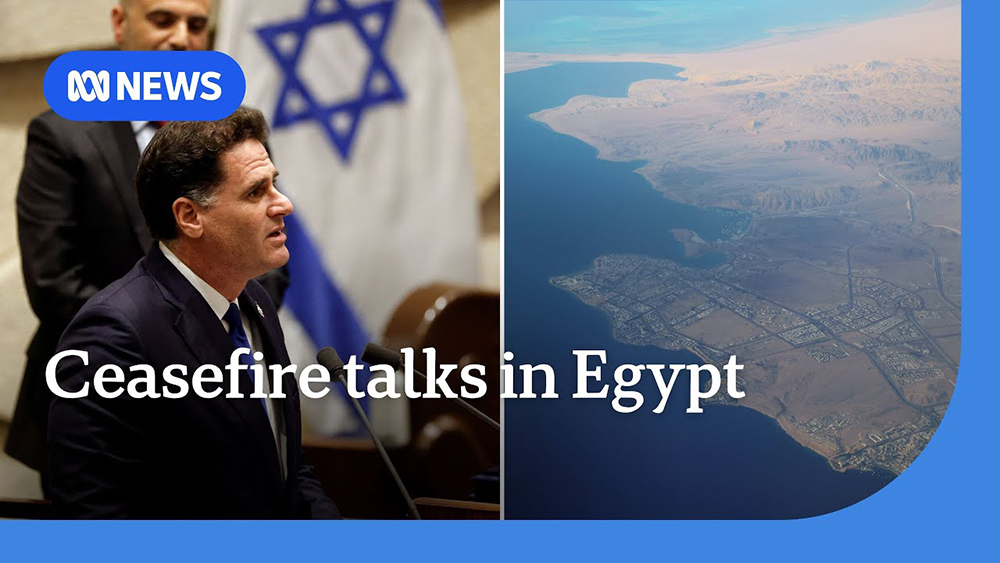
Indirect negotiations between Israeli and Hamas representatives began Monday in the Egyptian resort town of Sharm el-Sheikh, marking the latest attempt to broker a ceasefire in Gaza and secure the release of hostages. According to Egyptian state-affiliated outlet Al-Qahera News, the talks—facilitated by Egyptian and Qatari mediators—are designed to lay the “ground conditions” for an agreement that would incorporate U. S. President Donald Trump’s ceasefire proposal, one that he has repeatedly described as a historic chance to end the conflict.
As Israel National News (INN) reported on Monday, the Sharm el-Sheikh talks reflect weeks of behind-the-scenes shuttle diplomacy. While the delegations are not meeting face-to-face, mediators are working to craft a mechanism for both the exchange of Israeli hostages and Palestinian security prisoners and the eventual cessation of hostilities.
The negotiations follow several months of grinding conflict that began after Hamas’s October 7 attacks and Israel’s subsequent military campaign in Gaza. The United States has leaned heavily on regional partners to help craft an agreement, and according to the information provided in the INN report, the Egyptian and Qatari roles have been indispensable in keeping the channels of communication open despite deep mistrust between the parties.
President Trump has injected both urgency and stark warnings into the process. On Sunday, he issued a blunt message to Hamas via his Truth Social platform: “Time is of the essence or massive bloodshed will follow.”
He elaborated that “very positive discussions” had been held over the weekend with Hamas and a range of international actors—“Arab, Muslim, and everyone else”—to finalize a framework that would both end the war in Gaza and establish what he described as “long sought PEACE in the Middle East.”
Trump continued: “The technical teams will again meet Monday, in Egypt, to work through and clarify the final details. I am told that the first phase should be completed this week, and I am asking everyone to MOVE FAST. TIME IS OF THE ESSENCE OR, MASSIVE BLOODSHED WILL FOLLOW — SOMETHING THAT NOBODY WANTS TO SEE!”
As the Israel National News report observed, Trump’s rhetoric is a blend of optimism and threat. His tone has oscillated between proclaiming that Hamas has reacted “positively” to his plan and cautioning that failure to reach a deal would invite “complete obliteration” of the terror group.
Prime Minister Benjamin Netanyahu authorized his delegation, led by Minister Ron Dermer, to participate in the Sharm el-Sheikh negotiations. According to the INN report, Israel’s position remains clear: no phased concessions or withdrawals will be implemented until all 48 hostages—both living and deceased—are returned to Israeli territory.
The Israeli government views Trump’s plan as a potential framework but insists that Hamas’s dismantlement must remain the ultimate objective. Netanyahu, addressing bereaved families over the weekend, reiterated that Israel “will not proceed to any other clauses” of the agreement until the hostages are freed.
Defense Minister Israel Katz echoed that sentiment, warning that if Hamas stalls or refuses, the IDF will escalate operations in Gaza. As INN has reported, Israeli officials believe Hamas’s apparent willingness to discuss Trump’s plan stems from the intense military pressure applied during the IDF’s Gaza City operation.
Hamas’s messaging has been notably ambiguous. Officials told Al-Qahera News that they had begun “locating the bodies of deceased hostages” across Gaza but claimed they needed a halt in Israeli airstrikes to complete the process. They further suggested that while they were prepared to release the living hostages in one stage, the transfer of remains would “take some time.”
Hamas has also signaled, according to reports cited by Israel National News, that it is willing to hand over control of its weapons to a Palestinian-Egyptian authority under international supervision. At the same time, its leaders have linked any agreement to guarantees of a permanent Israeli withdrawal, a condition that Jerusalem has flatly rejected.
Trump himself acknowledged this tension. Speaking Friday, he said Hamas had responded “positively,” calling it “a big day” and “unprecedented.” Yet on Saturday, he issued his starkest warning yet: Hamas risked “complete obliteration” if it refused to relinquish control over Gaza.
Egypt and Qatar remain pivotal players. Cairo has leveraged its longstanding security role in Gaza, while Doha retains channels to Hamas leadership. Both are working to craft what Al-Qahera News described as a “mechanism” for the hostage-prisoner exchange and ceasefire enforcement.
As the INN report explained, such mechanisms are notoriously complex, requiring agreement not only on the sequencing of exchanges but also on monitoring and verification procedures. Past deals have faltered when either side accused the other of reneging or delaying.
The negotiations carry implications well beyond Gaza. For Trump, they represent a test of his ability to deliver on his oft-stated promise to achieve “the deal of the century” in the Middle East. For Israel, they are a test of whether military pressure can translate into meaningful political outcomes. For Hamas, they are a test of survival, balancing between concessions necessary to preserve the group and risks of collapse under continued military assault.
The report at Israel National News has stressed that the talks are also being closely watched in Arab capitals. Regional governments are weighing whether Hamas’s potential concessions—such as surrendering weapons to a multinational authority—signal genuine change or are simply tactical maneuvers to buy time.
Despite the optimism voiced by Trump, Israeli officials remain skeptical. The INN report quoted senior ministers warning that Hamas could use the negotiations to “waste time,” prolonging the conflict while eroding international patience with Israel’s operations. Finance Minister Bezalel Smotrich has already criticized Netanyahu for halting offensive operations during the negotiations, calling it “a severe mistake.”
National Security Minister Itamar Ben-Gvir has gone further, warning that his party will leave the coalition if Hamas is permitted to continue existing in any form after the war. His stance underscores the fragility of Israel’s internal political consensus around the talks.
As negotiations unfold in Sharm el-Sheikh, the contrast between Trump’s soaring promises and the entrenched realities on the ground could not be more stark. On one hand, the U. S. president frames the talks as “unprecedented,” an opening for peace in a region long defined by intractable conflict. On the other, both Israeli and Hamas leaders remain locked in hardened positions, deeply skeptical of each other’s intentions.
The report at Israel National News emphasized that for Israel, the release of hostages remains the non-negotiable first step, while the ultimate goal remains the dismantling of Hamas’s military capacity. For Hamas, survival itself is at stake. For Trump, the negotiations are a proving ground for his foreign policy and his promise of Middle East peace.
Whether these indirect talks can bridge such divides remains uncertain. Yet as Trump himself declared, “time is of the essence.” The coming days in Egypt will test not only the durability of the proposals on the table but also the credibility of threats and promises issued from Washington, Jerusalem, and Gaza.
