



|
Getting your Trinity Audio player ready...
|
By: Fern Sidman
The Israel Defense Forces (IDF) on Wednesday urged Palestinians in Gaza City’s Zeitoun district to evacuate to the southern Gaza Strip, as the military continues to press forward with its westward ground campaign aimed at dismantling Hamas’s remaining infrastructure. The directive, announced by Lt. Col. Avichay Adraee, head of the Arab Media Branch of the IDF Spokesperson’s Unit, comes as Israel intensifies its months-long campaign to neutralize Hamas while seeking to secure the release of hostages still held in Gaza.
According to a report at The Jewish News Syndicate (JNS), Zeitoun has long been viewed as a bastion of Hamas activity. The IDF first entered the neighborhood in November 2023, only to see militants reestablish themselves in subsequent months. In March 2024, Israeli forces conducted a two-week clearance operation to suppress renewed Hamas activity, underscoring the ongoing challenge of eradicating the group’s entrenched presence.
“As previously warned, the IDF is continuing to expand its operations westward. For your safety, evacuate immediately southward to the Al-Mawasi area,” Adraee posted on social media platform X. Al-Mawasi, located near Rafah in southern Gaza, was designated as a humanitarian safe zone by the IDF in 2023 and has since been expanded to accommodate displaced residents.
Later the same day, the IDF issued another evacuation order, this time affecting a section of Khan Yunis in southern Gaza. Adraee explained that heavy force was being deployed in the area as part of ongoing operations. “The IDF is continuing its ground maneuver and is using heavy force in your area to expand the scope of the fighting,” he wrote, in comments cited in the JNS report.
The evacuations are part of “Operation Gideon’s Chariots,” an ongoing campaign that seeks to dismantle Hamas’s military infrastructure, secure key territories, and achieve the release of an estimated 50 remaining captives. JNS reported that the operation involves coordinated efforts across multiple IDF divisions, supported by Israeli Air Force strikes and intelligence from the Israel Security Agency (Shin Bet).
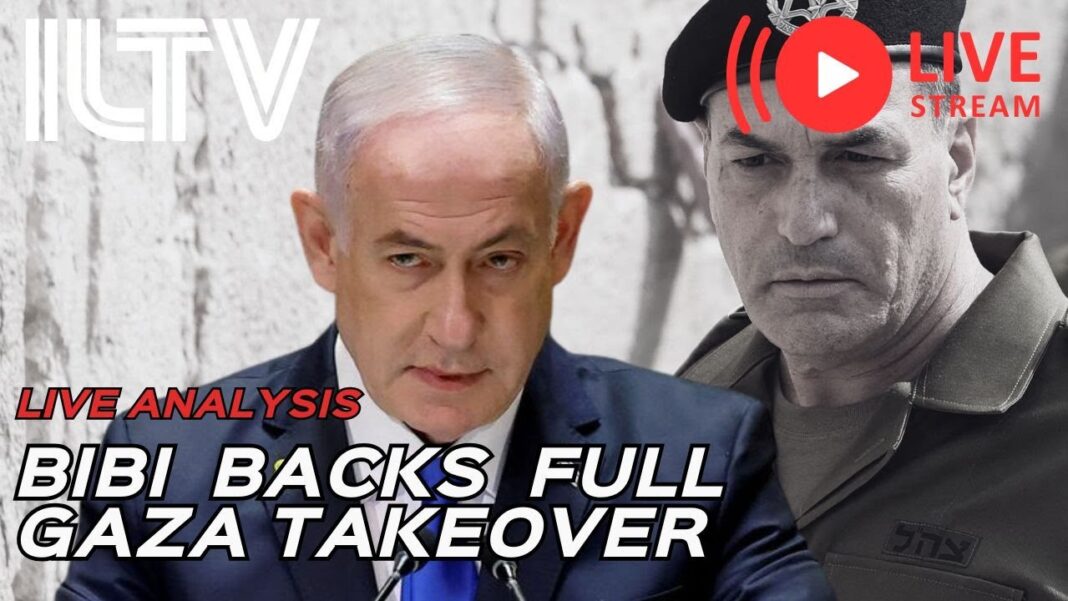
On Tuesday evening, Israeli Prime Minister Benjamin Netanyahu convened a high-level security meeting in which IDF Chief of Staff Lt. Gen. Eyal Zamir presented strategic options for continuing the campaign. According to the information provided in the JNS report, the discussions included consideration of a proposal for a full-scale military occupation of Gaza until Hamas agrees to surrender and releases the hostages.
A political source quoted by Israel Hayom said: “We have not been able to release the hostages using the methods that have been used until now. Therefore, the prime minister believes that with another method, that will be submitted for Cabinet approval, we can increase the chances.”
The IDF announced Wednesday afternoon that Israeli aircraft had struck a Hamas weapons manufacturing site in Gaza City’s Sheikh Radwan district the previous day. According to the information contained in the JNS report, the military emphasized that precautionary measures had been taken to minimize the risk of civilian casualties during the strike.
Additional operations were reported across Gaza. In the northern Gaza Strip, IDF troops destroyed a Hamas position from which mortar shells had been launched at Israeli forces. In Beit Hanoun, Israeli units engaged militants directly, killing several gunmen and demolishing terrorist infrastructure.
In central Gaza, the 401st Armored Brigade conducted an operation in Deir al-Balah, a strategic zone situated on the outskirts of the Nuseirat and Bureij refugee camps—areas believed to be housing hostages. The brigade identified a terrorist cell, called in air support, and eliminated ten gunmen.
The JNS report detailed that southern Gaza also witnessed intensified military activity. Troops from the IDF’s 36th Armored Division and the 143rd Division destroyed extensive tunnel infrastructure and neutralized additional gunmen, while continuing to target entrenched Hamas strongholds.
The IDF stressed that its operations are being closely coordinated between ground forces, military intelligence, and the Shin Bet. On Tuesday, the army confirmed that multiple brigades were conducting parallel missions aimed at dismantling Hamas’s capabilities across the enclave.
The 282nd Artillery Brigade reported striking over 30 targets within 24 hours, including buildings and apartments used by Hamas operatives as command centers. Meanwhile, the 188th Armored Brigade engaged in direct combat, eliminating gunmen and demolishing a structure concealing an attack tunnel.
In the northern sector, the Givati Brigade uncovered weapons caches and destroyed underground shafts, while the 99th Division concentrated on identifying and dismantling terrorist networks in northern Gaza. The 990th Artillery Brigade, operating under the 99th Division, was credited with neutralizing several Hamas operatives and targeting military compounds.
One of the most significant discoveries of the week came when soldiers of the 36th Division uncovered and destroyed a 2-kilometer tunnel in the southern Khan Yunis region. The tunnel, described as a major Hamas asset, was eliminated after troops secured its entrances and confirmed its use for operational purposes.
Additionally, forces located a large cache of weapons hidden inside a structure. The arsenal included mortar shells, grenades, and explosive devices. JNS reported that these finds highlight the persistent threat posed by Hamas’s underground networks and concealed weapons depots, even in areas repeatedly cleared by the IDF.
“The fighters of the Kfir Brigade’s combat team have so far destroyed hundreds of terrorist infrastructures, located dozens of weapons and eliminated terrorists in the area,” the IDF stated, emphasizing the scale of the effort.
Operation Gideon’s Chariots represents one of the most complex military efforts undertaken by Israel since the start of the conflict in October 2023. According to the JNS report, the campaign is designed not only to dismantle Hamas’s military capabilities but also to erode the organization’s ability to reconstitute itself in areas previously cleared by Israeli forces.
The ongoing operations in Zeitoun, Khan Yunis, and central Gaza reflect the IDF’s multi-pronged approach: combining direct ground engagement with precision air strikes, intelligence-driven raids, and the destruction of key infrastructure such as tunnels and weapons factories.
The strategy is also deeply tied to the fate of the hostages. Intelligence assessments suggest that many captives are being held in the dense urban areas of central Gaza, particularly within the refugee camps of Nuseirat and Bureij. By tightening control around these zones, the IDF aims to increase pressure on Hamas to release the captives.
As operations expand westward in Zeitoun and continue in multiple sectors of Gaza, Israeli leaders face critical decisions about the long-term trajectory of the war. Netanyahu’s potential proposal for a military occupation, if submitted and approved, would mark a significant escalation and could redefine Israel’s posture in Gaza for the foreseeable future.
For now, the IDF continues its ground maneuvers, relying on sustained military pressure to dismantle Hamas infrastructure and secure the release of hostages. As the JNS report has emphasized, the coming weeks will be pivotal in determining whether Operation Gideon’s Chariots achieves its objectives, or whether Hamas manages to prolong the conflict by regrouping in Gaza’s dense civilian areas.
