



|
Getting your Trinity Audio player ready...
|
By: Fern Sidman
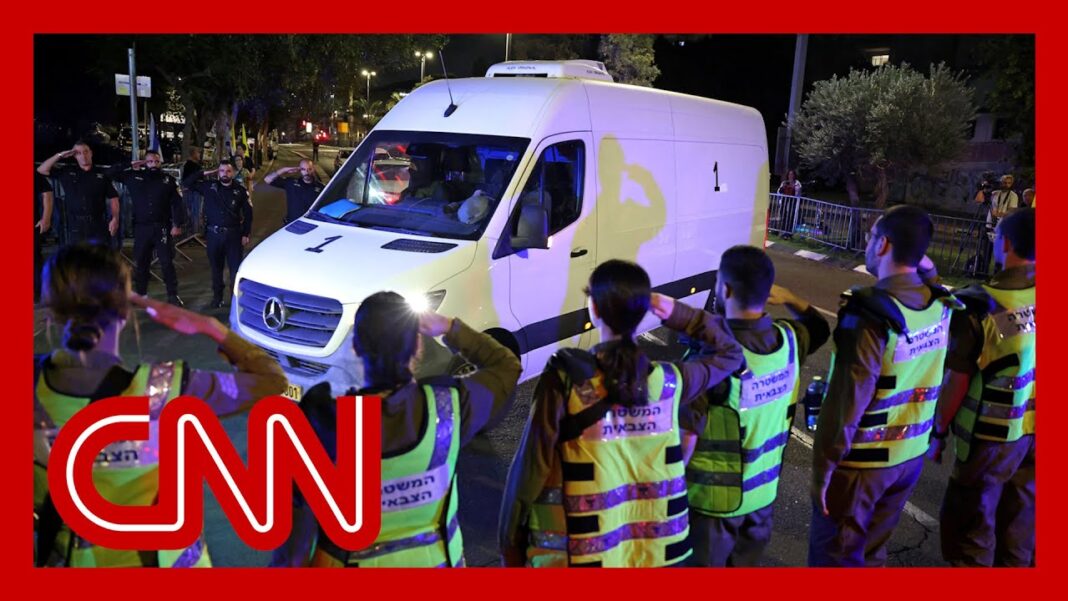
What began as a quiet procedural handover between Israel and Hamas under the terms of the U.S.-brokered Gaza truce has turned into a new diplomatic flashpoint. Israeli officials confirmed this week that one of the bodies transferred by Hamas—supposedly an Israeli hostage—was, in fact, the remains of a Gazan man named Khalil Duas, a Palestinian resident of the Aqabat Jabr camp near Jericho. The revelation, first reported by Israel National News, has sent shockwaves through Jerusalem, prompting accusations that Hamas intentionally staged the mix-up to “test Israel’s limits.”
According to a report that appeared on Wednesday at Israel National News, initial statements from Israeli security officials framed the handover as a “mistake” in coordination—a tragic confusion amid a tense and chaotic prisoner-and-body exchange. Yet, within hours, Arab-language media outlets and the Abu Ali Express Telegram channel, which closely monitors Palestinian militant communications, suggested that the incident was not accidental at all. Rather, they argue, it was a calculated move by Hamas designed to provoke, humiliate, and manipulate Israel during a delicate phase of the hostage-return process.
As reported by Israel National News, the body in question belonged to Khalil Duas, a Palestinian Arab originally from the northern Gaza Strip who had been living in the Aqabat Jabr “refugee” camp near Jericho. According to Fatah-affiliated sources cited in the same report, Duas was wanted by Palestinian Authority (PA) security forces for a range of criminal, ethical, and security offenses.
The controversy deepened when analysts recalled that, back in May, Hamas’s military spokesman, Abu Obeida, released a propaganda video that appeared to show Duas alive and presented him as an Israeli soldier abducted in a tunnel in Jabaliya. The footage, widely circulated at the time, was part of Hamas’s ongoing psychological warfare campaign, which sought to sow confusion in Israel and maintain an illusion of leverage through false claims of captured IDF soldiers.
Now, the discovery that Duas’s body was returned under the guise of an Israeli hostage has cast the earlier propaganda stunt in a darker light. “Hamas’s choice to return the body of Khalil Duas as an ‘Israeli soldier’ shows that Hamas continues to test Israel’s limits and keeps playing games,” the Abu Ali Express administrator wrote. “It’s totally on purpose.”
According to the same channel, Hamas knew precisely the impact such an act would have on Israeli society—especially among families waiting for the bodies of their loved ones still held in Gaza. “Hamas is aware of the effect this has in Israel,” the administrator added, “which indicates its intentions for the rest of the process of returning the bodies.”
Israel National News reported that Israeli officials have so far stopped short of directly accusing Hamas of deliberate deception, preferring to attribute the handover to “a breakdown in internal communication among Hamas factions.” But privately, several military and intelligence figures told the outlet that they view the incident as a strategic provocation, not a bureaucratic error.
“This was not confusion; it was choreography,” one senior Israeli defense official told Israel National News on condition of anonymity. “By sending the body of a Palestinian criminal and labeling him as an Israeli hostage, Hamas sought to remind Israel—and the world—that it still controls the tempo of the hostage file. It’s a power play dressed as a mistake.”
The timing adds weight to that suspicion. The incident occurred just as Israel and Hamas were entering a tense new phase of the U.S.-backed ceasefire deal, under which Hamas was obligated to release all remaining bodies of Israeli hostages in exchange for continued humanitarian aid shipments into Gaza. As Israel National News noted earlier this week, Israel had already warned that progress in the ceasefire framework could be frozen unless Hamas fully complied.
By inserting this “error,” Hamas appeared to be testing how far Israel could be pushed without derailing the truce—a risky but familiar tactic.
The deliberate exploitation of hostage and casualty narratives has long been a cornerstone of Hamas’s strategy. From the 2006 abduction of Gilad Shalit to the post-October 7 propaganda blitz, Hamas has weaponized human remains and emotional imagery as tools of political leverage. According to experts interviewed by Israel National News, this latest episode fits that same pattern: a low-cost maneuver to destabilize Israel’s psychological equilibrium at a moment when the government is under immense domestic pressure to bring everyone home—alive or dead.
For the families of hostages still unaccounted for, the Duas incident was devastating. Several relatives of missing Israelis told Israel National News that the false identification reopened deep wounds and shattered the fragile trust built through recent negotiations. “This was cruel beyond words,” one family member said. “We thought our nightmare might be ending, and instead we were told we’d been handed a lie.”
Political analysts note that Hamas likely understood that reaction all too well. “This is not about a clerical mix-up,” one intelligence analyst explained to the outlet. “It’s psychological warfare aimed at the Israeli public, reminding them that Hamas can still inflict emotional pain even when militarily cornered.”
In Gaza, Hamas propaganda channels framed the transfer differently. According to Israel National News, certain Hamas-affiliated Telegram accounts claimed the return of Duas’s body was “part of the ongoing process of reconciliation” and an “honorable return of a martyr of Palestinian resistance.” That narrative, designed for internal consumption, conveniently ignored the fact that Duas had been wanted by the Palestinian Authority and had been publicly denounced by Fatah sources as a criminal, not a hero.
This dissonance—between Hamas’s internal rhetoric and its external manipulation—captures the broader duplicity that Israel National News has repeatedly documented: a terrorist group that portrays itself as a defender of Palestinian honor while exploiting even its own dead for political theater.
“Hamas will continue these games as long as Israel allows it,” the Abu Ali Express administrator warned, in comments cited in the Israel National News report. “Israel needs to take an especially aggressive stance and not normalize Hamas’s games with hostages’ bodies; otherwise, it will just increase.”
Indeed, Israeli lawmakers across the political spectrum are calling for a review of how such exchanges are verified and whether tighter oversight or intermediary verification is required before any future body transfers. Some have even urged temporarily suspending humanitarian concessions to Gaza until Hamas provides verifiable proof of compliance with the terms of the truce.
Security commentators quoted in the Israel National News report noted that the affair underscores a deeper problem: Hamas’s willingness to “manipulate symbols of humanity for leverage.” As one IDF intelligence veteran put it, “Even the dead are pawns in Hamas’s political game. That tells you everything you need to know about what kind of actor we are dealing with.”
The “body swap” incident comes at a perilous time. As Israel National News has reported extensively, the U.S.-brokered ceasefire remains fragile, its continuation dependent on mutual confidence and adherence to key benchmarks—including the return of all deceased hostages. Any perception of bad faith on Hamas’s part could unravel weeks of painstaking diplomacy.
For Israel, the challenge is balancing outrage with restraint—avoiding the appearance of capitulation while keeping the humanitarian channels open that ensure the return of additional remains. For Hamas, the calculus is more cynical: provoke enough friction to reinforce its image of defiance without provoking a full-scale Israeli military response that could shatter the truce.
The Duas episode suggests Hamas may once again be walking that razor’s edge. “It’s a test balloon,” one Israeli security source told Israel National News. “They want to see how far they can push without losing the benefits of the ceasefire. Unfortunately, they’ve chosen to test that boundary on the backs of grieving families.”
The false return of Khalil Duas’s body has become more than a diplomatic misstep—it is now a symbolic cautionary tale about the perils of negotiating with an adversary that trades in deceit as readily as in death. As Israel National News observed in its analysis, the episode serves as a reminder that even amid the promise of peace and humanitarian relief, Hamas remains committed to manipulation over morality.
In the words of a bereaved father quoted by the outlet, “They murdered our children, and now they mock us with their bodies. There can be no peace built on this kind of cruelty.”
Until Hamas provides full, verifiable accounting of all hostages—living and dead—the truce that was meant to bring closure may instead deepen mistrust. And in that uneasy space between relief and resentment, Israel’s leaders must decide whether to play along with Hamas’s “mistakes,” or to finally call them by their proper name: provocations in the guise of diplomacy.
As Israel National News continues to monitor the aftermath of the Duas deception, one theme emerges unmistakably: the road to peace in Gaza remains littered not just with obstacles, but with the moral wreckage of a movement that cannot—or will not—negotiate in good faith.
