



|
Getting your Trinity Audio player ready...
|
From the Tunnels of Gaza to the Lights of Times Square: A Prayer Carried Across Captivity, Trauma, and a Global Jewish Awakening
By: Fern Sidman
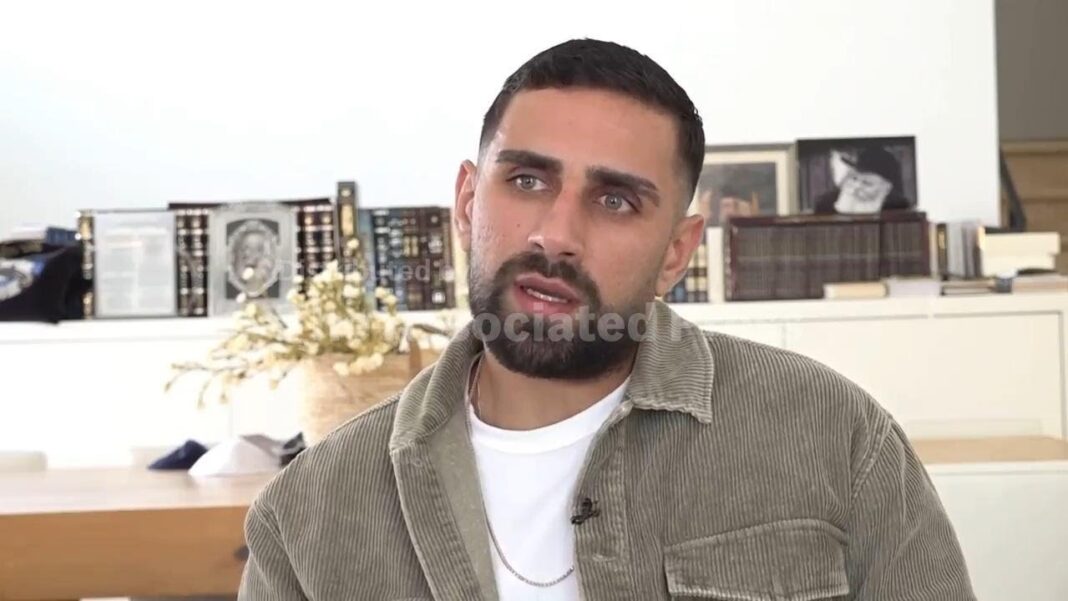
In the glare of Times Square’s colossal screens, amid the relentless pulse of Manhattan’s electric choreography, a sound rose that belonged to a far older register of human experience. It was not amplified by spectacle alone, nor carried by celebrity or politics, but by the quiet, indelible gravity of faith articulated in a single, ancient declaration: Shema Yisrael. For Segev Kalfon, a former hostage held by Hamas in the suffocating darkness of Gaza’s tunnels, the words were more than prayer.
They were the consummation of a vow forged in captivity, a whispered covenant with survival itself. As he stood before thousands of Jewish teenagers gathered for the CTeen International Shabbaton, Kalfon transformed one of the world’s most frenetic public stages into a sanctuary of collective memory and defiance. The Times of Israel, which chronicled Kalfon’s account in a report on Sunday, framed the moment as an inversion of terror’s theater: a public ritual of dignity where humiliation had once been staged.
During his prolonged captivity, Kalfon bore witness to the macabre pageantry of Hamas, which paraded other captives before crowds in Gaza prior to releasing Israelis last year. The Times of Israel reported that these orchestrated displays were designed to assert dominance, to convert human vulnerability into propaganda.
For Kalfon, such spectacles seeded an inner resolve. If his captors ever afforded him a stage, he vowed to repurpose it for the most elemental declaration of Jewish faith. In the depths of the tunnels, where time collapsed into an unlit continuum and the future seemed perpetually deferred, he clung to prayer not as abstraction but as a lifeline. “I was dreaming of saying Shema Yisrael, on the stage, to the world,” he told The Times of Israel, articulating a longing that fused spiritual endurance with a yearning for moral reclamation.
By the time Kalfon was released in October after more than two years in captivity, Hamas had abandoned its choreographed handover ceremonies. The stage he had imagined no longer existed. Yet the impulse to transform survival into testimony did not dissipate with freedom. Instead, it migrated, seeking another locus of visibility.
Kalfon found that stage in Times Square, the symbolic agora of global modernity, where attention itself is currency. “Hamas canceled the stage and the shows, so right now, I’m saying Shema Yisrael to all of the world,” he declared, reframing the cancellation of terror’s spectacle as an inadvertent concession to faith. The appropriation of Times Square for prayer, reported by The Times of Israel with palpable gravity, inverted the logic of intimidation: where captors once sought to display dominance, a former captive now asserted the irreducible sovereignty of conscience.
Kalfon did not stand alone. He was joined by fellow former hostages Ilana Gritzewsky and Matan Zangauker, whose presence embodied a collective passage from enforced silence to public voice. Together, they led thousands of Jewish teenagers in prayer on Saturday night as part of a series of events sponsored by the Chabad Hasidic movement. The Times of Israel report described the gathering as both devotional and declarative, a convergence of youthful exuberance with the solemnity of trauma transmuted into testimony.
The CTeen International Shabbaton, now in its eighteenth year, brought together more than 4,500 youths from approximately 60 countries, converging on New York City from 486 cities worldwide. Chabad’s headquarters in Crown Heights, Brooklyn, served as the movement’s gravitational center, but Times Square became its most luminous stage, where the movement’s global reach was rendered visible in a mosaic of languages, flags, and accents.
Saturday night’s event was more than a celebration of Chabad’s organizational prowess. It was a tableau of transnational Jewish solidarity forged in the shadow of violence inflicted thousands of miles apart. Among those watching the former hostages lead the Shema were teenagers from Bondi Beach, Australia, a community still reeling from a December attack in which two gunmen slaughtered 15 people at a Chabad Hanukkah event. Rabbi Eli Schlanger, a Chabad emissary, was among the victims. The Times of Israel, in tracing the emotional cartography of the gathering, emphasized the uncanny convergence of griefs: Gaza’s tunnels and Bondi Beach’s beachfront sanctuary linked by the same unrelenting targeting of Jewish life.
On the Times Square stage, Priva Schlanger, the rabbi’s daughter, addressed the assembly with words that distilled the paradox of communal resilience. “Pain doesn’t paralyze us, it pushes us. It doesn’t erase the pain, but it gives it direction,” she said, her voice carrying the cadence of mourning refracted through resolve. The Times of Israel report highlighted her statement as emblematic of a generational ethos that refuses to sacralize suffering while refusing equally to be immobilized by it. The articulation of pain as propulsion rather than paralysis resonated deeply with the teenagers in attendance, many of whom inhabit social landscapes where Jewish identity is once again becoming a site of contention.
Chida Levitansky, who led the Australian delegation, described to The Times of Israel how groups from around the world sought out the Bondi Beach teens to express solidarity. For the roughly twenty participants from Sydney and its environs, the Shabbaton was not merely a conference but an encounter with a global community that rendered their localized trauma intelligible within a larger narrative of shared vulnerability and mutual care. Levitansky noted that the Australian teens connected with peers from around 30 other countries, a lived demonstration of how diasporic networks can mitigate the isolating effects of violence.
Yehuda Nothman, one of the Bondi Beach teens, articulated the experience with unguarded candor. “It’s really empowering. It really makes me feel like the Jewish community’s coming together as one,” he told The Times of Israel, capturing a sentiment that hovered between relief and resolve. Eden Pryer, another participant, underscored the psychological alchemy of safety rediscovered: after the December shooting, to feel secure in a joyous Jewish gathering of 4,600 teenagers was, in her words, transformative.
The Times of Israel report framed the Shabbaton as a testament to Chabad’s infrastructural reach, with outposts in thousands of cities serving local and itinerant Jews alike. Yet beyond logistics, the gathering illustrated the movement’s capacity to curate spaces where religious ritual intersects with communal therapy.
The organizers, in a statement cited by The Times of Israel, asserted that the events demonstrated that “Jewish life is alive, vibrant, and not going anywhere,” casting the teenagers as emissaries of pride who would return to their communities as living rejoinders to intimidation. The language of ambassadorship, invoked by the organizers and reported by The Times of Israel, suggested a reframing of Jewish youth not merely as inheritors of tradition but as active custodians of communal morale.
The visual grammar of the evening reinforced this message. Participants chatted in a polyphony of languages, waving flags from Israel, Turkey, Brazil, Panama, Costa Rica, France, Morocco, and beyond. The Hungarian delegation painted their national colors on their cheeks, while impromptu photo sessions wove together young people from disparate geographies into fleeting tableaux of unity.
The mood, largely jubilant, was punctuated by images of Chabad’s late rebbe, Rabbi Menachem Mendel Schneerson, broadcast across Times Square’s billboards, an almost surreal juxtaposition of Hasidic reverence with commercial spectacle. The Jewish rapper Nissim Black performed, his presence bridging the aesthetic worlds of contemporary culture and devotional identity. The Times of Israel portrayed the scene as a choreography of continuity, where tradition was neither fossilized nor diluted but dynamically rearticulated in the idioms of the present.
Yet the exuberance was tempered by vigilance. The Times of Israel report noted that security concerns remained palpable, with police and volunteer Jewish community guards stationed behind metal barricades encircling the event perimeter. Organizers declined to publicize the gathering in advance, adhering to a now-standard protocol for Jewish events in the city.
The choreography of joy thus unfolded within a perimeter of precaution, a silent acknowledgment that public Jewish life, even in the heart of New York, is increasingly conducted under the shadow of threat. The presence of former hostages on the stage lent this precaution a poignant gravity. When Ilana Gritzewsky addressed the crowd with the declaration, “No one is going to bring us down. Never, never,” The Times of Israel report captured the line as a defiant epigraph to the evening, a refusal to allow trauma the final word.
Earlier in the week, the teenagers had traversed the civic and symbolic topography of New York, meeting with city leaders including City Council Speaker Julie Menin and Comptroller Mark Levine, visits that Chida Levitansky described to The Times of Israel as especially meaningful.
They toured iconic sites such as the Statue of Liberty and the Empire State Building, and visited the Ohel in Queens, Rabbi Schneerson’s resting place. For Kalfon, the pilgrimage to Chabad’s headquarters at 770 Eastern Parkway in Crown Heights, where he wrapped tefillin, constituted another layer of reclamation: ritual re-embedded in place after years of enforced dislocation. The Times of Israel report wove these moments into a broader narrative of reentry, in which former captives and young participants alike negotiated the passage from vulnerability to visibility.
In chronicling these events, The Times of Israel report situated the Times Square prayer within a wider moral drama that transcends any single geography. The arc from Gaza’s tunnels to Manhattan’s neon-lit crossroads is not merely spatial but symbolic, tracing a journey from coerced spectacle to chosen witness.
Kalfon’s vow, nurtured in darkness and fulfilled in light, epitomizes a form of resistance that does not depend on confrontation alone but on the audacity to sanctify public space with private faith. The teenagers who joined him in prayer, many bearing their own burdens of fear and grief, encountered in that moment a template for communal resilience that does not deny pain but directs it toward continuity.
The Times of Israel underscored the article’s central paradox: that in an era when Jewish visibility can invite danger, visibility itself has become a form of courage. The prayer recited in Times Square was at once ancient and insurgent, a declaration that neither captivity nor terror can annul the most intimate affirmations of identity. In the end, the spectacle Hamas once orchestrated was supplanted by a counter-spectacle of faith and fellowship, one that did not seek to humiliate but to heal.
The lights of Times Square flickered on, indifferent as ever, but for a moment, the world’s most public stage bore witness to a quieter, more enduring drama: a people insisting, through prayer and presence, that their story will not be consigned to the shadows.
