



|
Getting your Trinity Audio player ready...
|
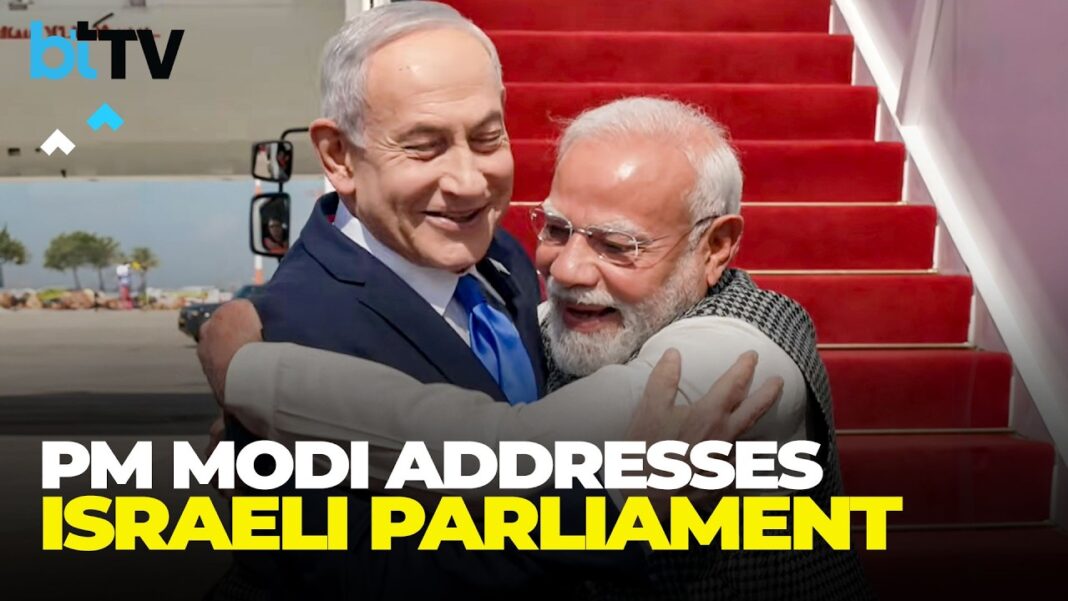
From New Delhi to Jerusalem: A Historic Embrace as Modi Addresses the Knesset and Seals a Strategic Bond With Israel
By: Fern Sidman
In a moment rich with historical symbolism and geopolitical resonance, Indian Prime Minister Narendra Modi stood before Israel’s Knesset this afternoon, becoming the first sitting Indian leader to address the Israeli parliament. The visit, undertaken alongside Prime Minister Benjamin Netanyahu, unfolded not merely as a ceremonial milestone but as a vivid articulation of a strategic partnership that has matured in recent years into one of the most consequential bilateral relationships in the emerging architecture of global politics.
As Israel National News reported on Wednesday, the convergence of the two leaders in Jerusalem was suffused with language of shared values, mutual resolve and a joint determination to confront the challenges of terrorism, extremism and a volatile international order.
Prime Minister Modi’s arrival at the Knesset marked a watershed in the long, complex evolution of ties between India and Israel. For decades, relations between the two states were conducted with caution, shaped by India’s historical commitments to the Non-Aligned Movement and its sensitivities toward the Arab and Muslim worlds. Yet the past decade has witnessed a decisive recalibration.
Under Modi’s leadership, New Delhi has embraced a pragmatic foreign policy that prizes technological innovation, security cooperation and strategic alignment with like-minded democracies. Israel, for its part, has increasingly viewed India not only as an economic partner but as a civilizational ally whose experience confronting terrorism and safeguarding pluralism mirrors its own struggles.
Writing in the Knesset guest book, Modi inscribed a message that captured both the gravity of the occasion and the philosophical underpinning of the bilateral relationship. He spoke of a shared commitment to freedom, pluralism and the rule of law, describing these values as the foundation of a partnership between two ancient civilizations navigating the uncertainties of a modern world. The Israel National News report noted that the language of the inscription was carefully chosen to emphasize continuity between the ethical traditions of India and Israel and the contemporary imperatives of innovation, security and prosperity. Modi’s invocation of peace, innovation and sustainability was not a rhetorical flourish but a declaration of intent, situating the partnership within a broader vision of global responsibility.
Prime Minister Netanyahu’s remarks, delivered with characteristic candor, placed the visit within the stark realities of Israel’s current security environment. Declaring that both Israel and India are stronger than ever, Netanyahu framed the moment as a test of resolve against what he termed the “jihadist axis of evil.”
The phrasing underscored Netanyahu’s conviction that the threats facing Israel are not isolated but embedded in a transnational network of extremist ideologies that seek to destabilize democratic societies. By situating India alongside Israel in this struggle, Netanyahu was not merely flattering a guest; he was articulating a vision of a broader coalition of states confronting radicalism in its various manifestations.
The emotional tenor of Netanyahu’s address revealed the personal dimension of the relationship between the two leaders. He spoke of Modi as a dear friend and a champion of the Indian-Israeli alliance, noting that the Indian prime minister was among the first world leaders to stand by Israel in the aftermath of the October 7 terrorist attack.
That early gesture of solidarity resonated deeply in Israel, where the trauma of the massacre and the ensuing war continues to shape public consciousness and policy. Israel National News highlighted the significance of Modi’s prompt support, portraying it as emblematic of a partnership grounded not merely in interests but in empathy and moral clarity.
Perhaps the most poignant moment of Netanyahu’s speech came when he thanked India for standing out in a world where antisemitism is resurgent. He invoked India’s civilizational history as a society in which Jews were never persecuted by the state but were welcomed and allowed to flourish. This acknowledgment was more than diplomatic courtesy; it was an affirmation of a historical memory that has long distinguished India’s relationship with the Jewish people. By recalling this legacy, Netanyahu was situating the contemporary alliance within a deeper narrative of tolerance and coexistence, a narrative that Israel National News emphasized as a counterpoint to the rising tides of hatred in many parts of the world.
Prime Minister Modi’s address to the Knesset was notable for its moral clarity regarding terrorism. Expressing condolences for the victims of the October 7 massacre and the subsequent war, Modi articulated a doctrine of zero tolerance for terrorism. In doing so, he aligned India’s own hard-earned experience with extremist violence to Israel’s current struggle, forging a rhetorical and strategic bridge between two nations that have both paid a heavy price for their refusal to capitulate to terror. Israel National News reported that Modi’s words were received with prolonged applause, reflecting a sense within the Knesset that India’s stance represents a rare instance of unequivocal solidarity at a time when Israel often finds itself the subject of international censure.
The Indian leader’s declaration that India stands by Israel with determination and full faith carried weight beyond the chamber. It signaled to regional actors, adversaries and allies alike that India’s engagement with Israel is not episodic but structural. This commitment has practical implications across a wide array of domains, from defense cooperation and intelligence sharing to cybersecurity, water management and agricultural technology.
While the speeches themselves did not enumerate specific agreements, the Israel National News report contextualized the visit within a broader trajectory of expanding cooperation that has already seen joint ventures in missile defense, counterterrorism training and technological research.
The symbolic crescendo of the visit came when Modi concluded his remarks with the Hebrew phrase “Am Yisrael Chai,” affirming the enduring vitality of the Jewish people. The gesture was laden with historical resonance. For an Indian prime minister to invoke a phrase so deeply embedded in Jewish collective consciousness was an unmistakable signal of cultural sensitivity and political solidarity. The Israel National News report described the moment as electric, capturing the way in which the phrase transcended diplomatic protocol to touch a nerve of collective memory and resilience within Israeli society.
Beyond the immediate theater of the Knesset, the visit has broader implications for the evolving geopolitics of the Middle East and South Asia. India’s deepening engagement with Israel reflects a recalibration of its foreign policy priorities, one that balances its traditional relationships in the Arab world with a recognition of Israel’s centrality as a technological powerhouse and security partner. For Israel, the partnership with India offers not only economic and strategic dividends but also a form of diplomatic ballast in an international environment that can often be inhospitable.
Israel National News has consistently framed the relationship as a counterweight to efforts by hostile actors to isolate the Jewish state, portraying India as a pivotal player in a more multipolar diplomatic landscape.
The convergence of Modi and Netanyahu in Jerusalem also speaks to a broader alignment of democratic states confronting the challenges posed by radical ideologies, cyber warfare and the erosion of the international order. Both leaders have cultivated reputations as assertive defenders of national sovereignty and security, unafraid to articulate hard truths about the nature of the threats they face. Their partnership thus resonates beyond bilateral ties, offering a template for cooperation among states that view the preservation of pluralism and the rule of law as inseparable from the maintenance of robust security architectures.
Critics may question the language of confrontation employed by Netanyahu, or the zero-tolerance rhetoric embraced by Modi, arguing that such formulations risk hardening lines in an already polarized world. Yet Israel National News has repeatedly emphasized that for both leaders, these positions are not abstractions but responses to lived realities of violence and extremism. The October 7 massacre in Israel and the long history of terrorist attacks in India have shaped a shared worldview in which the defense of civilian life is paramount and compromise with terror is seen as a moral and strategic failure.
As Modi’s address drew to a close, the image that lingered was not merely of two prime ministers exchanging warm words but of two civilizations affirming a partnership rooted in historical memory, contemporary necessity and a forward-looking vision of innovation and security. The speeches in the Knesset were, in this sense, both culmination and commencement: a culmination of years of quiet diplomatic labor and a commencement of a new phase in which India and Israel publicly embrace their alignment on the world stage.
Israel National News captured the tenor of the day as one of rare convergence between symbolism and substance. The guest book inscription, the mutual tributes, the invocation of shared values and the unequivocal denunciation of terrorism all coalesced into a narrative of partnership that transcends transactional diplomacy.
In an era marked by shifting alliances and uncertain commitments, the spectacle of Modi addressing the Knesset alongside Netanyahu offered a moment of clarity: that the bonds between India and Israel, forged in shared values and reinforced by shared trials, are poised to shape the strategic contours of the coming decades.
