



|
Getting your Trinity Audio player ready...
|
By: Chaya Abecassis
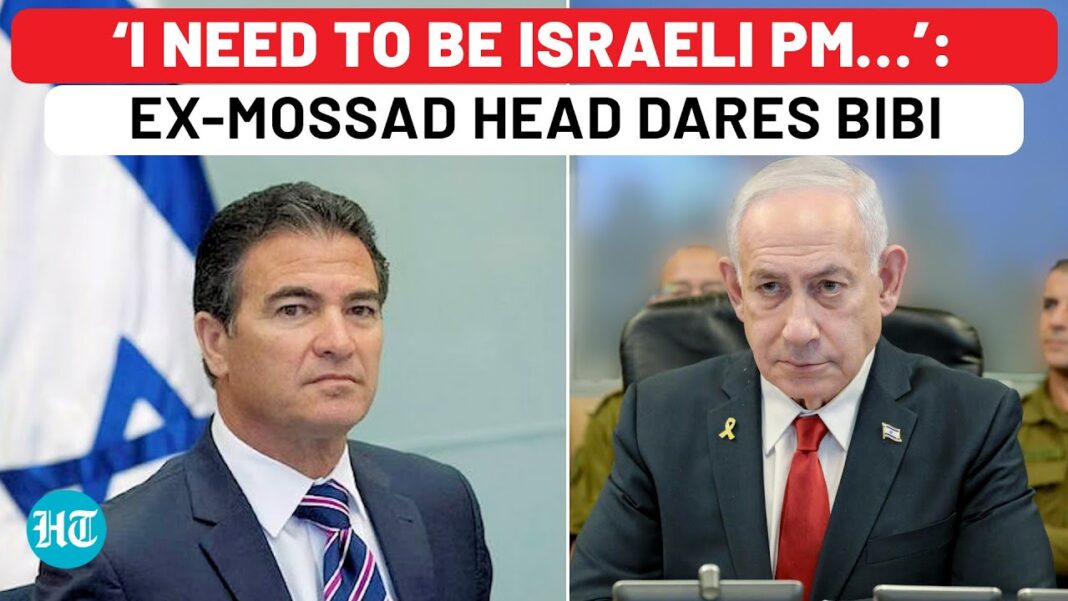
In a move that could reshape Israel’s political landscape, former Mossad chief Yossi Cohen has publicly expressed his ambition to become the country’s next prime minister, declaring that the nation is pressing for “real change.” His remarks, aired Tuesday in an interview on the Yasmin Lukatz podcast, mark the clearest articulation yet of his political aspirations, and are already igniting speculation about the formation of a new party and the potential realignment of Israel’s fractured right-wing bloc.
According to a report that appeared on Wednesday in The Times of Israel, Cohen stated unequivocally: “The public is pushing hard, and for real change to happen, I need to be prime minister.” The statement, while not an official declaration of candidacy, signaled a significant shift from years of coyness about his political intentions and positioned him as a serious contender in Israel’s complex succession politics.
Cohen’s emergence as a potential national leader is inextricably linked to his long and loyal association with Prime Minister Benjamin Netanyahu. Netanyahu appointed him as head of Mossad in 2016 after he had served as his national security adviser. At the time, the prime minister was widely reported to have seen Cohen, alongside close confidant Ron Dermer, as part of a small circle of trusted allies who could one day step into his shoes.
During his tenure at Mossad, Cohen was credited with several landmark achievements, most notably the daring 2018 operation in which Israeli operatives smuggled a trove of Iranian nuclear archives from a Tehran warehouse. That operation, celebrated by Netanyahu in a dramatic televised address, was viewed as both a strategic coup and a public relations triumph. The Times of Israel has noted that such high-profile successes earned Cohen not only Netanyahu’s deep trust but also widespread recognition among Israelis, who came to view him as a capable, disciplined, and charismatic leader.
In his interview, Cohen sought to frame his vision of leadership as something distinct from the rough-and-tumble of partisan politics. “I don’t see this as politics,” he explained, according to The Times of Israel. “I see it differently, and I think this should be defined differently. In my opinion, it’s a leadership role and not necessarily a political role.”
He anchored this conception of leadership in the day-to-day frustrations and anxieties of ordinary Israelis. “From your window, you see all the people standing in traffic jams, suffering from lack of security, lack of unity, terrible overcrowding, and the high cost of living,” Cohen said. His words, highlighting familiar grievances, resonated with a population weary from years of political turmoil, economic uncertainty, and the painful aftermath of October 7, 2023, when Hamas launched its unprecedented attack on southern Israel.
Cohen explicitly linked his proposed vision of leadership to that national trauma. “Our society is divided and fragmented and very painful, especially after October 7,” he said. “This leadership product, which I will try to sell — when there is an active election campaign — is one of national leadership, which is essentially unity and security.”
Despite his forceful language, Cohen stopped short of making a formal announcement of candidacy. Asked explicitly whether he would run in the next elections, scheduled for October 2026, he replied cautiously: “I will think about it then if there is space to run.” As The Times of Israel report observed, this ambivalence reflects his careful calculation. Cohen is aware of the volatility of Israeli politics, where timing and alliances often prove decisive.
Cohen’s hesitance is not without precedent. After months of speculation last year that he would create a new right-wing party, Cohen chose not to enter the fray, instead extending his contract as director of Israel operations at SoftBank, the Japanese investment giant. In that role, he has focused on technology, energy, and financial investments, an experience that he now points to as evidence of his ability to navigate both global markets and national governance.
Still, the signals are unmistakable. In June, Israel’s Channel 12 reported that Cohen was again considering establishing a new political party. The Times of Israel underscored that such a move would position him as one of the most high-profile newcomers to Israeli politics in decades, carrying the prestige of his Mossad career and the aura of someone untainted by legislative infighting.
Cohen has reportedly held discussions with several prominent political figures, including former prime minister Naftali Bennett, Yisrael Beytenu chairman Avigdor Liberman, and Netanyahu himself. The Times of Israel reported that while such alliances remain speculative, Cohen has increasingly leaned toward launching an independent political platform, convinced that Israel requires systemic change.
In his own words, Cohen framed his vision in almost entrepreneurial terms: he would bring a “new product” to the political market, one based on unity, security, and technocratic efficiency. His critics, however, caution that charisma and intelligence do not necessarily translate into effective governance in Israel’s fractious parliamentary system.
Any discussion of Cohen’s political future is inevitably entangled with Netanyahu’s enduring presence. Despite facing ongoing corruption trials and a turbulent tenure marked by protests and wars, Netanyahu remains the dominant figure on the Israeli right. According to the information contained in The Times of Israel report, Cohen has long been perceived as a potential heir to Netanyahu’s legacy, but the former spymaster now appears to be charting a more independent path.
This could set up a complex dynamic: should Netanyahu choose to run again in 2026, Cohen would have to decide whether to challenge his former patron directly or to position himself as a unifying alternative once Netanyahu steps aside. For now, Cohen has chosen not to confront Netanyahu head-on, a move that analysts interpret as both strategic patience and deference to the man who elevated him.
Cohen’s blend of intelligence credentials, personal charisma, and international experience gives him an aura of credibility unmatched by many would-be candidates. Polls cited by The Times of Israel in recent months have shown that the Israeli public, weary of entrenched politicians, views Cohen as a compelling outsider with the gravitas to lead.
Yet the path forward is fraught with obstacles. Cohen has never held elected office, nor has he managed the coalition politics that define Israel’s Knesset. Moreover, his close association with Netanyahu, while once an asset, could prove a liability in a political climate where large segments of the electorate are clamoring for a definitive break from the past.
Another challenge is ideological clarity. While Cohen speaks passionately about unity, security, and addressing the cost of living, his policy positions remain largely undefined. As The Times of Israel report noted, his vagueness may be strategic—delaying commitments until an election campaign forces specificity—but it also risks alienating voters who want concrete solutions to Israel’s economic and security crises.
Cohen’s potential entry into politics comes at a moment of deep uncertainty for Israel. The Gaza conflict, Iran’s expanding regional influence, and persistent domestic polarization have left the country’s future unsettled. Many Israelis are disillusioned with existing political elites and are looking for figures who can transcend factionalism.
Against this backdrop, Cohen’s pitch of leadership as a unifying role rather than a purely political one resonates strongly. His invocation of national trauma after October 7, and his insistence that Israel needs leaders who can heal social fragmentation while safeguarding security, align closely with the anxieties of a divided electorate.
In declaring that he “needs to be prime minister” for Israel to undergo real change, Yossi Cohen has taken a decisive step toward formal political engagement. Though he has not yet entered the race, his comments represent a clear testing of the waters, gauging both public appetite and political opportunity.
As The Times of Israel has documented, Cohen’s journey from the shadowy corridors of Mossad to the bright glare of politics reflects both his personal ambition and the nation’s yearning for leadership renewal. Whether he will succeed depends on factors beyond his control—Netanyahu’s longevity, the formation of alliances, and the unpredictable tides of Israeli politics. But one thing is clear: with his charisma, experience, and now his public declaration, Cohen has inserted himself firmly into the conversation about Israel’s next chapter.

Netanyahu has a lot to answer for when it comes to preparedness for the
“palestinian” barbarism on Oct.7th. But, he’s Israel’s leader right now and his heart and soul are clearly in Israel’s recovery and safety. Some of these other Israelis ought to shut up right now.