



|
Getting your Trinity Audio player ready...
|
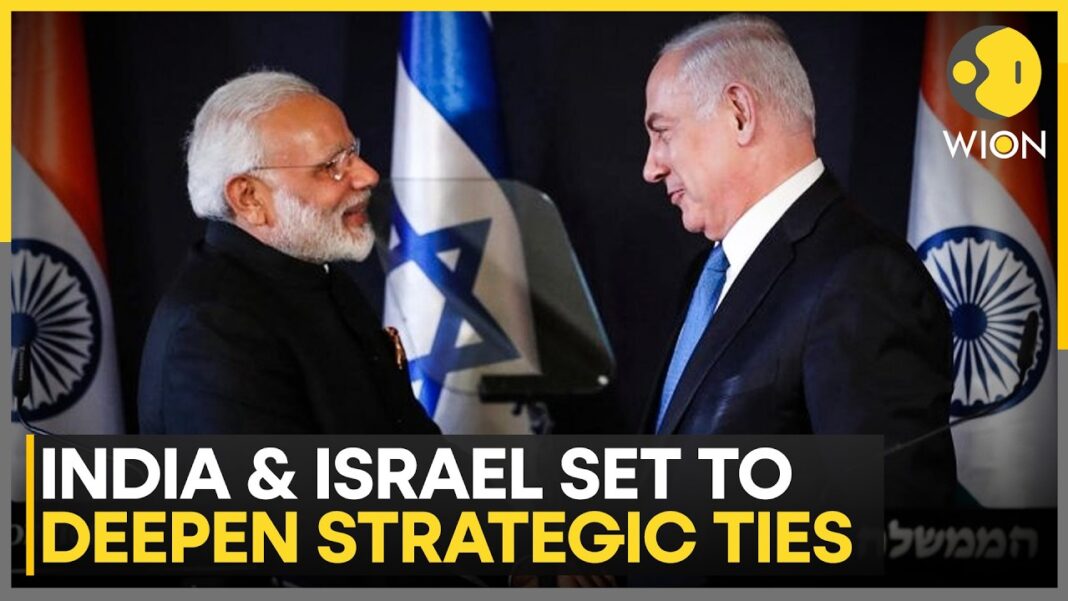
(TJV NEWS) The arrival of Indian Prime Minister Narendra Modi in Israel today is being described in some quarters as a diplomatic visit, an exchange of pleasantries between two leaders presiding over nations that have steadily drawn closer over the past decade. That description is inadequate to the point of irrelevance.
This visit is not theater; it is architecture. It is the deliberate construction of a strategic edifice designed to endure beyond electoral cycles, to shape the security calculus of two regions, and to declare—without ambiguity—that the democratic world is no longer content to respond episodically to the metastasizing threat of radical Islamist violence.
What is being unveiled in Jerusalem is nothing less than a new geometry of power, a reconfiguration of alliances anchored by Israel and India, two nations forged in adversity and bound by a shared resolve to defend civilizational continuity against nihilistic extremism.
The scale and substance of the agreements being signed during Modi’s brief sojourn underscore that this is not transactional diplomacy. Israel’s decision to offer India full technology transfer for its most advanced air-defense systems—Iron Dome and, even more strikingly, Iron Beam—marks a departure from decades of guarded restraint.
This is not a sale of hardware; it is the sharing of strategic DNA. Joint production, domestic manufacturing in India, and deep integration into India’s multi-layered air-defense grid amount to the weaving together of two defense ecosystems into a single operational fabric. The anticipated $8.6 billion in defense agreements are not mere line items in procurement ledgers; they are the material expression of a long-term security covenant.
Iron Beam, in particular, should command the attention of every serious observer of modern warfare. A directed-energy weapon capable of destroying incoming drones and rockets at negligible marginal cost, it fundamentally alters the economics of attrition. Where missile interceptors bleed treasuries with every successful defense, a laser system renders the arithmetic of asymmetric attack obsolete.
This is the quiet revolution of defense technology: the transformation of reactive protection from a financially draining necessity into a sustainable strategic posture. Israel has never transferred this capability to any other state—not to its closest Western allies, not to nations that have stood with it in wars and diplomatic battles alike. That India is now the first recipient is not a commercial decision; it is a geopolitical statement of trust and alignment.
Trust, in the realm of national security, is never abstract. It is codified in the willingness to expose one’s most sensitive systems, to share not merely blueprints but the evolving threat libraries, software updates, and operational doctrines that keep such systems viable.
By opening the architecture of Iron Dome and Iron Beam to Indian integration, Israel is binding India into its security ecosystem. The resulting interdependence will persist across governments and generations. Maintenance cycles, upgrade pathways, and intelligence fusion will tether Indian air defense to Israeli innovation in a manner that is structurally irreversible. This is what serious alliance-building looks like in the twenty-first century: not episodic arms sales, but institutional entanglement.
The strategic rationale for this embrace is as lucid as it is urgent. Prime Minister Benjamin Netanyahu has spoken openly of a broader coalition—a “hexagon” of aligned powers—united against the radical Sunni and Shiite axes that have destabilized the Middle East and radiated violence far beyond it. India’s inclusion in this emerging architecture is transformative.
As the world’s fifth-largest economy, a rising technological power, and a nation with its own long experience of Islamist terrorism, India brings weight and legitimacy to a coalition that seeks not conquest but containment of an ideology that sanctifies death. This is not a clash of civilizations; it is a defense of civilization.
The timing of Modi’s visit strips away any residual pretense that this is business as usual. He addresses the Knesset as geopolitical clocks tick toward decisions that could reshape the region. He signs defense agreements as the Israeli airspace hosts assets that signal readiness rather than rehearsal. He formalizes a security partnership at a moment when adversarial powers are actively arming Israel’s enemies and probing the seams of regional stability. This is not coincidence. It is choreography.
Netanyahu understands that alliances forged in advance of crisis possess a moral and diplomatic inertia that cannot be undone once the crisis erupts. Every signature collected before the first strike is a declaration of alignment that will echo in the councils of nations when resolutions are tabled and condemnations proposed.
For India, the calculus is equally compelling. New Delhi has long navigated a delicate diplomatic terrain, balancing historic ties with the Arab world against its growing strategic partnership with Israel. That balance is now being recalibrated by reality. Radical Islamist networks do not respect borders or diplomatic nuance; they exploit ambiguity. India’s own experience with terrorism, from Mumbai to the hinterlands, has taught it that the price of equivocation is paid in blood.
By deepening its strategic embrace with Israel, India is not abandoning its broader diplomatic engagements; it is asserting a clear-eyed understanding of where its long-term security interests lie. In doing so, it elevates the Israel–India relationship from pragmatic cooperation to principled alignment.
There is also a moral dimension to this axis that should not be underestimated. Israel and India are pluralistic democracies in regions where such political forms are contested by authoritarianism and theocratic absolutism. Their partnership is, therefore, not merely a military compact but a statement about the kind of world they seek to inhabit: one in which sovereign nations defend their citizens without apology, innovate without fear of coercion, and refuse to allow violent ideologies to dictate the terms of public life. In an age when moral relativism often paralyzes action, the clarity of this stance is itself a strategic asset.
Critics will inevitably warn of escalation, of arms races, of the dangers of entrenching blocs. Such cautions are not without merit in the abstract, but they ring hollow in the face of a relentless adversary that has demonstrated time and again its indifference to restraint. Deterrence is not provocation; it is prevention.
The consolidation of an Israel–India axis strengthens the capacity of responsible states to impose costs on those who traffic in terror, thereby reducing the incentives for adventurism. The economics of Iron Beam alone promise to shift the balance of tactical advantage away from groups that have thrived on the asymmetry between cheap offensive munitions and expensive defensive interceptors. When the cost of attack rises relative to the cost of defense, the calculus of violence changes.
What we are witnessing, then, is the maturation of a strategic partnership into a pillar of a broader security architecture. Modi did not come to Israel despite the crisis. He came because of it. The visit is a declaration that the democratic world’s response to radical Islam will no longer be episodic, reactive, or fragmented. It will be coordinated, technologically sophisticated, and anchored in durable alliances.
For Israel, this represents a triumph of strategic foresight: the transformation of innovation into influence, and of defensive necessity into diplomatic leverage. For India, it marks the assumption of a role commensurate with its rising global stature: not merely a participant in regional security, but a co-architect of a new axis of stability.
History often turns not on speeches but on signatures, not on rhetoric but on the quiet cementing of relationships that endure when the headlines fade. The agreements being inked in Jerusalem today are such signatures. They bind two ancient civilizations in a modern covenant of mutual defense against a shared threat. In doing so, they signal to the forces of radicalism that the age of isolated democracies facing asymmetric terror alone is drawing to a close.
A shield is being forged—of technology, of trust, of strategic alignment. And in that shield, Israel and India stand together, not merely defending themselves, but shaping the future contours of a world that refuses to surrender to nihilism.
