



|
Getting your Trinity Audio player ready...
|
By: Fern Sidman
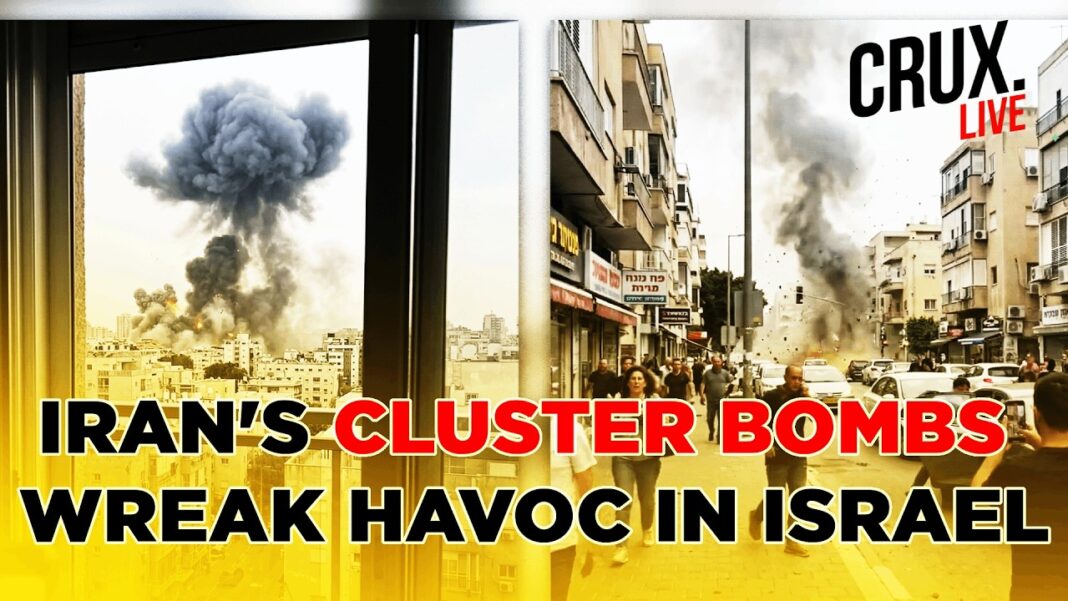
As the war between Israel and Iran continues to intensify, Israeli security officials have disclosed alarming new details about the nature of the missile attacks being launched from Iranian territory. According to a senior security source, approximately half of the missiles fired by Iran since the outbreak of hostilities have been equipped with cluster-type warheads—munitions designed to disperse numerous smaller explosives over wide areas, significantly increasing the risk to civilians.
The revelation, first reported by Israel National News on Tuesday, underscores the growing lethality of Iran’s missile campaign and highlights the extraordinary challenges faced by Israel’s civilian population as well as its defense systems.
Security officials described the use of such warheads as particularly alarming due to their ability to scatter explosive payloads over large swaths of territory rather than concentrating the destructive force at a single point of impact. This dispersal dramatically increases the likelihood that civilians will be harmed even if the missile itself is intercepted.
“This is a bomb that can cause extensive damage,” one security official explained, according to the report by Israel National News. “It is not hundreds of kilograms of explosives concentrated in one place. Instead, the payload spreads across an area of roughly ten kilometers. That requires enormous responsibility from civilians and strict adherence to safety instructions.”
The official emphasized that both the submunitions contained within cluster warheads and the debris generated by missile interceptions pose deadly threats.
“It kills,” the official said bluntly. “Interception debris from regular missiles as well as from large missiles is lethal.”
The warning reflects a grim reality of modern missile warfare. Israel’s advanced air defense systems—including the Iron Dome, David’s Sling, and Arrow systems—have succeeded in intercepting many incoming projectiles. Yet even successful interceptions can create dangerous fallout as fragments of missiles and warheads fall to the ground.
The threat is magnified when cluster munitions are involved. These weapons are engineered to release multiple explosive bomblets in midair, spreading destruction across broad areas that can include residential neighborhoods, highways, and critical infrastructure.
Military analysts note that such weapons are designed not merely to strike a single target but to saturate an area with explosive force, making them particularly hazardous in densely populated environments.
According to military sources cited by Israel National News, Iranian missile launches in recent days have been directed toward a wide range of Israeli targets. These include population centers, strategic military installations, and key national infrastructure.
Officials believe the Iranian regime’s objective is clear: to inflict maximum damage on Israel’s civilian population while simultaneously attempting to disrupt the country’s military operations and economic stability.
“The regime in Tehran is attempting to harm as many civilians as possible,” one military source stated.
The missile campaign has forced millions of Israelis to repeatedly seek shelter as air raid sirens sound across the country. Cities in central Israel, including Tel Aviv and surrounding metropolitan areas, have been frequent targets of incoming missile barrages.
Each warning siren triggers a race against time as residents scramble to reach protected spaces before the incoming projectiles arrive.
Civil defense authorities have repeatedly stressed the importance of following safety instructions issued by Israel’s Home Front Command. Officials warn that the spread of cluster submunitions increases the danger of unexploded ordnance remaining on the ground after an attack.
These unexploded bomblets can pose a lethal threat long after the initial strike, particularly if civilians approach them out of curiosity or attempt to handle them.
The scale of Iran’s missile arsenal has long been a central concern for Israeli defense planners. Over the past two decades, Tehran has invested heavily in ballistic missile development, viewing such weapons as a key component of its strategy for projecting power across the Middle East.
The current conflict has provided the first large-scale demonstration of how those capabilities might be employed in a direct confrontation with Israel.
Despite the intensity of the missile attacks, Israeli officials believe that Iran’s campaign has not yet achieved the level of coordination that its military planners likely envisioned.
Military sources told Israel National News that Iran appears to be launching relatively small missile volleys rather than the massive coordinated barrages that could potentially overwhelm Israel’s layered defense systems.
According to these assessments, Iran’s military leadership would prefer to orchestrate simultaneous launches from multiple locations across the country in order to saturate Israeli air defenses and increase the probability that missiles would penetrate the protective shield.
However, Israeli intelligence suggests that Tehran has thus far struggled to execute such large-scale coordinated attacks.
Analysts attribute this difficulty to several possible factors, including damage inflicted on Iranian missile infrastructure during Israeli and American airstrikes, logistical challenges in coordinating launches across vast distances, and disruptions to Iran’s command-and-control networks.
The result, according to military experts, is a pattern of smaller, less synchronized volleys that Israel’s defense systems have been more capable of intercepting.
Another significant observation reported by Israel National News is the apparent lack of coordinated timing between Iran’s missile launches and attacks carried out by Hezbollah from Lebanon.
Hezbollah, the powerful Iran-backed terrorist organization operating along Israel’s northern border, possesses a vast arsenal of rockets and missiles. In theory, simultaneous attacks from Iran and Hezbollah could create a multi-front assault designed to overwhelm Israeli defenses.
Yet military sources indicate that such synchronization has not materialized.
At present, officials say there is little evidence that Hezbollah and Iran are successfully coordinating their attacks to maximize strategic impact.
This lack of coordination may reflect internal communication difficulties, operational disruptions caused by Israeli military action, or strategic caution among Hezbollah’s leadership.
Nonetheless, the possibility of coordinated attacks remains a central concern for Israeli defense planners. Should Iran and its proxy forces succeed in launching simultaneous large-scale barrages, the strain on Israel’s missile defense systems could increase dramatically.
In response to the evolving threat, Israel has continued to expand both its defensive and offensive military operations.
The Israeli Air Force has conducted extensive strikes against Iranian military facilities, missile launch sites, and weapons production infrastructure. These operations are intended to degrade Iran’s ability to sustain its missile campaign.
Meanwhile, Israel’s Home Front Command has intensified efforts to educate the public about the dangers posed by cluster munitions and missile debris.
Residents have been instructed to report any suspicious objects or unexploded ordnance to authorities immediately and to avoid approaching potential hazards.
The psychological impact of the missile campaign has also been profound. For many Israelis, the knowledge that cluster warheads are being deployed adds a new dimension of fear to an already tense security environment.
Unlike conventional missile strikes that typically produce a single impact site, cluster munitions create uncertainty about where the scattered explosives may land.
This uncertainty complicates rescue operations and increases the risk to emergency responders working at the scene of an attack.
Despite these dangers, Israeli officials continue to emphasize that the country’s defensive systems remain highly effective.
According to data cited by Israel National News, the majority of incoming missiles have been successfully intercepted or have fallen in open areas where they posed minimal risk to civilians.
Nevertheless, the use of cluster warheads highlights the evolving tactics being employed by Iran as the conflict deepens.
For Israeli authorities, the message to the public remains clear: vigilance and adherence to safety instructions are essential.
As the war continues, the combination of advanced missile technology, unconventional warhead designs, and persistent attacks on civilian areas ensures that the threat remains both immediate and unpredictable.
And with each new barrage launched from Iran, the urgency of maintaining both defensive readiness and civilian preparedness becomes ever more apparent.
