



|
Getting your Trinity Audio player ready...
|
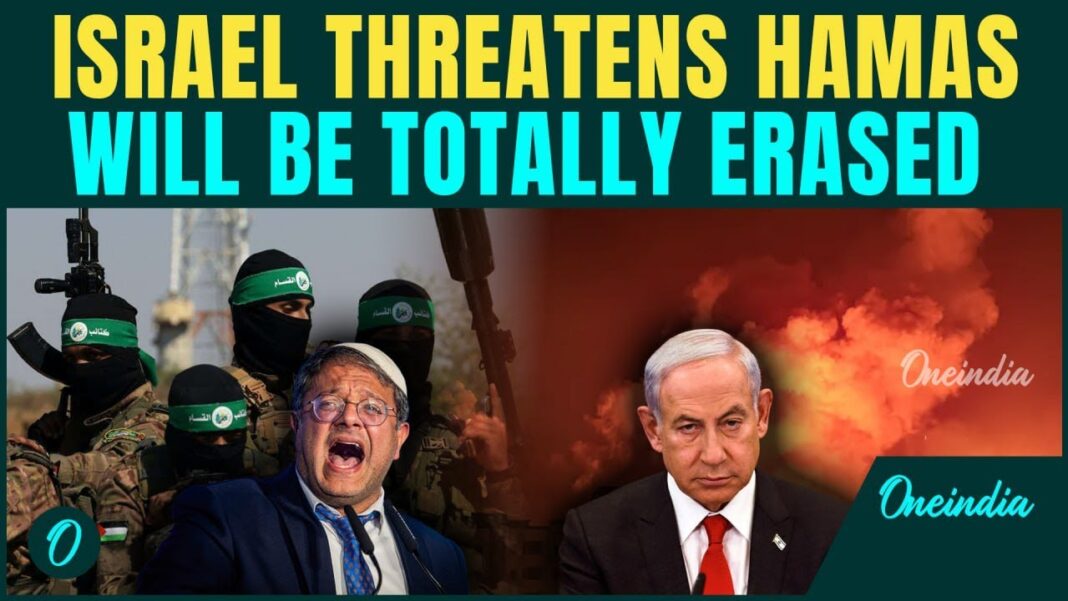
Ben Gvir at Memorial for Fallen Hostage: “We Must Dismantle Hamas Completely”
By: Fern Sidman
At a somber memorial service Wednesday evening honoring the late Uriel Baruch, one of the Israeli hostages whose body was recently returned from Gaza, National Security Minister Itamar Ben Gvir delivered fiery remarks that reverberated well beyond the synagogue walls. As reported by Israel National News, Ben Gvir’s address blended grief with defiance, pledging that Israel would “carry on in Uriel’s path” and achieve “total victory” over Hamas and those he called “enemies from within.”
Standing before a crowd of mourners that included Baruch’s family, IDF veterans, and local officials, Ben Gvir framed the return of the young hostage’s body as both a sacred moment of closure and a searing reminder of unfinished duty. “I want us to continue this war until Hamas is completely dismantled,” he declared, his tone sharp and unwavering. “We must dismantle Hamas.”
According to the information provided in the Israel National News report, the minister’s remarks encapsulated the current mood within segments of Israel’s governing coalition, where grief has fused with an unyielding resolve to pursue the destruction of Hamas as both a moral and national imperative.
Uriel Baruch, whose remains were among those returned under the terms of the recent U.S.-brokered ceasefire, was abducted from his home near the Gaza border during Hamas’s October 7 massacre. For months, his family endured the agony of uncertainty until the Israel Defense Forces confirmed his death and repatriated his body for burial.
As Israel National News reported, the memorial drew hundreds of attendees, including IDF soldiers who had fought in the same area where Baruch was taken. His story, one of youthful service and tragic loss, has become emblematic of the broader Israeli struggle against Hamas’s terror campaign.
Ben Gvir, who has long positioned himself as an unflinching advocate for harsher counterterror measures, invoked Baruch’s memory to underscore his broader security philosophy. “We must ensure that no one who participates in such atrocities will ever again walk free,” he said. “This is not vengeance—it is justice, it is morality, it is Torah.”
The most charged portion of Ben Gvir’s remarks centered on his renewed call for legislation instituting the death penalty for convicted terrorists.
“We need a death penalty law for terrorists,” he declared, drawing applause from segments of the crowd. “It’s just, it’s moral, it aligns with Jewish law. Those who have harmed, those who have slaughtered—should not be allowed to live.”
Ben Gvir argued that such a policy would serve as both justice for victims and deterrence against future attacks. “By doing so,” he said, “we will also remove the motivation for future kidnappings and atrocities.”
The idea of a death penalty for terrorists has circulated for years in Israeli political discourse, gaining traction during moments of heightened national trauma. Although Israeli law allows for capital punishment in extreme cases—most notably, it was applied to Nazi war criminal Adolf Eichmann in 1962—it is rarely invoked.
As the Israel National News report noted, Ben Gvir and members of his Otzma Yehudit party have repeatedly sought to formalize a clear statute applying the death penalty to terrorists convicted of killing Israelis. Proponents argue that current policies of life imprisonment and prisoner exchanges embolden Hamas and similar groups, while opponents, including many within Israel’s legal establishment, warn of moral and diplomatic repercussions.
Still, Ben Gvir’s message was unmistakable: Israel’s compassion for its dead and captured must not become an instrument of its enemies. “The days of weakness are over,” he declared. “Our enemies must understand that we do not compromise with murderers—we eliminate them.”
In language reminiscent of his earlier wartime speeches, Ben Gvir’s remarks, cited in the Israel National News report, invoked both religious conviction and national resilience. “We will carry on in Uriel’s path,” he said. “In the coming year, we will achieve total victory over our enemies—those who seek to destroy us, including many from within. We will win, and we will walk in our truth.”
The phrasing—“enemies from within”—was widely interpreted as a warning to political opponents who have criticized the government’s handling of the war and negotiations with Hamas. For Ben Gvir and his supporters, Israel’s current battle is not only military but also ideological—a fight to reassert moral clarity after years of compromise.
According to the information contained in the Israel National News report, Ben Gvir’s appearance at the memorial comes at a pivotal moment in Israel’s ongoing national reckoning. The country remains deeply divided over the ceasefire agreement that facilitated the release of 20 living hostages but left unresolved the fate of many others, including dozens of bodies still held by Hamas. While Prime Minister Benjamin Netanyahu has sought to balance international pressure with domestic demands for security, Ben Gvir has consistently called for a resumption of full-scale operations in Gaza until Hamas is eradicated.
Reactions to Ben Gvir’s speech reflected Israel’s polarized political landscape. Families of hostages and victims expressed appreciation for his acknowledgment of their pain, while centrist and left-wing commentators accused him of exploiting grief for political gain. Still, as the Israel National News report observed, the minister’s message resonated strongly among communities in southern Israel and the nationalist camp, where anger toward Hamas and frustration with diplomatic restraints run deep.
Political analysts quoted by the outlet noted that Ben Gvir’s emphasis on deterrence and retribution taps into a primal national instinct—the conviction that survival must never again depend on restraint. “He is channeling the national trauma of October 7 into a demand for moral reckoning,” one political scientist told Israel National News. “For his base, it is not rhetoric; it’s existential.”
Ben Gvir’s call for the death penalty also intersects with wider legislative efforts. Several coalition lawmakers have drafted parallel proposals in recent weeks, arguing that the moral contract between the state and its citizens demands stronger measures of justice. Israel National News reported that renewed public debate on the proposal is expected when the Knesset reconvenes, with Ben Gvir promising to “fight until justice for the victims is written into law.”
Beyond its legislative implications, Ben Gvir’s speech signaled a broader moral and strategic debate shaping Israel’s path forward. Should Israel prioritize the restoration of deterrence at any cost—or balance military objectives with humanitarian and diplomatic considerations?
The question of “total victory” has become a defining theme of Israel’s war narrative. To supporters of Ben Gvir’s approach, it means eradicating Hamas’s physical infrastructure and ideological appeal alike; to critics, it risks perpetuating a cycle of vengeance that clouds the prospect of long-term stability.
For the families of the fallen, however, these abstract debates fade before the human cost. “Uriel’s name will not be forgotten,” Ben Gvir said, his voice softening at the memorial’s close. “He was taken from us by murderers who sought to break our spirit—but instead, they have strengthened it. We will honor his memory not by mourning forever, but by finishing what he could not: defeating those who would destroy us.”
As the crowd dispersed, many lingered near Uriel Baruch’s portrait, adorned with candles and Israeli flags. The atmosphere, reported Israel National News, was one of heavy silence—an uneasy blend of grief, exhaustion, and pride.
Ben Gvir’s words, equal parts eulogy and manifesto, captured that complexity. “We will win, and we will walk in our truth,” he said, invoking both divine promise and human will. For some, it was a rallying cry. For others, a reminder of how far the nation has yet to travel before peace and justice can coexist.
But as the Israel National News report observed, the evening underscored a simple reality: even in mourning, Israel’s leaders are still fighting to define the moral language of victory—and to ensure that the names of its fallen, like Uriel Baruch’s, become emblems not only of loss, but of purpose.
