



|
Getting your Trinity Audio player ready...
|
By: Abe Wertenheim
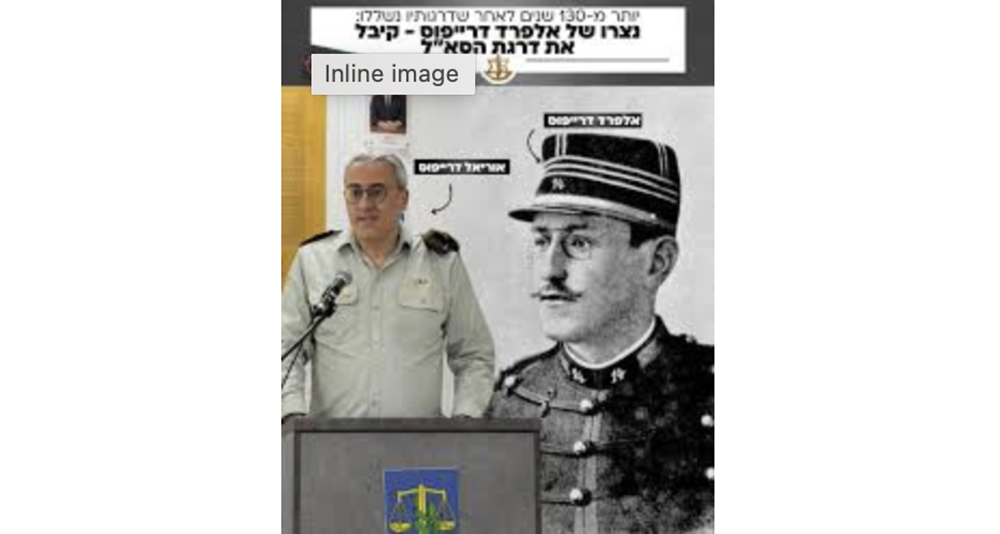
In a moment that reverberates far beyond the ceremonial halls of military protocol, the promotion of seven veteran reserve judges within Israel’s military court system has become a powerful symbol of historical continuity, resilience, and the enduring pursuit of justice. As reported on Sunday by Israel National News, the ceremony—held under the auspices of the President of the Military Court of Appeals, Maj. Gen. Orly Markman—was not merely a routine advancement of rank. Rather, it represented a profound intersection of past injustice and present sovereignty, most vividly embodied in the promotion of Lt. Col. (res.) Uriel Dreyfus.
The significance of this moment lies not only in the elevation of experienced jurists to the rank of lieutenant colonel, but in the symbolic resonance carried by the Dreyfus name itself. As Israel National News has underscored, Lt. Col. (res.) Uriel Dreyfus is a direct descendant of Alfred Dreyfus, the French Jewish artillery officer whose wrongful conviction for treason in the late nineteenth century became one of the most infamous manifestations of antisemitism in European history.
The promotion ceremony, held last week, was marked by a solemn yet celebratory atmosphere, reflecting both the professional achievements of the officers and the broader historical narrative in which their service is situated. According to the Israel National News report, the advancement of these seven judges underscores the critical role played by the military judiciary in maintaining the rule of law within the Israel Defense Forces.
Yet it was the address delivered by Lt. Col. (res.) Uriel Dreyfus that transformed the event into a moment of profound historical reflection. Standing before his colleagues and superiors, he invoked a legacy that stretches back more than a century—a legacy defined by injustice, perseverance, and ultimate vindication.
“I stand here today with the weight of two histories meeting in a single moment,” Dreyfus declared, as reported by Israel National News. “One is my family history—the name ‘Dreyfus,’ which for generations symbolized injustice, antisemitism, and the attempt to break the spirit of a Jewish officer. The second is the history we have written and continue to write since October 7.”
To fully grasp the magnitude of this moment, one must revisit the events that gave the Dreyfus name its enduring historical weight. The Dreyfus Affair, which erupted in 1894, remains a defining episode in the history of modern Europe. Alfred Dreyfus, a Jewish officer in the French army, was accused of passing military secrets to Germany—a charge that, as later evidence would reveal, was entirely unfounded.
Despite the absence of credible proof, Dreyfus was convicted in a trial that was as much a reflection of prevailing antisemitic sentiment as it was a legal proceeding. In a public ceremony that became emblematic of his humiliation, his military rank was stripped, and his sword was broken before a jeering crowd in Paris. He was then exiled to Devil’s Island, a remote penal colony where conditions were deliberately harsh and hope was intended to wither.
As the Israel National News report recounted, the case eventually unraveled as evidence of Dreyfus’s innocence came to light. After years of legal battles and public controversy, he was exonerated and reinstated in the army. Yet the scars of the affair—both personal and societal—endured long after his vindication.
For Lt. Col. (res.) Uriel Dreyfus, this history is not an abstract narrative but a deeply personal inheritance. In his remarks, he drew a direct line between the injustice suffered by his ancestor and his own service within the Israel Defense Forces.
“When I entered the induction center as a young soldier, I carried this memory with me,” he said, according to Israel National News. “I understood that every rank I would receive, every step I would take in the army, would represent a form of historical correction.”
This notion of “historical correction” lies at the heart of the ceremony’s significance. The ranks that were once torn from Alfred Dreyfus in disgrace are now, in a sense, being restored—stitched back onto the uniform of a descendant who serves within the armed forces of a sovereign Jewish state.
“Today, as I receive the rank of Lieutenant Colonel,” he continued, “I feel that the ranks torn away in disgrace are now being sewn back with pride onto the olive uniforms of the Israel Defense Forces.”
The contrast between past and present could not be more striking. Alfred Dreyfus stood alone, confronting a system that was both hostile and unyielding. His ordeal was marked by isolation and vulnerability, emblematic of the precarious position of Jews in Europe at the time.
By contrast, Uriel Dreyfus serves within a state that possesses not only sovereignty but also the means to defend itself against external threats. This transformation—from isolation to empowerment—was a central theme of his address.
“Alfred Dreyfus stood alone against a well-oiled system of lies,” he observed. “Today, the State of Israel stands on multiple fronts, facing threats of missiles, terrorism, and falsehoods in the international arena. The ranks we receive today are the answer and the proof that we no longer stand alone. We are not defenseless.”
As emphasized in the Israel National News report, this comparison underscores the broader historical arc that connects the Jewish experience in the diaspora with the realities of modern Israeli statehood.
The ceremony also took place against the backdrop of ongoing conflict and national trauma. Since October 7, Israel has faced unprecedented challenges, including sustained military engagements and significant losses.
Reflecting on this period, Dreyfus spoke candidly about the toll it has taken. “The past years have been among the most difficult of our lives,” he said. “We have lost friends, subordinates, and commanders.”
Yet even in the face of such hardship, he emphasized the importance of resilience and continuity. “Within this pain, we must remember the determination of those who came before us. We will endure and prevail because we have no other country and no other army.”
These remarks, cited in the Israel National News report, highlight the interplay between individual memory and collective responsibility—a theme that resonates deeply within Israeli society.
