



|
Getting your Trinity Audio player ready...
|
By: Fern Sidman
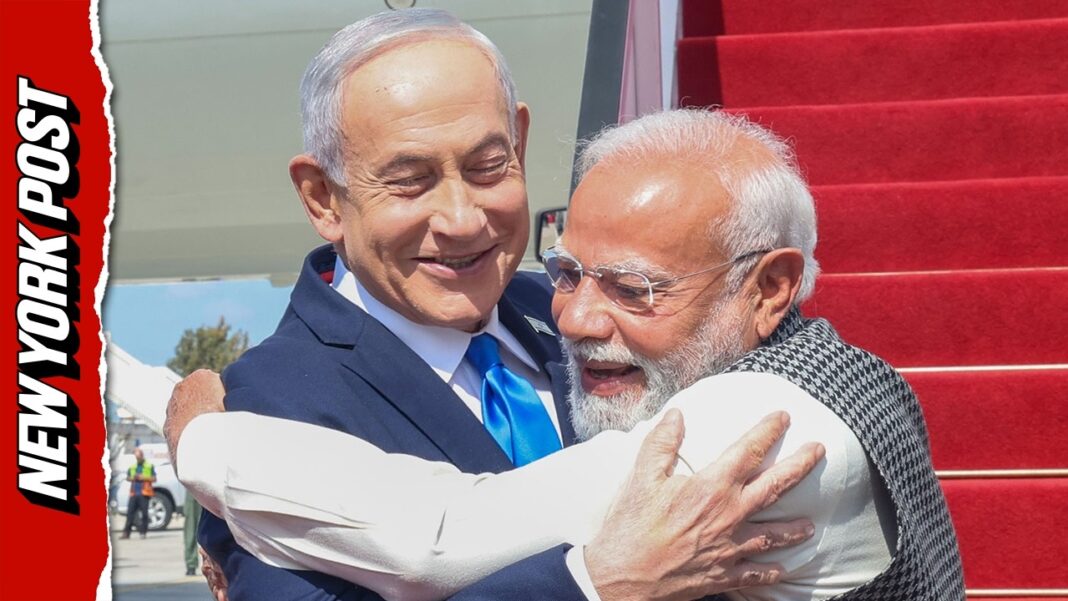
In a gesture laden with symbolism and diplomatic warmth, Israeli Prime Minister Benjamin Netanyahu and his wife, Sara Netanyahu, personally accompanied Indian Prime Minister Narendra Modi to Ben-Gurion International Airport on Thursday, marking the conclusion of a two-day state visit widely described as historic and strategically consequential. The scene, reported on Thursday by VIN News, encapsulated not only the cordial rapport between the two leaders but also the expanding arc of cooperation between Jerusalem and New Delhi.
The ceremonial farewell was more than a matter of protocol. As the VIN News report detailed, Netanyahu and his wife stood alongside Modi on the tarmac following a formal departure ceremony, underscoring the depth of personal and political ties that have steadily evolved over the past decade. For seasoned observers of international diplomacy, such gestures are not perfunctory; they signal a relationship that transcends transactional diplomacy and rests upon sustained mutual trust.
Prime Minister Modi’s visit, which commenced Wednesday, was dense with high-level engagements. He addressed Israel’s Knesset in a speech that emphasized shared democratic values, technological ambition and a common commitment to confronting global terrorism. According to the information provided in the VIN News report, Modi’s remarks were received with bipartisan warmth, reflecting a broad Israeli consensus that India represents not merely a strategic partner but a civilizational ally.
The Indian leader’s itinerary included substantive talks with Netanyahu and senior Israeli officials, culminating in the signing of agreements spanning innovation, advanced technology, defense cooperation, security collaboration and trade expansion. The agreements underscore an ambition to elevate bilateral ties into new domains, particularly in artificial intelligence, cybersecurity and joint defense development.
In a message posted on X following his departure, Modi expressed heartfelt appreciation for the hospitality extended by his Israeli hosts. He noted he was “deeply touched” that Netanyahu and Sara Netanyahu had come personally to bid him farewell at the airport—a gesture he characterized as emblematic of the friendship between the two nations. The VIN News report highlighted Modi’s confidence that the India-Israel partnership would “continue to reach new heights in the years to come,” a formulation that captures the forward-looking tenor of the visit.
For Netanyahu, the visit represented another chapter in a strategic realignment that has gradually reshaped Israel’s global alliances. Netanyahu has characterized the Israel-India relationship as “unique and historic,” rooted not only in shared interests but in a convergence of outlooks. Both nations have confronted the scourge of terrorism and have invested heavily in technological innovation as a driver of national resilience.
The origins of this burgeoning partnership can be traced to Modi’s landmark 2017 visit to Israel—the first by an Indian prime minister. That trip, widely regarded as a watershed moment, signaled India’s willingness to recalibrate its Middle East policy in a manner that openly embraced ties with Israel without sacrificing its broader regional engagements. Netanyahu’s reciprocal visit to India further cemented the bond, transforming what had long been a discreet security relationship into a publicly celebrated alliance.
Defense collaboration remains a central pillar of the relationship. Israel has emerged as one of India’s principal suppliers of advanced military technology, including missile defense systems, unmanned aerial vehicles and surveillance equipment. During this latest visit, officials reiterated their commitment to expanding joint research and co-development initiatives. VIN News reported that the two governments are exploring deeper industrial partnerships that would allow for shared manufacturing and technology transfer, reinforcing India’s domestic defense capabilities while strengthening Israel’s export footprint.
Trade relations have likewise expanded significantly in recent years. Bilateral trade, once modest, now encompasses pharmaceuticals, agricultural technology, water management solutions and cutting-edge digital systems. Negotiations toward a potential free-trade agreement have been ongoing, and both leaders signaled renewed momentum in advancing those discussions. Officials on both sides view economic integration as a stabilizing force capable of weathering geopolitical fluctuations.
The embrace of artificial intelligence and high-tech collaboration featured prominently in the visit’s agenda. Israel’s reputation as a global start-up hub aligns seamlessly with India’s burgeoning digital economy and vast pool of technological talent. Joint initiatives in AI, data analytics and cyber defense are poised to yield innovations with applications in both civilian and security sectors. The VIN News report underscored that such cooperation reflects a shared recognition that the twenty-first century’s strategic terrain is defined as much by algorithms and data as by conventional military might.
Beyond material agreements, the visit carried profound symbolic resonance. Netanyahu’s decision to personally accompany Modi to the airport evoked an intimacy that diplomatic communiqués alone cannot convey. In a region often characterized by volatility and shifting alliances, the stability of the Israel-India partnership offers a counterpoint of continuity. The personal rapport between the two leaders has been instrumental in sustaining this trajectory, with both men frequently describing their relationship in terms of friendship as well as statecraft.
The broader geopolitical context amplifies the visit’s significance. Both Israel and India operate in complex regional environments marked by security challenges and evolving alliances. For Israel, cultivating strong ties with a major Asian power diversifies its diplomatic portfolio beyond traditional Western partners. For India, engagement with Israel complements its own aspirations for technological leadership and defense modernization. The VIN News report observed that this synergy enhances each country’s strategic autonomy while reinforcing shared democratic credentials.
At the Knesset, Modi’s address highlighted common values of freedom, pluralism and rule of law. VIN News reported that Israeli lawmakers responded with enthusiasm, viewing India’s public affirmation as a testament to the normalization of relations that were once cautiously navigated. The optics of an Indian prime minister addressing Israel’s legislature would have been unthinkable in earlier decades; today, it signals the maturation of a partnership unencumbered by past hesitations.
Sara Netanyahu’s presence at the farewell ceremony further accentuated the personal dimension of the relationship. In diplomatic culture, the involvement of spouses in official send-offs often conveys a familial warmth that transcends protocol. Modi’s expression of gratitude for this gesture underscored the emotional as well as strategic bonds linking the two governments.
Critically, the visit also reinforced a shared stance against terrorism. Both leaders have consistently articulated zero tolerance for extremist violence, and this theme recurred throughout their discussions. VIN News highlighted Netanyahu’s emphasis on joint security cooperation, describing it as a cornerstone of a relationship grounded in mutual vigilance.
Looking ahead, the agreements signed during Modi’s visit are likely to shape the trajectory of Israel-India relations for years to come. Whether in defense co-production, AI research, or expanded trade, the momentum appears firmly upward. Analysts cited in the VIN News report suggest that the durability of this partnership stems from its multifaceted nature—encompassing economic, technological, cultural and strategic dimensions.
As Modi’s aircraft departed from Ben-Gurion Airport, accompanied by Netanyahu and his wife’s personal farewell, the imagery encapsulated a narrative of partnership fortified through vision and continuity. In an era defined by geopolitical uncertainty, the steady deepening of Israel-India ties offers a compelling example of how shared interests and personal diplomacy can converge to produce enduring alliances.
The two-day visit may have concluded, but its implications reverberate far beyond the tarmac. The Israel-India relationship stands as one of the most dynamic and promising bilateral partnerships of the contemporary era—anchored in common values, strengthened by innovation, and propelled by leaders committed to its continued ascent.
