



|
Getting your Trinity Audio player ready...
|
“A New Middle East in the Making”: Netanyahu Declares Strategic Turning Point as Israel and U.S. Intensify Campaign Against Iran
By: Jeff Gorman
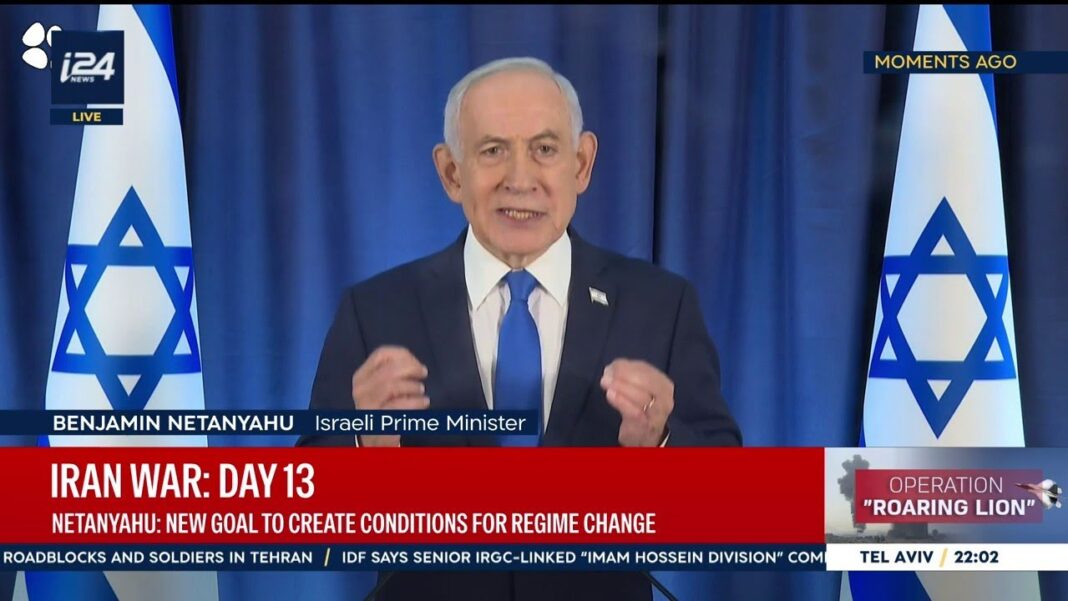
Israeli Prime Minister Benjamin Netanyahu declared Thursday that Israel’s ongoing military campaign against Iran has already transformed the geopolitical landscape of the Middle East, emphasizing that Jerusalem and Washington are working in unprecedented coordination to cripple Tehran’s nuclear and ballistic missile capabilities while potentially opening the door for political upheaval within the Islamic Republic.
Speaking at his first press conference since the outbreak of the war, Netanyahu delivered a sweeping assessment of the conflict, portraying Israel’s military operations as a decisive effort to neutralize what he described as an existential threat posed by Iran’s nuclear ambitions and expanding missile arsenal. According to a report by World Israel News, the Israeli leader argued that the strategic balance in the region has shifted dramatically since the beginning of the campaign.
“This is no longer the same Iran, this is no longer the same Middle East and this is no longer the same Israel,” Netanyahu declared, underscoring what he described as the profound consequences of the ongoing confrontation.
The prime minister’s remarks come as Israeli and American forces intensify operations aimed at dismantling the infrastructure that underpins Iran’s weapons programs. Military analysts say the campaign has already inflicted significant damage on Tehran’s strategic capabilities, including missile launch facilities, weapons production sites, and command centers belonging to the Islamic Revolutionary Guard Corps.
Netanyahu outlined what he described as the two principal objectives of Israel’s military strategy.
The first goal, he explained, is to severely damage Iran’s nuclear program, which Israel has long argued represents a grave threat not only to the Jewish state but to global stability.
The second objective focuses on neutralizing Iran’s ballistic missile program, which has expanded rapidly over the past decade and now includes weapons capable of reaching targets throughout the Middle East and beyond.
According to the World Israel News report, Netanyahu stressed that Israel’s operations are designed not merely to damage existing facilities but also to prevent the Iranian regime from preserving its strategic assets by relocating them underground. “We are aiming to stop Iran from moving nuclear and ballistic projects underground,” the prime minister said.
Israeli intelligence officials believe Tehran has increasingly relied on fortified underground installations to shield sensitive programs from airstrikes. By targeting these facilities early, Israel hopes to prevent Iran from rebuilding its capabilities in hardened locations that would be far more difficult to destroy.
A central theme of Netanyahu’s remarks was the deep coordination between Israel and the United States during the conflict. According to the World Israel News report, the Israeli prime minister described his relationship with President Donald Trump as one of close strategic partnership, revealing that the two leaders communicate almost daily as they coordinate military and diplomatic decisions.
Netanyahu said their discussions involve exchanging ideas and shaping the direction of the campaign together. “We created an alliance unlike any other with the United States,” he said.
The statement reflects the unusually close alignment between Jerusalem and Washington in confronting Iran’s military capabilities. American support has included intelligence cooperation, logistical assistance, and direct military involvement in certain operations targeting Iranian infrastructure.
Defense experts say the collaboration has significantly enhanced Israel’s ability to conduct sustained operations across vast distances.
Beyond the immediate military objectives, Netanyahu suggested that the war could have broader political consequences within Iran itself. The prime minister said Israeli operations are also intended to create circumstances that might allow the Iranian public to challenge the ruling regime. However, he acknowledged that such an outcome cannot be engineered from outside. “We can create conditions for regime change, but it is up to Iran’s people to take to the streets,” Netanyahu said. He cautioned that the prospect of political upheaval remains uncertain. “It’s not certain that this will happen – it depends on the Iranian people.”
To illustrate the point, Netanyahu invoked a familiar proverb. “You can bring a man to water, but you can’t force him to drink.” His comments reflect a longstanding belief among Israeli policymakers that the Iranian regime’s survival ultimately depends on internal repression rather than widespread popular support.
By weakening the regime’s military and economic power, Israel hopes to increase pressure on Iran’s leadership while potentially emboldening opposition movements within the country.
While the primary focus of Israel’s military campaign remains Iran, Netanyahu also addressed the escalating conflict along Israel’s northern border with Lebanon. World Israel News reported that the Iranian-backed terrorist organization Hezbollah began launching rockets toward Israeli territory on March 2, shortly after the killing of Iran’s supreme leader in the early phase of the war.
The attacks have opened a second front in the conflict, raising fears of a wider regional war. Netanyahu warned that Hezbollah would face severe consequences if the attacks continue. “Hezbollah is feeling the strength of our hand and will pay a very heavy price,” he said.
Israeli forces have already responded with airstrikes targeting Hezbollah positions in southern Lebanon, while military planners are reportedly considering the possibility of broader ground operations if the situation escalates further.
During the press conference, Netanyahu revealed that he had issued a direct warning to Lebanese authorities regarding Hezbollah’s actions. The prime minister said he told Lebanese officials that allowing Hezbollah to attack Israel would carry serious consequences. “I told them, ‘you’re playing with fire,’” Netanyahu said.
The warning underscores Israel’s longstanding position that the Lebanese government bears responsibility for activities carried out by armed groups within its territory. Hezbollah, which receives extensive support from Iran, remains one of the most powerful non-state military forces in the world, possessing tens of thousands of rockets and missiles. Israeli officials fear that a sustained Hezbollah campaign could threaten major cities across northern Israel.
During the press conference, Netanyahu was also asked about two prominent figures: Mojtaba Khamenei, the son of Iran’s former supreme leader, and Naim Qassem, Hezbollah’s current leader.
Both figures are widely viewed as key decision-makers within their respective organizations. Netanyahu declined to comment on potential Israeli plans regarding these leaders. According to World Israel News, the prime minister avoided revealing any operational intentions. “I wouldn’t issue life insurance policies on any of the leaders of the terrorist organization,” Netanyahu said.
However, he also made clear that he would not publicly discuss potential targets. “I don’t intend to give an exact message here about what we are planning or what we are going to do.” The remark was widely interpreted by analysts as a deliberate effort to maintain strategic ambiguity regarding Israel’s future actions.
Netanyahu’s press conference offered one of the clearest indications yet of how Israeli leaders view the current conflict. World Israel News reported that the prime minister believes the war has already reshaped the geopolitical dynamics of the Middle East. By striking Iranian military infrastructure and confronting Tehran’s regional proxies, Israel hopes to alter the balance of power that has defined the region for decades.
Military experts say the outcome of the conflict could influence not only Israel’s security but also the broader strategic environment stretching from the Persian Gulf to the Mediterranean.
Despite the confidence expressed by Israeli leaders, significant uncertainty remains about how the conflict will unfold. Iran still possesses a substantial arsenal of missiles and drones, and its network of regional allies—including Hezbollah—retains the capacity to escalate the war.
At the same time, international concerns about the potential economic consequences of the conflict, including disruptions to global energy markets, continue to grow.
For Netanyahu, however, the stakes remain clear. According to World Israel News, the prime minister believes Israel’s campaign represents a historic effort to prevent Iran from acquiring the weapons and military capabilities that could threaten the country’s existence.
Whether the war ultimately leads to the weakening of the Iranian regime—or triggers a wider regional confrontation—remains to be seen. But one point, Netanyahu suggested, is already undeniable: the Middle East is entering a new and uncertain chapter.
