



|
Getting your Trinity Audio player ready...
|
By: Ariella Haviv
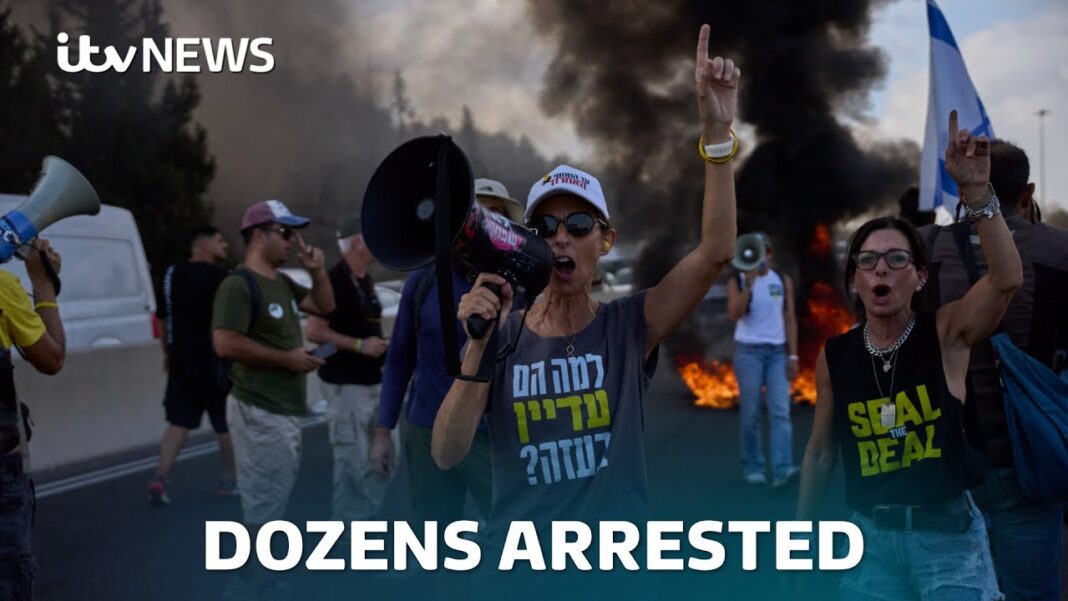
According to Ynet News, at least 38 demonstrators were detained across Israel on Sunday as large-scale protests intensified, including the closure of key entry routes into Jerusalem. The nationwide strike, which drew thousands into the streets, centered on demands for the release of some 50 hostages who have remained in Gaza captivity for nearly two years.
The demonstrations, supported by a broad coalition of businesses, academic institutions, and local municipalities, brought much of the country to a standstill—disrupting roadways and halting sections of train service. Former hostages and relatives of those still held in Gaza took part in the rallies, lending a deeply personal and emotional dimension to the public outcry.
Among the most striking voices was that of Arbel Yehoud, himself a former hostage, who issued a stark warning: “Military pressure will kill them,” he cautioned, underscoring the peril facing those still in captivity. His words, reported by Ynet News, encapsulated the wrenching tension between Israel’s military objectives and the families’ desperate pleas for the hostages’ safe return.
An eyewitness speaks out
An eyewitness to the violence that ensued during the strike, spoke to the media on the condition of anonymity. He said: “I found myself sitting in my car, struggling to steady my breath after what should have been an ordinary errand at the mall to pick up something for my son.
At first, the scene unfolded quietly: a group of demonstrators entered, moving deliberately with flags in hand. The calm veneer, however, quickly fractured. Having attended protests before—at intersections, outside the Knesset, near the courts and rabbinic authorities—I know the charged but purposeful atmosphere of places where change might genuinely be pursued, where policymakers and leaders could be compelled to listen. But this was different.
Here in the mall, whistles and blaring horns pierced the air. Some protesters took photographs of diners, others confronted passersby. Skirmishes broke out amid the shops and food courts. The noise was deafening, the tension unrelenting. Yet no one in this building holds hostages; no one here can determine the government’s course; no one among the parents and children seeking respite from the August heat bears responsibility for decisions made in Jerusalem.
The strain was unbearable. We are all carrying trauma in different forms: parents with children serving in the army, spouses and siblings stationed on the front lines, mothers cradling infants and simply trying to keep life moving forward. I understand the yearning for an end to this war; I share the frustration that so little seems within our grasp to change. But to channel that desperation by imposing guilt on fellow citizens—by suggesting that those who do not march, or who do not march here, in this place, at this moment, are somehow complicit—feels cruel.
The emotional toll was such that I could not bring myself to drive. My nerves were frayed, my stress overwhelming. I cannot stand behind what took place in that mall. By all means, demonstrate outside the halls of government, direct outrage at Hamas, pray, donate, work constructively for change. But why turn this anguish against one another?
What I witnessed today was not unity, but its opposite: anger and energy misdirected. Rather than healing, it deepens the wounds of a people already stretched to their limit.”
Reeling from Oct 7th
In a country still reeling from the traumas of October 7 and its devastating aftermath, the anguish of hostage families has been a defining feature of Israel’s national discourse. Yet, even in their grief, the families are not immune from the storms of political polarization now coursing through the state. This was underscored powerfully on Sunday when Avishai David, the father of hostage Evyatar David, delivered a searing condemnation of the disruptive nationwide protests that swept across Israel. His remarks, covered by Israel National News (INN), reveal not only the raw torment of a father watching his son’s suffering but also the growing unease among some hostage families who fear that their plight is being cynically instrumentalized to undermine the government.
Avishai David spoke with painful honesty about the emotional weight of his family’s ordeal. “It’s difficult for us after seeing him in such a bad condition. It’s difficult for us, it’s difficult for him,” he told Israel National News (INN), describing the unbearable agony of witnessing images of his son in captivity. Evyatar David, like many others abducted into Gaza, remains in perilous circumstances, with occasional signs of life offering little comfort. The father’s words conveyed a sense of despair deepened by time; far from finding solace in the persistence of public activism, he admitted that his anguish only intensifies as weeks turn into months without resolution.
In his remarks, Avishai David leveled sharp criticism at the Hostages’ Families Forum, an organization that has spearheaded much of the advocacy and demonstrations in recent months. While acknowledging that “there are amazing people in the forum who sacrifice a lot for the families,” David nonetheless warned that a “negative force” had taken root within its ranks. “The hidden and declared goal is first of all to topple the government and its leader,” he said, as reported by INN, lamenting that “there is a movement that hitched a ride on the backs of the hostages’ families.”
For David, the greatest betrayal lies in the transformation of a sacred cause—the struggle to save loved ones—into a political weapon. His statement reflects a mounting tension between those families who wish to focus their efforts on the urgent humanitarian imperative of freeing the hostages, and others who, in his view, have allowed partisan opposition to Prime Minister Benjamin Netanyahu to take precedence. “Every once in a while, the flame against the government and Netanyahu rises,” he explained. “There is a negative force that isn’t letting up, that won’t miss an opportunity to oppose the government and topple Netanyahu.”
Avishai David’s words, cited in the INN report, strike at the heart of Israel’s fractured public square. His frustration is not with protest itself—an intrinsic part of democratic life—but with what he perceives as its misdirection and manipulation. “There are people in the forum who do amazing things,” he said, “but there are people in the back who come with an anti-Netanyahu approach.”
This duality—admiration for genuine solidarity, mixed with deep resentment toward political exploitation—captures the paradox facing many hostage families. On the one hand, they desperately need the attention of the public and the leverage of protest to pressure decision-makers. On the other hand, the intrusion of partisan agendas threatens to corrode the unity of purpose upon which their cause should rest.
Perhaps the most personal and devastating critique from Avishai David came when he addressed the use of his son’s image in promotional materials for the nationwide strike. A flyer had circulated featuring a haunting photo of Evyatar in captivity, visibly injured and “as he looked burned by fire,” according to his father. For Avishai, this was a line crossed—his son’s suffering transformed into a political prop.
“We saw the picture on the flyers promoting the strike; the strike is so wrong, I don’t know who it helps,” he said bitterly. “It horrified us that they used a picture of my son, as he looked burned by fire, and exploited it for political propaganda. It’s upsetting and weakening. It’s difficult for me; the cynicism and hypocrisy are so intense.” His remarks, carried by INN, captured the raw indignation of a father unwilling to see his son’s agony leveraged for partisan gain.
Avishai David is not alone in his concerns. According to the information provided in the INN report, other hostage families have similarly voiced dismay at the politicization of their trauma. While some see the protests as a vital means of keeping the plight of the hostages at the forefront of public consciousness, others fear that such demonstrations—especially when disruptive or divisive—do more harm than good. The delicate balance between advocacy and politicization has become a recurring theme, deepening rifts even among those bound together by shared suffering.
The controversy was further sharpened by comments from Prime Minister Benjamin Netanyahu, who directly linked the demonstrations to the emboldening of Israel’s enemies. Opening a cabinet meeting, Netanyahu warned: “Those calling today to end the war without defeating Hamas are not only hardening Hamas’s stance and delaying the return of our hostages, they are also ensuring that the horrors of October 7 will repeat themselves and that we will have to fight an endless war.”*
The prime minister cautioned that Hamas’s goal is the opposite: “It wants us completely out of the Gaza Strip – north, south through the Philadelphi Corridor that prevents smuggling, and from the security perimeter protecting our communities. This would allow them to reorganize, rearm and attack us again, threatening Nir Oz, Kisufim and Sderot.”
At the core of this debate lies the question of how a society should grapple with trauma while continuing to function politically. As INN has frequently noted, the October 7 attacks inflicted deep psychological wounds on Israeli society, and those wounds remain raw. Families of the hostages live with unbearable uncertainty, and every photograph, every rumor, every delayed negotiation compounds the torment. In this context, protests serve both as a cathartic outlet for public rage and as a visible cry for urgency.
Yet, as Avishai David’s testimony illustrates, not all such expressions of anger lead to constructive outcomes. For him, disruptive strikes in malls and highways, or the circulation of graphic images, represent misplaced energy—actions that, rather than uniting the nation, risk tearing it further apart. “The strike is so wrong,” he emphasized to INN, stressing that the use of his son’s suffering for propaganda “weakens” rather than strengthens the cause of the hostages.
The dispute over the protests encapsulates a broader challenge facing Israel: how to balance democratic freedoms with national cohesion in times of existential crisis. The right to protest is sacrosanct, yet the line between advocacy and political opportunism can easily blur, particularly when emotions run so high. As the INN report observed, the hostage issue, perhaps the most personal and unifying of all, is in danger of becoming yet another battleground in the country’s ongoing political wars.
The risk is that the genuine, human plea to rescue those still in Gaza becomes overshadowed by partisan rivalries. If the public perceives hostage activism as little more than an anti-government campaign, its moral authority may diminish, reducing pressure on decision-makers rather than increasing it. This is precisely the danger Avishai David sought to highlight in his remarks.
At the heart of this controversy lies a father’s anguished plea. Avishai David is not calling for silence, nor for passivity. He is calling for dignity, for restraint, and for a redirection of energy toward actions that genuinely serve the hostages and their families. His denunciation of the protests, as reported by INN, reflects not indifference but profound concern that the nation’s solidarity is being fractured at the very moment it is most needed.
As Israel continues its long struggle against Hamas and as negotiations for the hostages grind forward, the question remains: can the country distinguish between genuine advocacy and political exploitation? For Avishai David, the answer will determine not only the fate of the protests but the very integrity of the national effort to bring his son—and all the hostages—home.
Opening a cabinet meeting, Netanyahu warned: “Those calling today to end the war without defeating Hamas are not only hardening Hamas’s stance and delaying the return of our hostages, they are also ensuring that the horrors of October 7 will repeat themselves and that we will have to fight an endless war.”*
The prime minister cautioned that Hamas’s goal is the opposite: “It wants us completely out of the Gaza Strip – north, south through the Philadelphi Corridor that prevents smuggling, and from the security perimeter protecting our communities. This would allow them to reorganize, rearm and attack us again, threatening Nir Oz, Kisufim and Sderot.”
