



|
Getting your Trinity Audio player ready...
|
By: Yaakov Lapin – TPS.com
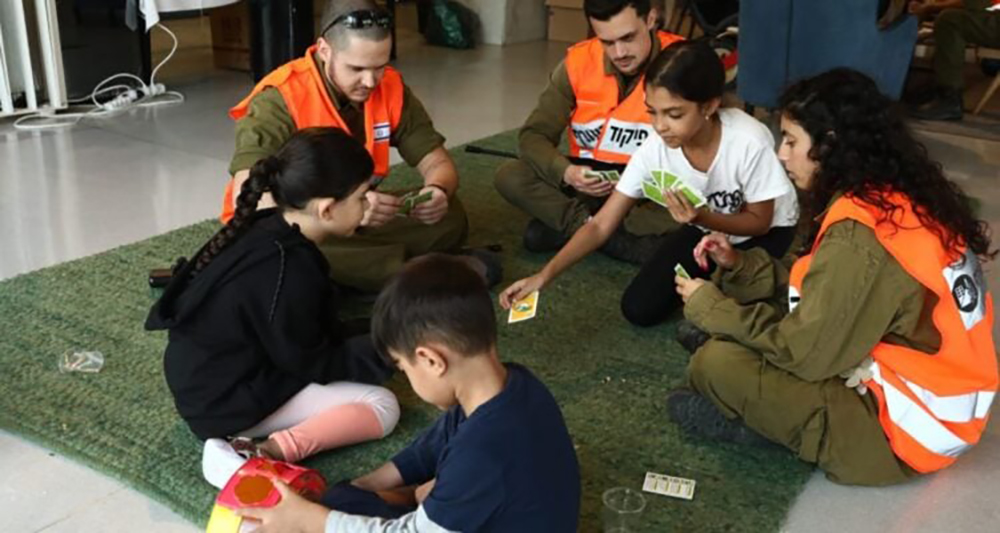
Some 250,000 Israelis have been displaced by the war so far, and the Israel Defense Forces are working with local councils to care for devastated communities of traumatized people from the south, including children who have been orphaned and dispersed throughout 29 regional councils, according to a senior Israeli military official.
The official said that it took more than two weeks to identify some of the southern victims of the Oct. 7 mass murder attack launched by Hamas death squads, including a mother burned to death in Kibbutz Kfar Aza after her home was burned down and her husband killed.
“Kfar Aza was a living place; no one locked the doors there, and bicycles were all over. Three days ago in Kfar Aza, we were examining a house that was totally burned. The husband was declared dead, and his wife was declared missing. We searched the house several times; nothing was found.
He added that a group of archeologists were then brought to the home.
“In the reinforced room, there was a pile of ashes next to a wooden cabin; no one paid attention to it. But upon further inspection, a jaw was found among the ashes. It was her. The wife was then declared dead, more than two weeks after the attack,” the official recalled.
Temporary graves have been created in the south.
The level of evil unleashed on Israeli civilians is “beyond anything we imagined,” the official said.
“Sha’ar HaNegev Regional Council’s civilians are now divided into 29 regional councils around Israel. There is a need to take care of orphans who lost both parents. These people have been evacuated around the country,” he stated.
Founded in 1992, the Israel Defense Forces Home Front Command was established as a lesson of the 1991 Gulf War based on the realization that wars are changing and that missile attacks targeting the Israeli civilian population indiscriminately would become the new threat.
Should Hezbollah enter the war in a full-scale manner, it could fire some 1,000 projectiles at central Israel a day, and more than 10,000 a day at the north for a period of time, according to some assessments.
“We already face a very significant fire on our civilians like we’ve never seen before. But on the other hand, I think we are now protecting the populated areas of Israel in a good way. The threat is significant,” said the source.
He cautioned against being deceived by the semi-routine on display in places like Tel Aviv, warning that the Iron Dome air-defense system is not hermetic and that the threat of terrorism in central Israel has not vanished either.
The IDF has been working for a lengthy period of time to secure factories and sites with hazardous materials.
The Home Front Command has also been working with Bedouin communities in the south to improve early warning and protection for them against rocket threats.
At present, Israel is divided into almost 2,000 alert areas. This precision prevents unnecessary evacuation to safe rooms—enabling more of the country to take part in keeping the economy going and caring for their basic needs.
“We had significant numbers of direct hits that we never had before on buildings in Israel during this war,” said the source. “These are unguided projectiles fired at cities, towns and villages. Hamas does not care where they hit.”
(TPS)
