



|
Getting your Trinity Audio player ready...
|
By: Russ Spencer
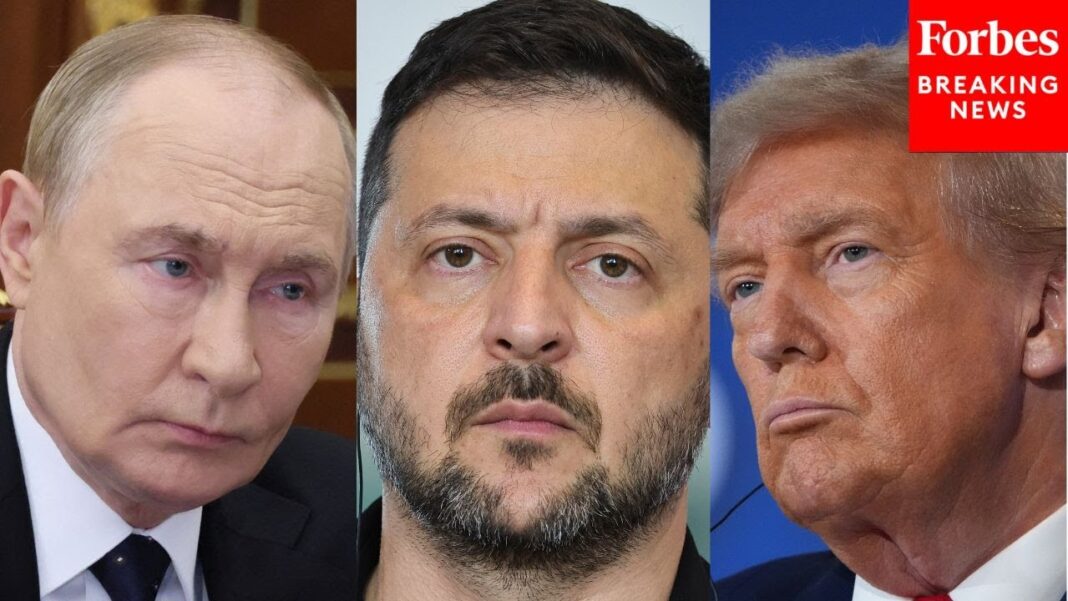
What began as a bilateral meeting between President Donald Trump and Ukrainian President Volodymyr Zelensky has swiftly evolved into a far more consequential gathering. According to a report on Sunday at VIN News, nearly half a dozen European leaders, together with NATO’s new Secretary General, will converge on Washington tomorrow, transforming the encounter into a de facto partial summit of the Western alliance.
The sudden expansion of the guest list underscores the urgency with which the United States and Europe are seeking to project unity in the face of Russia’s protracted war in Ukraine. Beyond symbolic displays of solidarity, insiders suggest the summit could produce substantive security guarantees for Kyiv — commitments that would mark a new phase in the West’s engagement with the conflict.
As VIN News reported, the original plan was for President Trump to host President Zelensky at the White House in what would have been a closely watched bilateral exchange. However, in the days leading up to the meeting, invitations were extended to leading figures from across Europe, turning the event into a broad-based show of NATO-style cooperation.
Those expected to attend now include French President Emmanuel Macron, German Chancellor Friedrich Merz, British Prime Minister Keir Starmer, Italian Prime Minister Giorgia Meloni, European Commission President Ursula von der Leyen, Finnish President Alexander Stubb, and NATO Secretary General Mark Rutte.
The presence of such a constellation of European leaders alongside Trump and Zelensky ensures that the summit will carry a significance well beyond the parameters of the U.S.-Ukraine relationship. As the VIN News report emphasized, this gathering marks one of the most ambitious attempts since the start of the war to synchronize Western policy on Ukraine at the highest political levels.
The meeting will unfold in two stages. First, Trump and Zelensky will hold discussions with their respective delegations in a closed-door session focused on bilateral concerns. This portion of the talks is expected to touch upon U.S. military assistance, intelligence sharing, and humanitarian aid.
Following this, the two leaders will join their European counterparts for a larger session and working lunch. Observers note that this second stage of the summit is where significant announcements could emerge — particularly regarding coordinated security guarantees and longer-term commitments to Ukraine’s defense.
Speculation is mounting that the summit may yield concrete pledges binding the United States and European powers to Ukraine’s defense in unprecedented ways. While formal NATO membership for Ukraine remains a distant prospect, Western capitals are increasingly exploring alternative mechanisms to provide Kyiv with durable assurances of military support.
These could take the form of multi-year aid packages, joint training initiatives, or even quasi-treaty arrangements modeled on mutual defense pacts. The presence of NATO Secretary General Mark Rutte at the meeting is viewed as a sign that the alliance itself is closely tracking the outcome and prepared to integrate any commitments into its broader strategy.
For Ukraine, such guarantees would not only bolster its immediate war effort but also signal to Moscow that Western support is not wavering. For the United States and Europe, the commitments would serve to reinforce credibility both within the alliance and to adversaries abroad.
President Trump enters the summit in a pivotal role, balancing his longstanding “America First” philosophy with the demands of leadership in a moment of international crisis. As the VIN News report observed, Trump has repeatedly emphasized the importance of burden-sharing within NATO, pressing European allies to contribute more substantially to defense spending and collective security.
By orchestrating a gathering of this magnitude, Trump will be in a position to underscore his demand that Europe step up, while simultaneously demonstrating that the United States remains the indispensable anchor of the Western alliance. For Trump, this is both a test of statesmanship and an opportunity to shape the strategic narrative heading into a volatile phase of the war.
The European leaders attending the summit bring with them distinct political imperatives and domestic pressures. French President Emmanuel Macron has sought to position himself as a continental statesman, often straddling the line between hardline deterrence and cautious diplomacy. German Chancellor Friedrich Merz faces internal political divisions over Berlin’s military commitments, even as Germany has become a top supplier of aid to Ukraine.
British Prime Minister Keir Starmer will use the summit to cement Britain’s continued role as a leading security actor in Europe post-Brexit. Italian Prime Minister Giorgia Meloni has emerged as a staunch supporter of Ukraine, aligning her right-wing government with the broader transatlantic consensus. European Commission President Ursula von der Leyen, once again, will emphasize the European Union’s institutional role in sustaining aid flows.
Meanwhile, Finnish President Alexander Stubb represents a newly expanded NATO — with Finland now a member — underscoring the profound geopolitical shifts brought about by Russia’s aggression.
As the VIN News report stressed, the very image of Trump, Zelensky, and the assembled European leaders at the White House will serve as a symbolic rebuke to Moscow, a reminder that Ukraine’s plight has not faded from Western agendas. But the summit’s significance will ultimately hinge on whether it produces actionable measures.
Diplomats note that Zelensky’s government is desperate not only for symbolic backing but also for tangible commitments that can alter the balance of the war. With Russian forces intensifying assaults in eastern Ukraine, Kyiv urgently requires both matériel and political assurances of continued Western support.
The involvement of NATO Secretary General Mark Rutte reflects how closely the alliance is tethered to the outcomes of the summit. According to the information provided in the VIN News report, Rutte is expected to brief NATO members following the meeting and explore ways to integrate any commitments into the alliance’s broader posture.
For NATO, the gathering represents an opportunity to align U.S. leadership with European contributions, ensuring that disparate initiatives coalesce into a coherent strategy. For Russia, the sight of NATO and EU leaders rallying behind Ukraine at the White House will serve as a powerful signal that its attempts to fracture Western unity have not succeeded.
Despite the momentum surrounding the summit, formidable challenges remain. Domestically, Trump faces critics who question the scale of U.S. involvement in Ukraine. In Europe, leaders such as Merz and Macron must contend with electorates wary of open-ended commitments. Meanwhile, Russia is likely to respond with escalatory rhetoric, framing the summit as proof of Western belligerence.
The VIN News report noted that Moscow has previously sought to exploit such moments by amplifying disinformation campaigns aimed at sowing discord among Western publics. In this sense, the stakes of tomorrow’s summit are as much about narrative control as they are about policy substance.
As President Trump and President Zelensky prepare to welcome a cadre of Europe’s most influential leaders to the White House, the summit represents a defining moment in the West’s collective response to Russia’s aggression. What was initially a bilateral conversation has morphed into a broader declaration of shared resolve, one that could crystallize into new security guarantees for Ukraine.
The urgency of coordination has never been greater. For Trump, the summit is an opportunity to assert leadership while demanding greater European responsibility. For Europe’s leaders, it is a chance to reinforce transatlantic unity at a time of extraordinary peril. And for Zelensky, it is perhaps one of the last opportunities to secure the long-term assurances Ukraine needs to withstand Russia’s assault.
Whether Monday’s meeting yields sweeping commitments or carefully hedged pledges, its significance cannot be overstated. The very act of convening at the White House — the symbolic seat of American power — with such a broad assembly of European leaders sends a message of unmistakable clarity: the fate of Ukraine remains inseparable from the future of the Western alliance itself.
