



|
Getting your Trinity Audio player ready...
|
(TJV NEWS) The United States is making contingency plans for the possibility of prolonged military operations against Iran if President Donald Trump authorizes action, two US officials told Reuters, signaling that any future confrontation could be more extensive than prior clashes between the two nations.
According to Reuters, the officials, who requested anonymity due to the sensitivity of the matter, said the Pentagon is preparing for a campaign that could last several weeks rather than a single, limited strike. The development adds pressure to ongoing diplomatic efforts between Washington and Tehran.
As the Jerusalem Post reported, US and Iranian representatives met in Oman last week in an attempt to revive negotiations surrounding Iran’s nuclear program. The talks come after Trump increased the US military presence in the region, heightening concerns about potential military escalation.
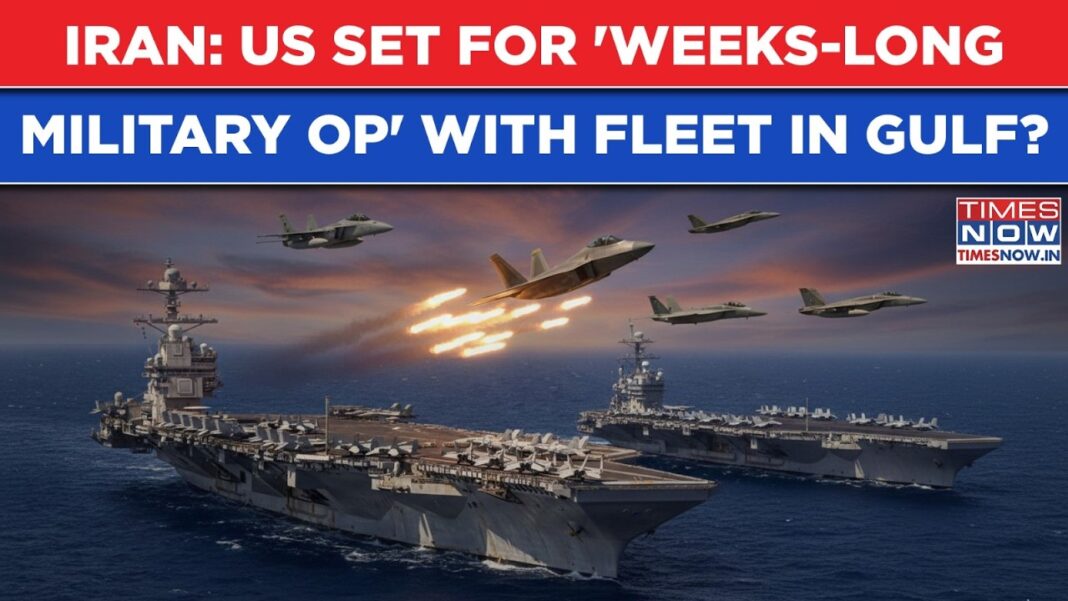
On Friday, US officials confirmed that the Pentagon is deploying an additional aircraft carrier to the Middle East, along with thousands of additional troops, fighter jets, guided-missile destroyers, and other assets capable of both offensive and defensive operations, Reuters reported.
Speaking to American service members at a military base in North Carolina, Trump acknowledged the challenges of reaching a deal with Tehran.
“It’s been difficult to make a deal,” Trump said. “Sometimes you have to have fear. That’s the only thing that really will get the situation taken care of.”
When asked about preparations for a sustained military campaign, White House spokesperson Anna Kelly said the president is keeping all options available.
“President Trump has all options on the table with regard to Iran,” Kelly said, adding that he considers multiple viewpoints before making decisions based on US national security interests.
The Pentagon declined to comment on the reported operational planning.
The United States previously deployed two aircraft carriers to the region last year during what was described as a limited operation targeting Iranian nuclear facilities. As Reuters noted, the June mission, dubbed “Midnight Hammer,” involved US stealth bombers flying from the United States to strike nuclear-related sites in Iran. Tehran responded with a limited retaliatory strike against a US base in Qatar.
However, officials told Reuters that current planning envisions a more complex and potentially broader campaign. One official indicated that, in a sustained operation, the US military could target not only nuclear infrastructure but also Iranian state and security facilities. Specific targets were not disclosed.
Experts have cautioned that the risks to US forces would increase significantly in a prolonged conflict. Iran possesses a large and sophisticated missile arsenal capable of targeting US bases across the Middle East. Retaliatory strikes could trigger a cycle of escalation and heighten the risk of a wider regional conflict.
The same official told Reuters that US planners anticipate Iranian retaliation in the event of an attack, potentially leading to extended exchanges between the two sides.
Neither the White House nor the Pentagon provided additional comment regarding the risks of broader regional escalation.
Trump has repeatedly warned that military action remains an option if diplomatic efforts fail, citing concerns over Iran’s nuclear ambitions, ballistic missile program, and domestic crackdown. On Thursday, he said that if talks collapse, the alternative would be “very traumatic.”
Iran’s Islamic Revolutionary Guard Corps has warned that any strike on Iranian territory would prompt retaliation against US military bases in the region. The United States maintains installations in countries including Jordan, Kuwait, Saudi Arabia, Qatar, Bahrain, the United Arab Emirates, and Turkey.
As the Jerusalem Post reported, Israeli Prime Minister Benjamin Netanyahu met with Trump in Washington this week, stating that any agreement with Iran must include provisions essential to Israel’s security.
Iran has indicated it is open to discussing limitations on its nuclear program in exchange for sanctions relief but has ruled out negotiations over its missile program.
