



|
Getting your Trinity Audio player ready...
|
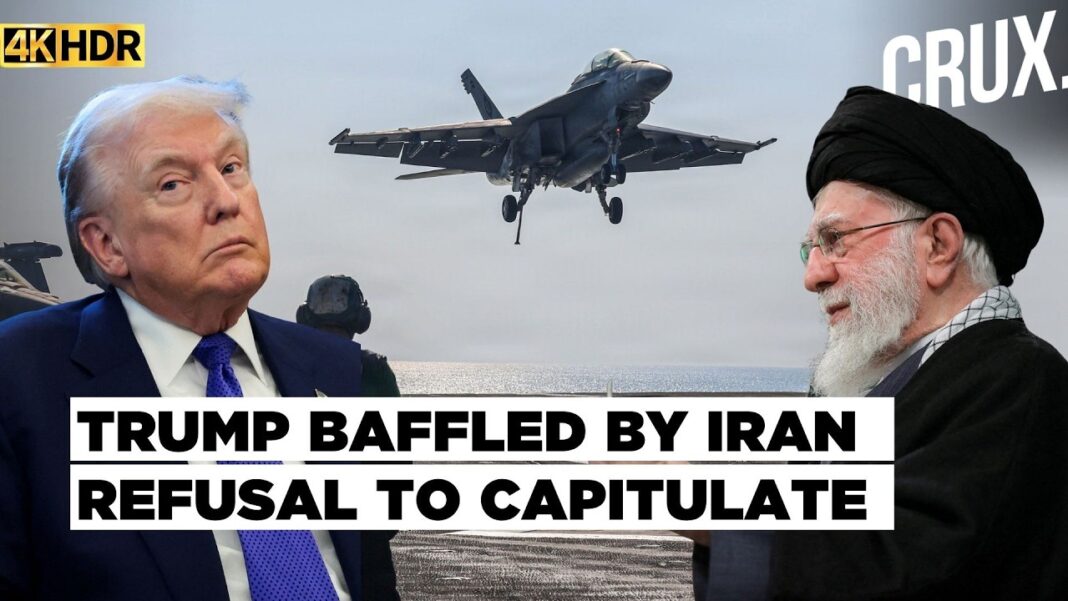
Trump Wonders Why Tehran Hasn’t Backed Down amid American Military Surge, Witkoff Says
By: Chaya Abecassis
As American naval power consolidates across the Middle East and the rhetoric of ultimatum replaces the cadence of cautious diplomacy, the long-simmering confrontation between Washington and Tehran has entered a perilous new phase. President Donald Trump, according to remarks by his special envoy Steve Witkoff, has expressed a pointed curiosity about why Iran has not yet “capitulated” in the face of mounting US pressure to curb its nuclear program.
The word choice itself, however carefully hedged by Witkoff in a televised interview, speaks volumes about the tenor of the moment: a diplomacy increasingly framed not as negotiation among sovereign equals but as the expectation of submission by a besieged adversary. Reuters and The Algemeiner, in their respective reporting on the administration’s posture, have portrayed a White House convinced that the sheer mass of American military power now arrayed in the region ought to have compelled Tehran to bend.
Witkoff’s comments, delivered on Fox News’ “My View with Lara Trump,” were notable not only for their candor but for the conceptual framework they revealed. “I don’t want to use the word ‘frustrated,’ because he understands he has plenty of alternatives,” Witkoff said of the president, before adding, “but he’s curious as to why they haven’t… I don’t want to use the word ‘capitulated,’ but why they haven’t capitulated.” Reuters quoted these remarks as emblematic of an administration that sees coercive leverage as the primary engine of diplomacy. The Algemeiner report, reflecting on the same exchange, noted the rhetorical tension in Witkoff’s careful disavowal of the term even as he returned to it, underscoring how deeply the notion of capitulation has permeated the administration’s thinking.
The backdrop to this rhetorical posture is a substantial American military buildup in the Middle East and preparations for a potential multi-week air campaign against Iranian targets. The accumulation of seapower and naval assets has been framed by the administration as a necessary show of resolve designed to compel Tehran to demonstrate, in Witkoff’s words, that it does not seek a nuclear weapon and is prepared to articulate concrete concessions.
Yet this logic presumes a linear relationship between pressure and compliance, a presumption that decades of fraught US-Iranian engagement have repeatedly called into question. Tehran, for its part, has responded by threatening to strike US bases in the region should it come under attack, transforming the buildup into a classic deterrence spiral in which each side’s efforts to signal resolve intensify the other’s sense of vulnerability.
At the heart of the dispute lies the question of uranium enrichment and the broader architecture of Iran’s nuclear ambitions. The United States insists that Iran relinquish enriched uranium stockpiles that Washington argues could be diverted toward weapons production, cease its support for armed groups across the Middle East, and accept constraints on its missile program. Iran counters that its nuclear program is peaceful in intent, though it has signaled a willingness to accept certain curbs in exchange for the lifting of financial sanctions.
Reuters has reported that Tehran rejects linking nuclear concessions to issues such as missiles and regional alliances, viewing such linkage as an attempt to leverage nuclear talks to extract broader strategic capitulation. The Algemeiner report, in its analysis, has emphasized that this divergence in negotiating frames—Washington’s insistence on a comprehensive reordering of Iran’s strategic posture versus Tehran’s demand for a narrowly tailored nuclear accord—has become the central impediment to any durable agreement.
Witkoff’s own articulation of the nuclear concern was stark. “They’ve been enriching well beyond the number that you need for civil nuclear. It’s up to 60 percent [fissile purity],” he said. “They’re probably a week away from having industrial, industrial-grade bomb-making material, and that’s really dangerous.” Reuters carried these claims, which have been echoed by American officials in recent months as evidence of the urgency of the threat.
The Algemeiner report contextualized such statements within a broader campaign to frame Iran’s nuclear advances as imminent and intolerable, thereby justifying the acceleration of military preparations. Tehran, however, continues to deny any intention to build a nuclear weapon, insisting that enrichment levels are part of a peaceful program and that international scrutiny, if coupled with sanctions relief, could provide sufficient assurance of non-militarization.
The diplomatic picture is further complicated by ongoing talks over sanctions relief. A senior Iranian official told Reuters that Tehran and Washington remain divided on the contours and sequencing of sanctions removal, a core incentive Iran seeks in return for any nuclear concessions. The Algemeiner report highlighted that for Tehran, sanctions relief is not merely an economic matter but a question of political legitimacy and regime stability. Years of financial isolation have exacerbated domestic economic hardship, fueling unrest and amplifying the stakes of any negotiation with Washington. To capitulate on nuclear enrichment without tangible relief would, from Tehran’s perspective, risk appearing weak at home while gaining little in return abroad.
Layered atop these strategic calculations is a strikingly personal dimension to Washington’s approach: Witkoff revealed that, at Trump’s direction, he has met with Iranian opposition figure Reza Pahlavi, the son of the shah ousted in Iran’s 1979 Islamic Revolution.
Pahlavi, who lives in exile, emerged as a rallying figure for segments of Iran’s opposition during last month’s anti-government demonstrations, which were reportedly met with a brutal crackdown resulting in thousands of deaths, the worst domestic unrest since the revolution era. By engaging with Pahlavi, the Trump administration appears to be signaling that its Iran policy is not confined to nuclear containment but encompasses an openness to regime transformation, a prospect that Tehran has long regarded as an existential threat.
Earlier in February, Pahlavi publicly argued that US military intervention in Iran could save lives and urged Washington not to prolong negotiations with Tehran’s clerical rulers over a nuclear deal. The Algemeiner reported these remarks as indicative of a strand within the Iranian opposition that views external force as a catalyst for internal change. For Washington, such voices can be rhetorically convenient, lending a veneer of humanitarian justification to coercive strategies. Reuters, however, has cautioned that overt alignment with exiled opposition figures risks reinforcing Tehran’s narrative that domestic dissent is orchestrated from abroad, potentially delegitimizing indigenous movements and hardening the regime’s resolve.
The intersection of military escalation, nuclear brinkmanship, and flirtations with regime change has produced an atmosphere of acute volatility. Reuters’ reporting on the administration’s preparations for a potential multi-week air attack paints a picture of a Middle East bracing for upheaval. Iran’s threats to retaliate against US bases underscore the regionalization of any prospective conflict, with allies and proxies drawn into a widening vortex of insecurity. The specter of escalation looms not as an abstract possibility but as a contingency for which both sides are visibly preparing.
Yet the very premise of Washington’s current strategy—the expectation that overwhelming pressure will induce capitulation—rests on assumptions that history renders dubious. Iran’s political system, forged in the crucible of revolution and sustained through decades of confrontation with external powers, has often demonstrated a capacity to absorb economic pain and military threat in the name of sovereignty and ideological resilience. Appeals to national dignity and resistance remain potent within Iran’s political culture, complicating any attempt to coerce compliance through force alone. Reuters’ accounts of Tehran’s negotiating posture suggest that, far from capitulating, Iranian leaders view the current pressure campaign as confirmation of their longstanding distrust of American intentions.
This impasse raises the question of whether the administration’s rhetoric of curiosity masks a deeper strategic dilemma: how to reconcile maximalist demands with the realities of an adversary unwilling to concede under duress. The language of capitulation, even when disavowed, frames the negotiation as a zero-sum contest rather than a reciprocal process, narrowing the space for compromise. The Algemeiner report argued that such framing risks entrenching hardliners on both sides, marginalizing more pragmatic voices that might otherwise seek a middle ground between enrichment limits and sanctions relief.
As naval assets gather and diplomatic channels strain under the weight of ultimatum, the coming weeks may prove decisive. The trajectory of US-Iran relations is being set not only by technical disputes over centrifuge thresholds but by the deeper narratives each side tells itself about power, pride, and the meaning of concession. Whether curiosity hardens into coercion or gives way to compromise will depend on choices made in the rarefied corridors of power, choices whose consequences will reverberate far beyond the negotiating table and into the volatile landscapes of a region long accustomed to living on the edge of war.

The problem with President Trump and most of their advisors is that they can’t understand the Islamist ideology. “The art of the deal” works with rational businessmen and westerners, not with Islamists.