



|
Getting your Trinity Audio player ready...
|
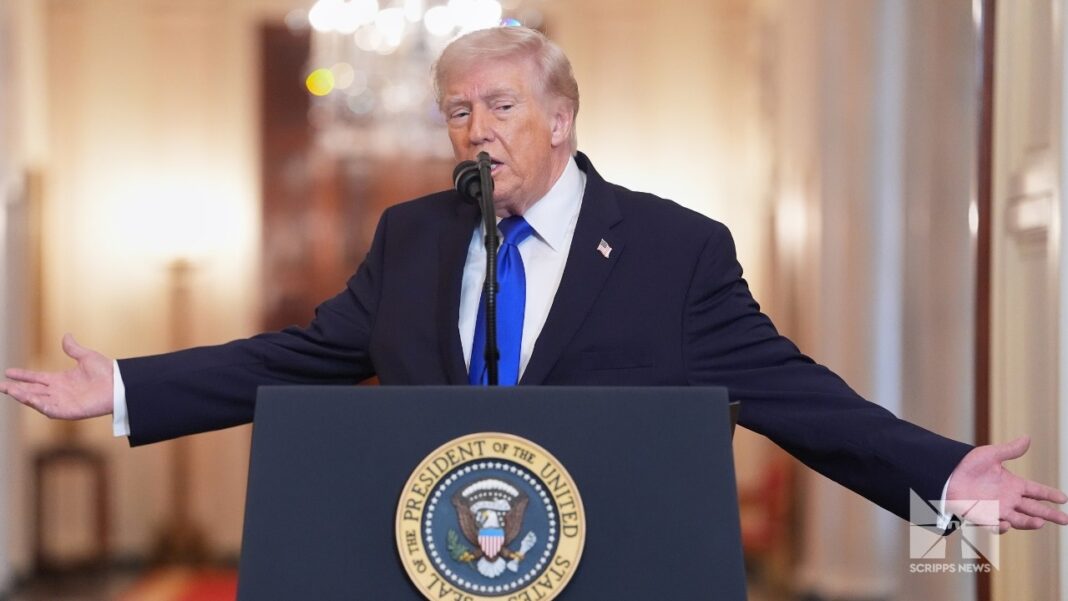
(JNS) U.S. President Donald Trump said on Monday that if Iran does not reach a deal with Washington, “it will be a very bad day for that country and, very sadly, its people,” as the American military buildup in the region continued.
Responding to a report that Gen. Dan Caine, chairman of the U.S. Joint Chiefs of Staff, had expressed skepticism about military action, Trump claimed that “everything that has been written about a potential war with Iran has been written incorrectly, and purposefully so.”
“I am the one that makes the decision,” Trump stressed in the Truth Social post, adding that he “would rather have a deal than not but.”
“They are great and wonderful, and something like this should never have happened to them,” he wrote, referring to the Iranian people.
The president denounced the Axios report about Caine’s opposition to a war as “100% incorrect.” According to him, “General Caine, like all of us, would like not to see war but, if a decision is made on going against Iran at a military level, it is his opinion that it will be something easily won.”
“He has not spoken of not doing Iran, or even the fake limited strikes that I have been reading about, he only knows one thing, how to war and, if he is told to do so, he will be leading the pack,” wrote Trump.
According to figures gathered by Israel’s Institute for National Security Studies, over 200 U.S. fighter aircraft are currently deployed in the Middle East, and more than 300 when those based in Europe are included.
In addition to fighter aircraft, U.S. forces in the region include more than 100 refueling, command-and-control, intelligence and transport planes.
Two U.S. aircraft carriers—the USS Abraham Lincoln, which arrived on Jan. 26, and the USS Gerald R. Ford, currently in the Mediterranean and heading east, having recently been spotted near Crete—are also operating in the area, accompanied by 12 destroyers, per the most recent INSS data analysis.
Israel continues to monitor the deployment, as part of the ongoing tight coordination between the Israel Defense Forces and the Pentagon. The moves by Washington are seen as part of a strategy aimed at presenting a credible military threat should negotiations fail, Channel 12 reported.
According to the report, Israel’s defense establishment sees a “window of opportunity” for possible U.S. military action “in the coming days.”
A third round of indirect talks between Washington and Tehran is set to take place in Geneva on Thursday. Axios reported that the sides would “discuss a detailed Iranian proposal for a nuclear deal,” the draft of which the Trump administration expected to receive by Tuesday.
At the same time, the State Department on Monday ordered non-emergency government personnel and family members to leave Lebanon due to concerns for the “security situation in Beirut.”
In addition, embassy personnel are “restricted from personal travel without advance permission,” the State Department announced.
The move came amid concerns that the Iranian-backed Lebanese terrorist army Hezbollah could attack the Jewish state in case of a conflict with Iran, triggering Israeli retaliatory actions.
Israeli Prime Minister Benjamin Netanyahu declared on Monday that “no one knows what the day will bring” but that the Jewish state was “prepared for any scenario.”
He said he had relayed the message to Iran that it would make “perhaps the worst mistake in its history” if it attacked the State of Israel. “We will respond with a force that they cannot even imagine,” he vowed.
The Israel Defense Forces is completing preparations for renewed multi-front conflict, Channel 12 News reported on Monday, adding that the IDF’s Home Front Command, as well as municipalities, were in the process of updating their emergency preparedness plans amid the threats.
Along the northern border, Jerusalem is intensifying military operations in Southern Lebanon, in an attempt to reduce Hezbollah’s abilities to participate in a potential multi-front confrontation with Iran, according to Channel 12.
The diplomatic efforts and military tensions come against the backdrop of renewed protests in the Islamic Republic. Trump said on Friday that regime forces had killed 32,000 people “over a relatively short period of time,” referring to the regime’s crackdown on nationwide protests.
The president on Monday posted commentary on the negotiations from conservative Fox News host Mark Levin to Truth Social, in which Levin expressed deep skepticism regarding the possibility of reaching a deal with Tehran.
In the segment, Levin argued that signing an agreement with Iran would not change “the mindset of a terrorist regime that is slaughtering its people as I speak, that is already trying to build new nukes.”
He added, “We signed a paper. Peace in our time. No. The problem isn’t negotiations. The problem isn’t they won’t agree to this or that, or that we can get the best deal in world history. The problem is them.”
According to Levin, the Islamic regime “needs to be eliminated to save our children and grandchildren from having to deal with it and to save the people of Iran who, as I speak, are being slaughtered.”
