



|
Getting your Trinity Audio player ready...
|
Trump Touts Qatari Role in Gaza Peacekeeping as Global Coalition Takes Shape
By: Fern Sidman
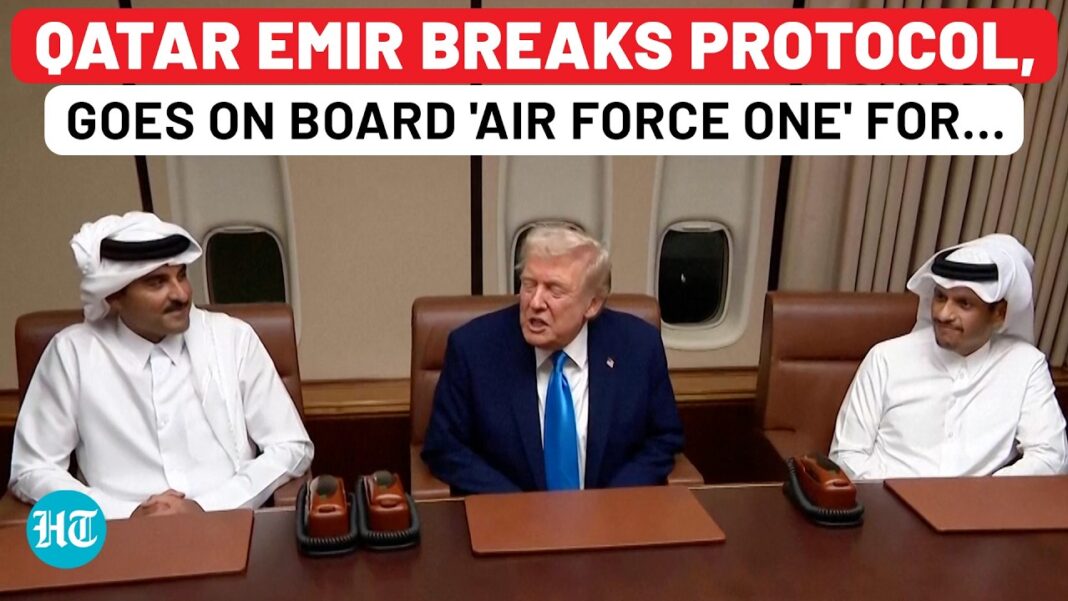
In a development that calls attention to both the complexity and ambition of the Trump administration’s postwar vision for Gaza, President Donald Trump announced on Saturday that Qatar may be prepared to contribute peacekeeping forces to help stabilize the region. The announcement came after the president met with Emir Sheikh Tamim bin Hamad al-Thani during a refueling stop in Doha, where the two leaders discussed Qatar’s potential role in what Trump described as an unprecedented multinational stabilization mission.
According to a report on Saturday at World Israel News, Trump characterized Qatar as “a vital partner in achieving enduring peace,” lauding the Gulf state for its willingness to take part in a mission that would not only ensure Gaza’s reconstruction but also prevent a resurgence of terror. “They’ve been a great ally and a key player in the region’s stability,” Trump told reporters. “If called upon, Qatar has indicated it’s ready to assist with peacekeeping operations. This is about securing an enduring peace, one that will last.”
Trump’s remarks followed a detailed briefing from Secretary of State Marco Rubio, who has been leading the administration’s diplomatic and operational efforts to implement what the World Israel News report described as “the most comprehensive post-conflict plan for Gaza in modern history.” The plan, a 20-point framework unveiled earlier this month, sets forth an integrated roadmap for demilitarization, reconstruction, governance reform, and humanitarian recovery — all designed to lay the foundation for what Trump calls “a peaceful and prosperous Gaza under new management.”
Speaking in Israel before traveling to Doha, Secretary Rubio told World Israel News that the first phase of the Gaza plan had already achieved “significant progress” within two weeks of its launch, though he cautioned that the road ahead would involve “ups and downs and twists and turns.”
“This is something the world has never done before,” Rubio said, emphasizing that the initiative blends military precision, humanitarian coordination, and economic recovery in ways that surpass any previous peacekeeping mission. “It’s the most ambitious stabilization operation the international community has ever undertaken — and it’s being led by the United States.”
During his visit, Rubio toured a U.S.-Israeli coordination center overseeing the humanitarian and logistical operations inside Gaza. World Israel News reported that the center, staffed by American, Israeli, and allied officers, has been instrumental in mapping secure and semi-secure corridors for the movement of aid convoys. These convoys are now crossing beyond the so-called “yellow line” — the demarcation separating stable zones from contested territory still under assessment.
Rubio emphasized that international and faith-based organizations are now managing the distribution process under the supervision of joint security teams. Crucially, he stated that the United States would not cooperate with or rely on UNRWA, the controversial UN agency long accused of perpetuating Hamas influence.
“UNRWA has been a subsidiary of Hamas,” Rubio told World Israel News bluntly. “We’re not going to use a structure that has enabled terror networks for decades. Aid will flow directly through vetted partners that serve the people — not the militants.”
The World Israel News report noted that the decision to bypass UNRWA marks a defining shift in U.S. strategy, signaling a total realignment of international aid policy in Gaza. The administration’s goal, according to senior officials, is to ensure transparency, accountability, and security at every step of the humanitarian process — a framework that many in Israel’s defense establishment have praised as “long overdue.”
At the heart of the Trump administration’s Gaza strategy lies one immovable principle: Hamas must completely disarm. As Rubio explained to World Israel News, Israel has already met its commitments under the first phase of the plan, while Hamas continues to obstruct efforts at demilitarization.
“Israel has kept its end of the bargain,” Rubio stated. “If Hamas fails to demilitarize, that will have to be enforced. There are clear enforcement provisions in the plan, and the international community is prepared to act if Hamas continues to resist.”
The secretary’s remarks were interpreted by analysts cited in the World Israel News report as a strong warning that any failure by Hamas to surrender its weapons or dismantle its command structures could trigger renewed international action — potentially including targeted operations or coordinated sanctions.
The Trump plan, which already involves more than two dozen countries, has drawn participation from several Arab and Muslim nations that have historically refrained from direct engagement in Gaza affairs. The World Israel News report noted that this multilateral coalition represents a strategic breakthrough — the first time that such a diverse alliance has united around a shared mandate for Gaza’s demilitarization and reconstruction.
While details remain under discussion, World Israel News reported that Qatar’s potential involvement in the International Stabilization Force (ISF) marks a critical development in securing regional buy-in. Trump’s willingness to engage directly with Doha — a nation that has at times maintained a delicate balance between Western alliances and regional Islamist actors — reflects both pragmatism and strategic foresight.
Qatar’s Emir, Sheikh Tamim bin Hamad al-Thani, reportedly expressed interest in contributing to the peacekeeping operation, which could see a blend of Arab, European, and U.S.-led forces maintaining security in postwar Gaza. Trump’s meeting with the Emir, according to the World Israel News report, focused on defining the scope of Qatar’s role, ensuring that any contribution aligns with the broader objective of neutralizing Hamas’ remaining influence while stabilizing civilian life.
“We’re creating a coalition that crosses old boundaries,” Trump said, describing the prospective mission as a “partnership of nations determined to replace war with accountability and terror with opportunity.”
As the World Israel News report detailed, Washington is now drafting the legal and operational framework for the International Stabilization Force, which could operate either under a UN Security Council resolution or an independent multinational mandate. While the specifics are still being negotiated, administration officials say the U.S. prefers a hybrid model that ensures operational flexibility while maintaining international legitimacy.
Discussions on the mission’s structure and composition are scheduled to continue in Doha on Sunday, with delegations from Egypt, the UAE, Saudi Arabia, Jordan, and several European nations expected to participate.
A senior diplomat quoted in the World Israel News report described the Doha discussions as “the most consequential security dialogue in the region since the Abraham Accords.” He added that the stabilization effort is “not just about rebuilding Gaza — it’s about reshaping the Middle East’s security architecture for a generation.”
For Trump, the Gaza peacekeeping initiative is more than a regional effort — it is a legacy project that builds upon the foundations laid by the Abraham Accords and his broader “Peace through Strength” doctrine. The inclusion of Qatar, one of the region’s wealthiest and most diplomatically active states, could prove pivotal in ensuring the mission’s funding and credibility across the Arab world.
As the World Israel News report noted, Trump’s approach blends transactional diplomacy with strategic coalition-building, seeking not only to stabilize Gaza but also to reinforce a new geopolitical order anchored in U.S.-led cooperation.
Still, challenges remain formidable. The disarmament of Hamas, the prevention of Iranian interference, and the creation of a viable civilian governance model all represent monumental tasks. Yet, as Secretary Rubio told reporters before departing Israel, the effort has already achieved what many thought impossible — uniting adversarial nations behind a single framework for peace.
“We’re witnessing history in motion,” Rubio said. “This isn’t just about Gaza — it’s about the world proving that peace can be built from the ashes of terror.”
The proposed peacekeeping mission in Gaza, with Qatar emerging as a potential frontline partner, marks a defining moment for the Trump administration’s Middle East policy and for global diplomacy at large. As the World Israel News report observed, the initiative represents “the first genuine attempt to transform Gaza from a battlefield into a bridge — from a symbol of despair into a model for coexistence.”
If successful, it could usher in a new era of coordinated security, humanitarian recovery, and regional collaboration. But if it falters, the consequences — political, humanitarian, and moral — could once again plunge Gaza into chaos.
For now, as the world’s eyes turn to Doha, one reality is unmistakable: the Trump administration has redrawn the diplomatic map of the Middle East, and the next steps — led by Qatar, Israel, and their allies — will determine whether that new map leads toward lasting peace or renewed peril.

Disgusting. He and his administration have been financially corrupted by the worst Sunni terrorist supporters in the world.