



|
Getting your Trinity Audio player ready...
|
Trump Hesitated on Iran Strikes Amid Fears of ‘Another Libya’
By: Fern Sidman
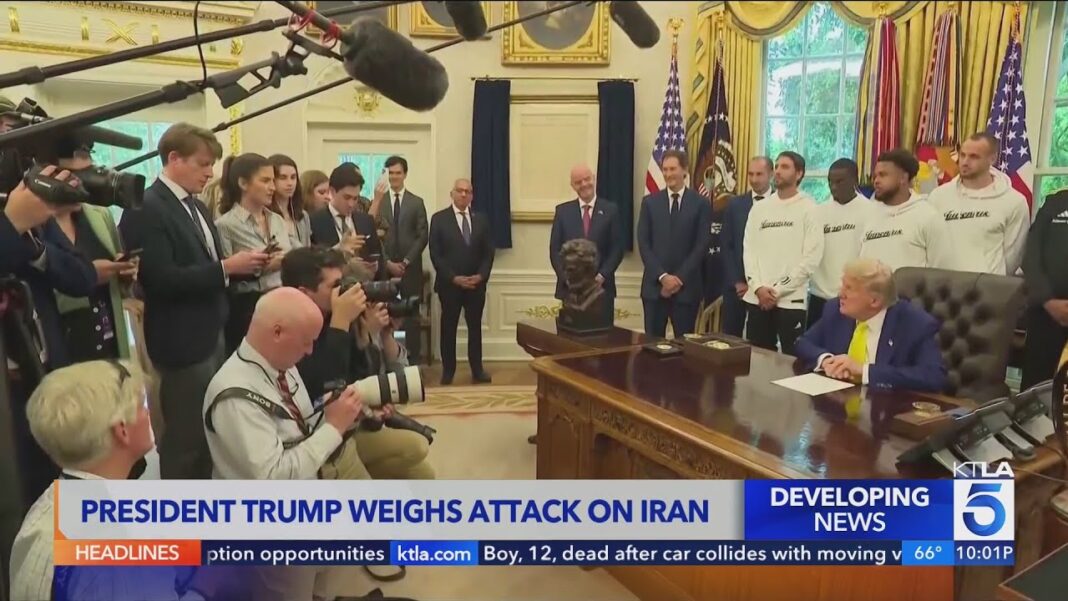
As the world watches the deepening confrontation between Israel and the Islamic Republic of Iran, President Donald J. Trump is reportedly holding back on authorizing direct U.S. airstrikes out of concern that military intervention could spiral into an uncontrollable regime collapse and usher in a new era of chaos in the region. According to a report that appeared in The New York Post, the President has drawn explicit parallels between the current dilemma and the 2011 NATO-led campaign in Libya that toppled Muammar Qaddafi — a mission Trump now views as a cautionary tale.
Multiple sources close to the Trump administration have told The New York Post that the President is weighing the risks of destabilizing Iran’s already volatile power structure. “Trump doesn’t want it to turn into Libya,” one insider revealed, emphasizing the President’s deep reservations about unleashing a sequence of events that might end in anarchy, jihadist resurgence, or even civil war within Iran’s borders.
As Israel National News reported on Thursday, the Libya analogy has become a key reference point in internal administration deliberations. After the fall of Qaddafi, Libya descended into tribal conflict, rival militias, and eventually became a haven for jihadist groups, including ISIS. Trump’s concern, aides say, is that a similar fate could befall Iran — with far graver consequences given Iran’s size, resources, and regional influence.
Sources quoted by The New York Post elaborated: “Libya was a much more extended kind of bombing commitment, and it ended up being regime change.” The President reportedly fears that an American-led air campaign, no matter how surgical, could inadvertently catalyze a power vacuum in Tehran. “You could end up installing someone even worse than Khamenei,” the source warned.
This posture aligns with President Trump’s longstanding political brand — one deeply skeptical of foreign entanglements that resemble the U.S. interventions in Iraq, Afghanistan, and Libya. According to the insider quoted in The Post, Trump is acutely aware that his political base prefers a robust America-first strategy focused on deterrence without long-term occupations or nation-building efforts. “He’s not going to get in the business of who runs Iran,” the source said. “That’s very salable to his base.”
Meanwhile, the Israeli Defense Forces (IDF) have been steadily widening their campaign against Iranian nuclear and military sites, most recently striking facilities believed to house critical components of Iran’s uranium enrichment program. According to the information provided in the Israel National News report, the IDF’s latest targets include weapons depots, research centers, and forward-operating bases controlled by the Islamic Revolutionary Guard Corps (IRGC).
Despite Washington’s hesitation, Israeli officials continue to signal that their operations will proceed with or without direct American participation. As the Israel National News report noted, Israel views Iran’s nuclear ambitions as an existential threat and considers unilateral military action a justified and necessary defense.
Still, the stakes of American involvement are significant. The U.S. possesses the only aircraft — notably the B-2 Spirit stealth bomber — capable of deploying the GBU-57 Massive Ordnance Penetrator, the 30,000-pound “bunker buster” required to destroy Iran’s deeply buried Fordow facility. Israeli aircraft do not have access to that level of firepower.
Thus, while the U.S. remains militarily indispensable to any strike on Fordow, Trump’s cautious posture has introduced a pause in what might otherwise be a synchronized escalation between Washington and Jerusalem.
White House Press Secretary Karoline Leavitt confirmed on Thursday that President Trump has not yet made a final decision, stating that the matter remains under active consideration and may be resolved “within the next two weeks.” She emphasized that the President remains open to potential diplomatic overtures from Tehran, saying there is “a substantial chance of negotiations that may or may not take place with Iran in the near future.”
Still, Leavitt was clear about the administration’s red lines. “The President’s top priority right now is to ensure that Iran cannot attain a nuclear weapon and providing peace and stability to the Middle East,” she told reporters, echoing statements previously reported by Israel National News.
The remarks suggest a dual-track strategy: keeping military options credible while leaving a diplomatic window ajar. However, skepticism abounds as to whether meaningful negotiations with Tehran are possible in the current climate, especially given Supreme Leader Ayatollah Ali Khamenei’s public defiance and Iran’s ongoing missile tests.
According to the information contained in the Israel National News report, analysts in Jerusalem are closely watching how Trump’s internal calculus evolves. Some fear that prolonged indecision could embolden Tehran, especially if Iran perceives hesitation as weakness. Others argue that Trump’s strategic ambiguity — a hallmark of his foreign policy — could be buying time for Iran’s internal factions to reassess their brinkmanship.
What remains clear is that the president is attempting to walk a fine line between decisive action and overreach. His reluctance to repeat the missteps of Libya, Iraq, and Afghanistan reflects both a political imperative and a genuine strategic concern: how to neutralize the Iranian threat without plunging the Middle East into another generation of chaos.
For now, the world waits. The Fordow and Natanz facilities remain active. Israeli jets continue to fly. And President Trump, with the power to alter the trajectory of the region, continues to weigh the cost of action against the peril of restraint. As the Israel National News report noted, in the high-stakes chessboard of the Middle East, it is the next U.S. move that could define the game.
