



|
Getting your Trinity Audio player ready...
|
By: Fern Sidman – Jewish Voice News
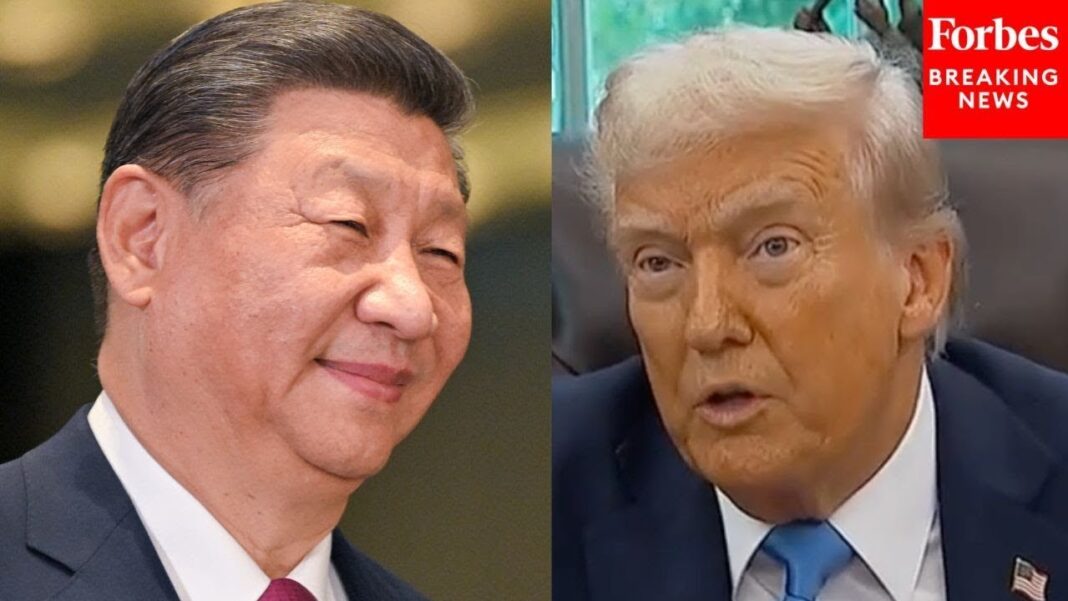
President Trump on Monday praised what he called a “truly great meeting” with Chinese President Xi Jinping, describing the talks as a breakthrough moment for U.S.–China relations and announcing a series of significant trade and energy agreements he said would “deliver prosperity and security to millions of Americans.”
In a lengthy post on Truth Social, the president said the discussions — held during his multi-nation trip to Asia — had been “tremendously successful,” underscoring what he described as the “enormous respect between our two countries.” Trump claimed the meeting yielded multiple accords and progress on several unresolved issues of “high importance.”
“There is enormous respect between our two countries, and that will only be enhanced with what just took place,” Trump wrote. “We agreed on many things, with others, even of high importance, being very close to resolved.”
Among the key outcomes Trump cited was China’s decision to resume large-scale purchases of U.S. agricultural products, including soybeans, sorghum, and other farm goods. Trump hailed the move as a major win for American farmers, framing it as the latest example of his administration’s efforts to strengthen the U.S. agricultural sector.
“I was extremely honored by the fact that President Xi authorized China to begin the purchase of massive amounts of soybeans, sorghum, and other farm products,” he wrote. “Our farmers will be very happy! In fact, as I said once before during my first Administration, farmers should immediately go out and buy more land and larger tractors.”
The president thanked Xi directly, calling the agreement a “great sign of mutual respect and economic cooperation.”
Trump also announced that China had agreed to continue the open and unrestricted flow of rare earth elements, critical minerals, and industrial magnets — resources vital to U.S. manufacturing, defense technologies, and clean energy production.
He added that the Chinese government had “strongly stated” its commitment to working with U.S. officials to curb the flow of fentanyl and its precursors into the United States, an issue that has been a central focus of American law enforcement and public health policy in recent years.
“Very significantly, China has strongly stated that they will work diligently with us to stop the flow of fentanyl into our country,” Trump wrote. “They will help us end the fentanyl crisis.”
The agreement, if implemented, would mark one of the most substantive joint commitments between the U.S. and China on the fentanyl epidemic — a crisis that has claimed hundreds of thousands of American lives and strained bilateral relations.
Perhaps most notably, Trump announced that China would begin purchasing American energy, signaling the potential for a landmark trade expansion between the world’s two largest economies. He hinted at what he described as a “very large-scale transaction” involving the purchase of oil and gas from Alaska, noting that U.S. energy officials were already coordinating to explore the deal’s feasibility.
“China also agreed that they will begin the process of purchasing American energy,” Trump said. “In fact, a very large-scale transaction may take place concerning the purchase of oil and gas from the great state of Alaska.”
The president named Chris Wright — CEO of Liberty Energy — and Doug Burgum, the governor of North Dakota, as among those who would participate in discussions with their Chinese counterparts. Trump said these talks would determine “whether such an energy deal can be worked out.”
Energy experts have described China’s potential involvement in Alaskan oil and gas projects as geopolitically significant, potentially boosting U.S. exports while diversifying China’s resource imports amid ongoing tensions with the Middle East and Russia.
Trump’s statement also highlighted his “historic trip to Asia,” during which he met with numerous regional leaders. He expressed gratitude to Malaysia, Japan, and South Korea for what he called their “generosity and hospitality,” and extended thanks to several other nations — including Australia, Canada, New Zealand, Singapore, Thailand, and Vietnam — that attended a dinner hosted by South Korean President Lee Jae-myung.
“I want to thank the great countries of Malaysia, Japan, and South Korea for being so generous, gracious, and hospitable,” Trump wrote. “Also, Australia, Canada, New Zealand, Singapore, Thailand, and Vietnam, who were at the dinner last night hosted by His Excellency Lee Jae Myung.”
He added that these diplomatic efforts were already paying economic dividends, saying “hundreds of billions of dollars are being brought into our country because of them.”
Throughout the post, Trump struck a familiar tone of economic nationalism, linking foreign trade agreements directly to domestic prosperity and emphasizing his longstanding commitment to strengthening America’s industrial base. His remarks echoed themes from his 2017–2021 presidency, during which he framed trade policy as a tool for national renewal and rural revitalization.
“The agreements reached today will deliver prosperity and security to millions of Americans,” he declared. “Our nation is strong, respected, and admired again — and the best is yet to come!”
The meeting with Xi — which Trump described as “extremely cordial and productive” — appears to signal a temporary easing of U.S.-China tensions after years of friction over trade, technology, and military posturing. While the details of the agricultural and energy agreements remain unclear, Trump’s post suggested that both sides were committed to building what he termed a “mutually beneficial” relationship.
The Truth Social announcement marks a notable revival of Trump’s diplomatic engagement with Xi, with whom he once claimed a close personal rapport. During his first term, Trump alternated between praise and sharp criticism of the Chinese leader — negotiating the Phase One Trade Agreement in 2020 while simultaneously imposing tariffs on Chinese imports and blaming Beijing for the COVID-19 pandemic.
Analysts told The Wall Street Journal that this new outreach could be part of Trump’s broader foreign policy realignment as he seeks to position himself, ahead of 2025, as the architect of renewed global economic stability.
In his post, however, Trump downplayed geopolitical tensions and focused instead on practical outcomes. He framed the discussions as an affirmation of U.S. strength and influence under his leadership.
“After this historic trip to Asia, I am now heading back to Washington, D.C.,” he concluded. “Our nation is strong, respected, and admired again — and the best is yet to come.”
Trump’s rhetoric, infused with both confidence and triumphalism, reflected his broader message of restoring American greatness through assertive diplomacy and economic leverage. The president presented the Xi meeting as a validation of his approach: that by negotiating from a position of strength, the U.S. could secure concessions that directly benefit its citizens.
If his claims bear out, the commitments from Beijing — particularly regarding fentanyl cooperation and agricultural imports — could mark a major victory for Trump’s foreign policy agenda, reinforcing his narrative that “America First” diplomacy yields tangible results.
In closing, Trump reiterated the slogan that has come to define his political movement:
“Our Nation is strong, respected, and admired again — and the best is yet to come!”
As with many of Trump’s foreign policy pronouncements, questions remain about the scope and enforceability of the agreements. Yet the tone of his post, coupled with the sweeping promises of economic gain, suggests a renewed confidence in his ability to project American strength abroad — and to bring home the spoils of negotiation.
