



|
Getting your Trinity Audio player ready...
|
By: Suzan Fraser
On Sunday, millions of voters in Turkey head to the polls to elect mayors and administrators in local elections which will gauge President Recep Tayyip Erdogan’s popularity as his ruling party tries to win back key cities it lost five years ago.
A victory for Erdogan’s party might spur the Turkish leader into pursuing constitutional changes that could allow him to rule beyond his current term’s limit.
Meanwhile, retaining the key cities’ municipalities would help invigorate Turkey’s opposition, left fractured and demoralized following a defeat in last year’s presidential election.
Here’s a deeper look at what’s at stake and what the results could hold for Turkey’s future.
In the last local elections held in 2019, a united opposition won the municipalities of the capital Ankara and the commercial hub of Istanbul, ending the ruling party’s 25-year hold over the cities.
The loss of Istanbul especially was a major blow to Erdogan, who began his political career as mayor of the metropolis of nearly 16 million in 1994.
Erdogan has named Murat Kurum, a 47-year-old former urbanization and environment minister, to run against incumbent mayor, Ekrem Imamoglu — a popular politician from the center-left Republican People’s Party, or CHP. Imamoglu has been touted as a possible presidential candidate to challenge Erdogan.
This time around, however, Imamoglu, 52, is running in the local elections without the support of Turkey’s main pro-Kurdish party or the nationalist IYI Party who are fielding their own candidates.
Meanwhile, a new religious-conservative party, the New Welfare Party, or YRP, has also thrown its hat into the ring. Appealing to conservative and religious voters who have been disillusioned with Erdogan’s handling of the economy, it is expected to steal some votes from Erdogan’s candidates.
Opinion polls point to a neck-and-neck race between Imamoglu and Kurum who have both promised infrastructure projects to render buildings earthquake-proof and to ease the city’s chronic traffic congestion.
The opposition is widely expected to maintain its hold on Ankara where the incumbent mayor Mansur Yavas, who has also been named as a future presidential candidate, remains popular.
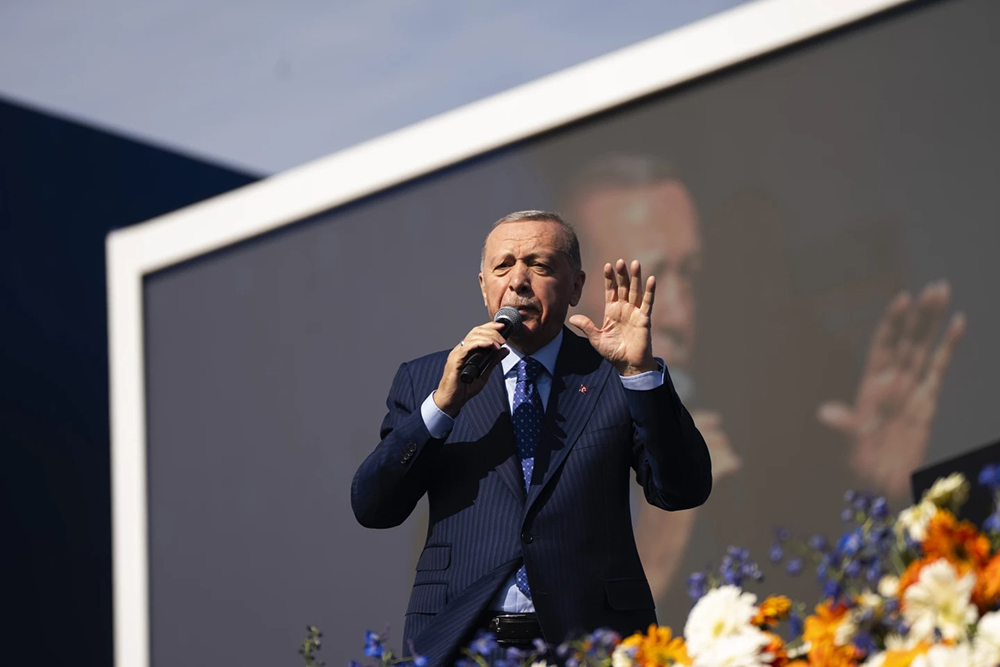
Leaving nothing to chance, Erdogan, who has been in power as prime minister and then as president for more than two decades, has been holding election rallies across the country, campaigning on behalf of candidates running for mayor.
Analysts say winning back Istanbul and Ankara and achieving a strong showing in the ballots would stiffen Erdogan’s resolve to introduce a new constitution that could allow him to rule beyond 2028 when his current term ends. The current constitution sets a two-term limit on the presidency. Erdogan, 70, ran for a third term last year, citing a technicality, because the country switched to a presidential system in 2018 and his first term was held under the previous system.
Erdogan and his allies don’t currently have sufficient seats in parliament to enact a new constitution, but another electoral triumph may sway some conservative opposition parliamentarians to switch sides, analysts say.
Earlier this month, Erdogan said Sunday’s election would be his last according to the constitution. Critics see his comments as a ploy to win sympathy votes of supporters reeling from a cost-of-living crisis, as well as a strategy to push for the constitutional amendments.
The alliance’s supporters were left demoralized after it failed to unseat Erdogan despite the economic turmoil and the fallout from a catastrophic earthquake.
(AP)
