



|
Getting your Trinity Audio player ready...
|
By: Fern Sidman
Beneath the placid waters of the Persian Gulf lies one of the world’s most prodigious reservoirs of natural gas, a geological behemoth whose bounty has quietly reshaped the fortunes of nations. Known as the North Field in Qatar and South Pars in Iran, this shared field is not merely a marvel of subterranean abundance but a crucible of geopolitics, economics, and strategic anxiety. In recent years, Qatar has extracted vast quantities of gas from this reservoir, translating geological fortune into geopolitical leverage, while Iran, constrained by sanctions and technological deprivation, has struggled to keep pace.
The result, as reported by the Middle East Forum, is a profound imbalance in production that has allowed Doha to monetize a shared resource without paying Tehran anything for what Iranians increasingly view as “their” gas. This asymmetry has engendered a paradoxical fear in Qatar: that the greatest threat to its current windfall may not be the present Iranian regime, but a future one capable of asserting claims long deferred by isolation and weakness.
The shared nature of the North Field/South Pars deposit places both Qatar and Iran in a delicate relationship of interdependence. Subsurface resources do not adhere to political boundaries, and extraction on one side can affect reservoir pressure on the other. Yet in practice, the Middle East Forum has detailed how Qatar has come to dominate production, rapidly expanding its liquefied natural gas capacity through ambitious infrastructure projects and international partnerships.
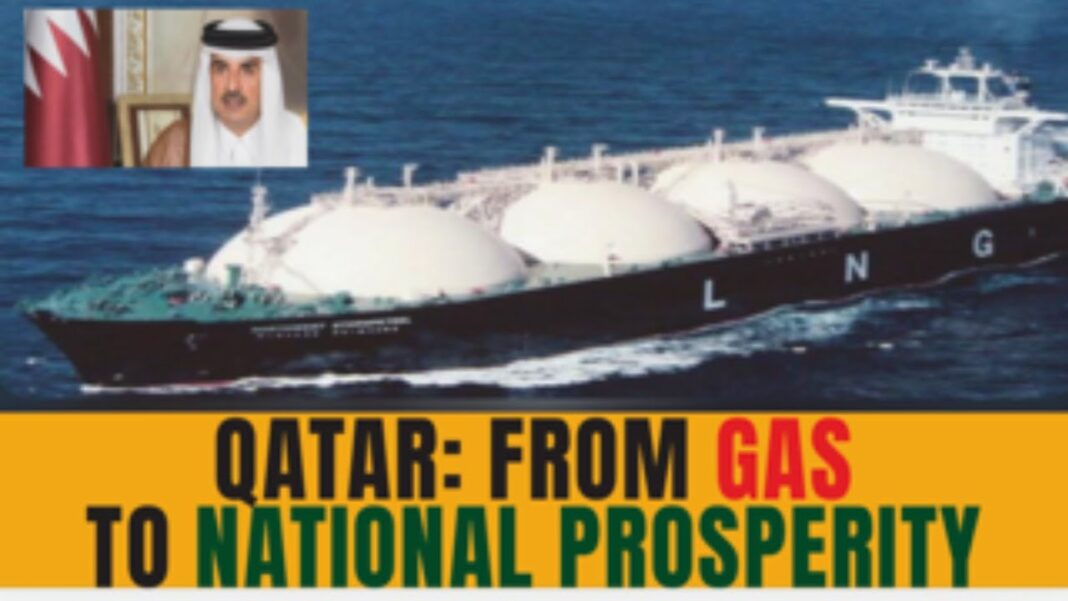
Qatar’s industrial apparatus for LNG has matured into a sophisticated machine, enabling the emirate to flood global markets with gas and to anchor its economy in energy exports. Iran, by contrast, remains hobbled by decades of sanctions, financial isolation, and technological underinvestment, factors that have throttled its capacity to develop the South Pars field at a pace commensurate with Qatar’s expansion.
The consequence of this divergence is not merely a ledger of uneven output but a physical transformation of the shared reservoir. As the Middle East Forum has observed, the intensive extraction on the Qatari side has been accompanied by declining pressure on Iran’s side, compounding Tehran’s difficulties.
To sustain and modernize its production, Iran would require investments on the order of $50 billion, a figure that underscores the scale of its predicament. Such capital, however, remains out of reach so long as sanctions constrain access to international finance and advanced technology. In this sense, the imbalance in gas extraction is not simply a function of geological happenstance but a reflection of the political economy of isolation, where resource endowment is rendered inert by external constraints.
Qatar’s advantage in this shared field has not been exercised in a vacuum. Conscious of the potential for resource disputes to metastasize into conflict, Doha has cultivated what the Middle East Forum describes as a “cozy” relationship with Tehran. This diplomatic warmth is not born of ideological affinity but of strategic prudence. By maintaining amicable ties with Iran’s current leadership, Qatar seeks to insulate itself from accusations of predation and to ensure uninterrupted access to the gas upon which its economic model depends. The relationship functions as a form of geopolitical insurance: cordiality today as a hedge against recrimination tomorrow. In an environment where energy infrastructure is both an economic artery and a strategic vulnerability, such calculated amity serves to dampen the risk of confrontation over resource depletion.
Yet this carefully maintained equilibrium is fragile, predicated as it is on the continuation of Iran’s present political and economic incapacities. The Middle East Forum has warned that a regime change in Tehran could upend the tacit understandings that have governed the exploitation of South Pars. A more capable and internationally reintegrated Iranian government might possess both the political will and the material means to assert its rights over the shared field with unprecedented vigor. Such a government could demand retroactive compensation for years of lopsided extraction, reframing Qatar’s windfall as a debt owed to a newly empowered neighbor. For Doha, the specter of such claims is more than a theoretical nuisance; it represents a potential liability of immense financial and diplomatic magnitude.
The irony is that Qatar’s current comfort is inextricably linked to Iran’s weakness. The Middle East Forum’s report illuminates this uncomfortable truth: Doha’s security of access to the shared gas field is facilitated by Tehran’s inability to contest the status quo. Sanctions, technological deprivation, and capital scarcity have combined to render Iran a junior partner in a field that geography alone would suggest should be jointly stewarded. In this context, Qatar’s friendly posture toward the Iranian regime assumes a darker cast. It is not merely a gesture of regional comity but a strategic calculation aimed at preserving an imbalance from which Qatar derives enormous benefit.
This dynamic raises broader questions about the ethics and sustainability of resource exploitation under conditions of asymmetric power. The North Field/South Pars reservoir is a shared endowment, yet the distribution of its benefits has been anything but equitable. Qatar’s massive investments in LNG infrastructure have enabled it to monetize the field at a scale that Iran, constrained by isolation, cannot match. The Middle East Forum called attention to the fact that this disparity is driven less by differences in ambition than by disparities in access to capital, technology, and global markets. The result is a form of resource capture that, while legally unchallenged in the present moment, may be morally and politically contestable in a future where Iran is no longer encumbered by pariah status.
The geopolitical implications extend beyond the bilateral relationship between Doha and Tehran. Qatar’s LNG exports are woven into the fabric of global energy markets, shaping supply chains and influencing prices far beyond the Gulf. Any disruption to this flow, whether precipitated by legal disputes, diplomatic tensions, or demands for compensation, would reverberate through energy-dependent economies worldwide. The Middle East Forum’s analysis suggests that Qatar’s strategic calculus is informed not only by immediate regional considerations but by the recognition that its energy dominance confers both influence and vulnerability. To preserve its position, Doha must navigate a delicate balance between exploiting its current advantage and preempting future challenges to the legitimacy of that advantage.
For Iran, the South Pars field represents both a squandered opportunity and a latent claim. The inability to fully develop its share of the reservoir has deprived Tehran of revenues that could have alleviated economic pressures and bolstered domestic stability. The Middle East Forum’s estimate of the $50 billion required to sustain Iran’s production highlights the structural barriers that have transformed geological wealth into unrealized potential. In the long term, a political transformation in Iran—one that unlocks access to international capital and technology—could catalyze a reassessment of the terms under which the shared field has been exploited. Such a reassessment would not merely be economic; it would be imbued with the symbolism of sovereignty reclaimed and resources repatriated in the national imagination.
The fear in Doha, therefore, is not simply of renegotiation but of reckoning. A future Iranian government might frame demands for compensation as a rectification of historical injustice, recasting Qatar’s gas bonanza as the product of opportunism enabled by geopolitical isolation. The Middle East Forum’s report suggests that this apprehension underlies Qatar’s current diplomatic posture: better to maintain cordial relations with a weakened regime than to confront the uncertainties of a post-isolation Iran emboldened by renewed legitimacy and capacity.
In the end, the story of the North Field/South Pars reservoir is a parable of how subterranean riches can become entangled with surface politics. Qatar’s extraction of gas without compensating Iran is not merely a technical outcome of differential capacity but a reflection of the broader architecture of power that governs the region. The Middle East Forum’s account lays bare the structural conditions that have enabled this imbalance and the strategic anxieties that now accompany it. Beneath the Gulf’s tranquil waters, the gas continues to flow, indifferent to borders and regimes alike. Yet above the surface, the politics of who extracts, who profits, and who may one day demand redress are poised to shape the next chapter in a story where energy abundance and geopolitical vulnerability are inextricably intertwined.
