



|
Getting your Trinity Audio player ready...
|
By: David Avrushmi
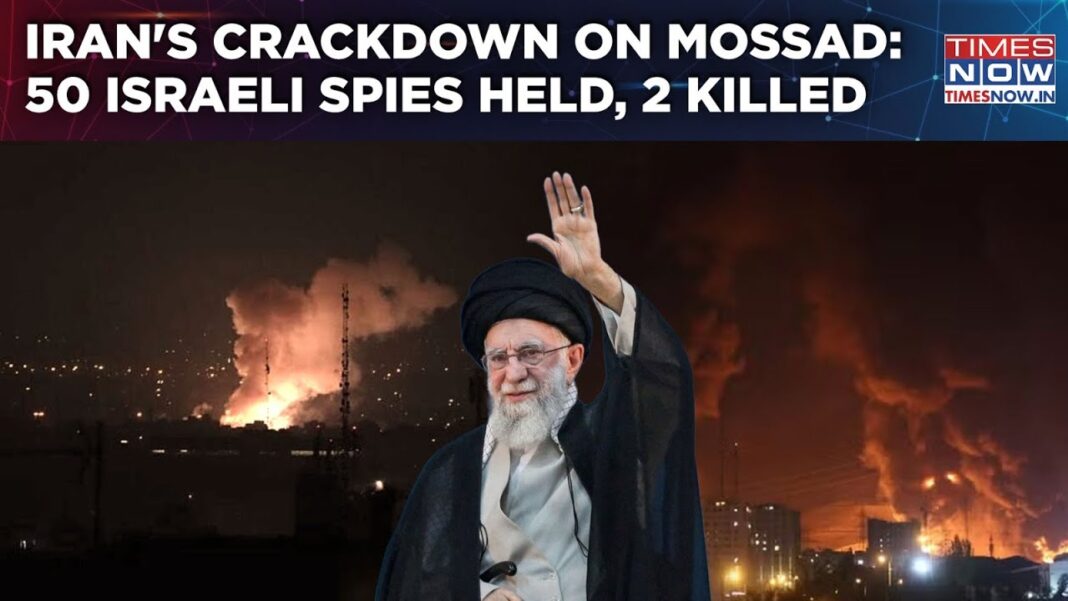
Iranian authorities announced over the weekend that they had detained dozens of individuals across the country accused of espionage and collaboration with Israel, a development that underscores the intensifying shadow conflict between Tehran and Jerusalem amid the broader regional war. The arrests, reported by several Iranian state-linked media outlets, allegedly involve multiple networks suspected of transmitting sensitive intelligence related to military installations, infrastructure sites, and public institutions.
The sweeping operation, which reportedly spanned several Iranian provinces, comes as tensions between Israel and Iran remain at a historic high during the ongoing Middle Eastern conflict linked to Operation Epic Fury, the coordinated campaign involving Israeli and American military strikes against Iranian strategic assets. According to a report on Sunday at World Israel News, Iranian officials claim the suspects were part of organized espionage rings that provided Israel with detailed information about potential targets inside the Islamic Republic.
The arrests also highlight a deeper and more politically sensitive issue for Tehran: growing indications that some Iranian citizens may be cooperating with Israel in opposition to the regime, a phenomenon that Iranian authorities have repeatedly attempted to suppress.
Iran’s Ministry of Intelligence confirmed that security forces had detained what it described as “enemy operatives” in several provinces across the country. Officials alleged that the individuals were working either directly or indirectly with Israeli intelligence services.
According to the World Israel News report, the arrests appear to have targeted several alleged espionage cells operating simultaneously in different regions of Iran. Iranian investigators claim these groups were tasked with identifying strategic locations and relaying precise geographic coordinates to Israeli operatives.
Tasnim, a semi-official Iranian news agency closely aligned with government institutions, reported that authorities dismantled two separate networks consisting of ten members each.
One of the networks was reportedly discovered in Mazandaran province, located along the southern coast of the Caspian Sea. The second network was uncovered in Khorasan Razavi province in northeastern Iran, a region that includes the city of Mashhad, one of the country’s largest urban centers and a major religious and political hub.
According to Iranian officials, the individuals arrested in these provinces allegedly gathered intelligence about military bases, industrial facilities, and infrastructure sites considered vital to national security.
Authorities also claimed the suspects transmitted information regarding academic institutions, research centers, and public locations, suggesting that Israeli intelligence may have sought a wide array of data points related to Iran’s military, economic, and scientific capabilities.
These allegations which were widely circulated in Iranian media and subsequently reported by World Israel News, noted that Iranian officials frequently accuse domestic opponents and dissidents of espionage during periods of heightened geopolitical tension.
Separate reports emerged from West Azerbaijan province, where prosecutors in the northwestern city of Urmia announced the arrest of 20 additional suspects accused of collaborating with Israel.
According to Fars News Agency, a media outlet affiliated with Iran’s Islamic Revolutionary Guard Corps (IRGC), the detainees allegedly supplied intelligence concerning the locations of military, police, and security facilities.
Authorities claimed the suspects provided sensitive information that could potentially assist foreign forces in identifying strategic targets for future attacks.
As reported by World Israel News, Iranian officials have long maintained that Israel operates covert intelligence networks inside Iran, relying on local contacts to gather information about military developments and infrastructure vulnerabilities.
Although Tehran has frequently announced similar arrests in the past, independent verification of the claims has often proven difficult due to restrictions on foreign journalists and the opaque nature of the country’s security apparatus.
Iranian intelligence officials also announced the detention of three individuals in Khuzestan province, a strategically important region in southern Iran that borders Iraq and hosts a significant portion of the country’s oil infrastructure. According to Iranian authorities, the suspects were described as members of what officials called a “terrorist team.”
Security forces accused the group of carrying out armed attacks against government facilities and security personnel, though detailed information about the alleged incidents was not immediately released.
Reports cited by World Israel News indicated that Iranian officials linked the group’s activities to foreign intelligence services, though the exact nature of the alleged collaboration has not been fully disclosed.
Khuzestan has long been considered a sensitive area for the Iranian government due to its economic importance and ethnic diversity, and authorities have frequently accused separatist or foreign-backed groups of attempting to destabilize the region.
The wave of arrests comes amid mounting reports that Israel may be receiving assistance from inside Iran in identifying targets for military strikes.
According to a recent report by The Wall Street Journal, Israeli intelligence agencies have been able to obtain information from ordinary Iranian citizens regarding potential targets.
The report cited a senior Israeli security official who said that Iranians have submitted tips through Persian-language social media channels operated by Israeli authorities.
These accounts reportedly allow individuals inside Iran to transmit information anonymously, which Israeli intelligence services then verify through additional sources before acting upon it.
As noted by World Israel News, such reports have fueled speculation that dissatisfaction with Iran’s ruling regime may be prompting some citizens to cooperate with Israel.
Iranian officials, however, have dismissed these suggestions as propaganda and insist that the individuals arrested were acting as agents of foreign intelligence services rather than independent whistleblowers.
The arrests highlight the growing intensity of the covert intelligence battle between Iran and Israel—a struggle that has unfolded for decades through cyber operations, espionage, sabotage, and targeted strikes.
Israel has repeatedly accused Iran of orchestrating attacks through proxy groups such as Hezbollah, Hamas, and Islamic Jihad, while Tehran has blamed Israel for a series of covert operations inside Iran, including the assassination of nuclear scientists and sabotage of nuclear facilities.
World Israel News reported that Israeli officials have neither confirmed nor denied the existence of internal networks providing intelligence from inside Iran.
However, analysts say that the success of several Israeli strikes on sensitive Iranian targets in recent years suggests that detailed information about military installations and infrastructure sites has likely been obtained from sources within the country.
For Iran’s leadership, the reported espionage arrests carry both security and political implications. Public acknowledgment that individuals inside the country may be assisting Israel risks undermining the regime’s claims of national unity and loyalty.
At the same time, such announcements serve as a warning to potential dissidents and reinforce the government’s narrative that foreign powers are actively attempting to destabilize the Islamic Republic.
State media often publicize espionage arrests as evidence of vigilance by Iran’s intelligence services and as a means of deterring further cooperation with foreign agencies.
Yet analysts note that the repeated emergence of such cases may also reveal underlying tensions within Iranian society.
Economic hardship, political repression, and growing dissatisfaction with the government have fueled periodic protests in recent years.
Some experts suggest that these factors could contribute to a willingness among certain individuals to assist foreign adversaries of the regime.
The arrests come at a moment of extraordinary geopolitical turbulence in the Middle East.
Israel and the United States have intensified military operations targeting Iranian nuclear and missile infrastructure, while Tehran has responded with missile attacks and support for regional proxy forces.
In this environment, intelligence gathering has become a critical component of military strategy.
Precise information about military installations, weapons facilities, and infrastructure networks can significantly enhance the effectiveness of air strikes and covert operations.
As World Israel News has reported, the alleged espionage networks uncovered by Iranian authorities illustrate how deeply the conflict has penetrated into the domestic sphere.
The battlefield is no longer confined to distant front lines or aerial engagements—it has extended into the shadows of intelligence operations and clandestine information exchanges.
Whether the individuals arrested by Iranian authorities were indeed members of organized espionage networks or victims of political crackdowns remains difficult to determine.
What is clear, however, is that the struggle between Iran and Israel has entered a new and increasingly complex phase.
Beyond missiles and military operations, the conflict now includes an expanding web of intelligence gathering, covert communication, and internal resistance.
As reported by World Israel News, the unfolding situation suggests that the confrontation between the two nations is being fought not only in the skies and on distant battlefields but also within Iran itself—through the quiet and dangerous work of espionage.
And as long as that shadow war continues, the line between domestic security and international conflict will remain perilously thin.
