



|
Getting your Trinity Audio player ready...
|
Jared Evan
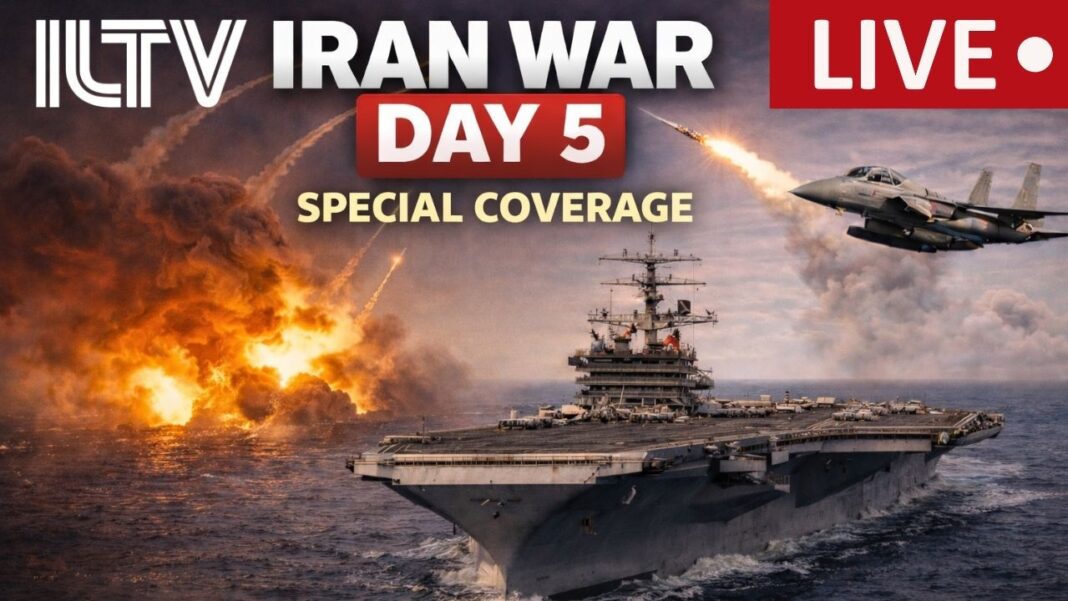
(TJV NEWS) What began as a targeted military operation has spiraled into one of the most volatile regional conflicts in decades, dragging the Middle East — and parts of Europe — into a widening confrontation.
As Axios points out, the war ignited when the United States and Israel launched coordinated strikes aimed at crippling Iran’s military and nuclear infrastructure. Tehran’s retaliation was swift and expansive, transforming a bilateral clash into a regional showdown.
Rather than focusing solely on Israel, Iran broadened its response across the Gulf. Missiles and drones were launched toward U.S. installations and allied nations, putting countries that had hoped to avoid direct involvement squarely in the line of fire.
Among the hardest hit was Qatar, where key energy infrastructure reportedly came under attack. The small but strategically vital state — home to major U.S. military assets — became a central theater in the unfolding crisis. The United Arab Emirates also faced incoming projectiles, while Saudi Arabia, Bahrain, Kuwait and Oman reported threats or attempted strikes tied to the expanding hostilities.
Meanwhile, the conflict reignited long-smoldering proxy fronts. In Lebanon, the Iranian-backed militant group Hezbollah opened a northern front against Israel, prompting retaliatory strikes and raising fears of a full-scale second war on Israel’s border.
The violence did not stop there. According to Axios, Iranian strikes or related military activity also touched Iraq and even Cyprus, where Western military facilities are located. That development has sharpened concern in Europe, particularly in United Kingdom, France and Germany, all of which have personnel or strategic interests at risk.
Beyond the battlefield, the global economic stakes are rising. The Strait of Hormuz — the narrow maritime artery through which a significant share of the world’s oil flows — has become a focal point of anxiety. Any sustained disruption there could send shockwaves through global energy markets, especially as Gulf gas exports face uncertainty.
What stands out most in this war’s early days is the speed of escalation. What might have remained a contained exchange between long-standing adversaries instead metastasized into a multi-front confrontation involving Gulf monarchies, Western powers and Iranian proxies.
As Axios underscores, the map of the conflict expanded in a matter of days — not months — underscoring just how interconnected the region’s security architecture has become. With air defenses active across multiple capitals and retaliatory options still on the table, the trajectory now hinges less on who fired first and more on who decides to widen the circle next.
