



|
Getting your Trinity Audio player ready...
|
By: Fern Sidman
Satellite imagery now emerging from multiple independent monitoring efforts paints a revealing portrait of an Islamic Republic moving swiftly to repair, fortify, and in some cases entomb elements of its military and nuclear infrastructure damaged in recent Israeli and American strikes. As World Israel News reported on Wednesday, the pace and character of this reconstruction effort suggest not merely routine maintenance after wartime damage, but a deliberate campaign to harden sensitive facilities against future attack while diplomatic engagement with Washington proceeds in parallel. The juxtaposition of concrete and conversation—of accelerated fortification alongside stalled negotiations—has become a defining motif of Iran’s strategic posture in the current phase of regional tension.
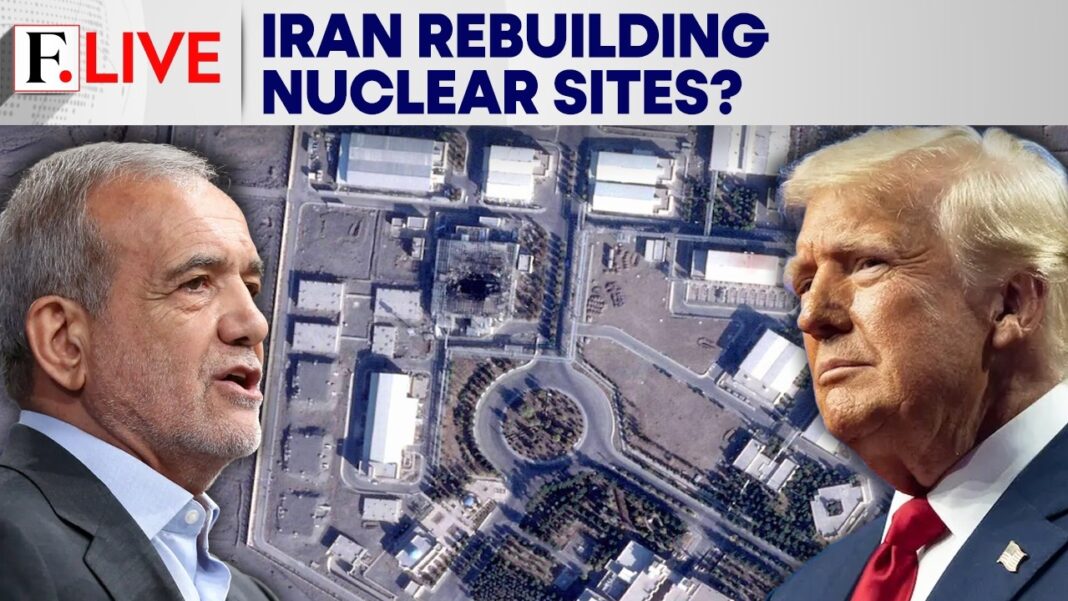
The most striking example of this subterranean turn is visible at the sprawling Parchin military complex southeast of Tehran, long a focal point of international concern. Analysts reviewing high-resolution satellite imagery say that a structure reportedly struck by Israel in October 2024 has been sealed beneath a thick layer of concrete and subsequently covered with soil. The effect is both physical and epistemic: not only is the building now shielded from aerial munitions, but its very outline has been erased from the surface, complicating the work of intelligence agencies that rely on visual cues to track changes on the ground.
The World Israel News report cited specialists who assess that the concealed structure may incorporate a high-explosives containment vessel—an installation relevant to advanced conventional weapons testing and, potentially, to research with nuclear implications. The implication is unsettling: what was once exposed to the sky has been interred beneath it, transformed into a bunker-like installation whose contents are increasingly opaque.
This pattern of burial and reinforcement appears to be repeating itself across Iran’s strategic geography. At the Isfahan nuclear complex, where the United States struck tunnel entrances last year, imagery now shows those access points filled with earth. The act of backfilling is not merely cosmetic. By collapsing or obscuring entrances, Iran complicates any future attempts to penetrate the site, whether through air-delivered ordnance or ground-based operations. Similarly, at the Natanz uranium enrichment facility—long the centerpiece of international anxieties over Iran’s nuclear ambitions—analysts have observed work to strengthen entrances to underground passages. These measures appear calibrated to limit exposure to airstrikes and to frustrate the feasibility of commando-style incursions, thereby preserving Iran’s most sensitive capabilities even under sustained pressure.
Missile installations, too, are being tended with methodical urgency. At the Shiraz South missile base, satellite data reveals rebuilding at structures linked to command and logistics functions that were damaged during last year’s fighting. Near Qom, a missile base shows newly installed roofing over buildings previously struck. Experts caution that while reconstruction is visibly underway, the facilities do not yet appear to have regained full operational capacity. The scaffolding of recovery is present, but the machinery of readiness may still lag behind. This distinction matters, for it underscores the temporal dimension of Iran’s strategy: reconstruction is both an act of resilience and a race against the clock, undertaken in anticipation of a future in which hostilities may resume.
The Institute for Science and International Security, in a recent assessment highlighted by World Israel News, interprets these activities as part of a broader Iranian doctrine of “hardening” sensitive locations. The addition of concrete shielding and soil coverage at sites described as sensitive and previously bombed reflects an intention not merely to repair damage, but to alter the architectural logic of vulnerability itself. Facilities are being reshaped to absorb punishment, to survive strikes that might once have been decisive. In this reading, reconstruction is not a return to the status quo ante but an evolution toward a more survivable posture—one that preserves leverage in negotiations by ensuring that Iran’s strategic assets remain intact and, therefore, bargaining chips on the diplomatic table.
Independent experts cited in an analysis by The New York Times examined roughly two dozen sites struck by Israel or the United States during the twelve-day conflict last June and found evidence of construction or repair work at more than half of them. The breadth of this activity suggests a coordinated national effort rather than ad hoc local initiatives. Iran is not merely patching holes; it is systematically reconfiguring the physical infrastructure of its deterrent. The strategic calculus is evident: by reinforcing and concealing key facilities, Tehran seeks to raise the cost and complexity of any future military action against it, thereby strengthening its hand in ongoing diplomatic engagements.
Yet the timing of these efforts introduces a paradox. As the World Israel News report emphasized, the fortification campaign unfolds even as diplomatic channels between Tehran and Washington remain open, however tenuous. The optics of pouring concrete over damaged sites while negotiators trade proposals spotlights a deep mistrust. Iranian officials may publicly affirm a commitment to dialogue, but the earthworks at Parchin and the reinforced tunnels at Natanz speak to an expectation of renewed confrontation. This dual-track approach—talks in conference rooms, fortresses in the desert—reflects a strategic culture shaped by decades of sanctions, covert action, and intermittent military exchanges. For Tehran, diplomacy and defense are not sequential phases but concurrent tracks, each hedging against the failure of the other.
From Jerusalem’s vantage point these developments reinforce long-standing concerns about Iran’s intentions. The burial of facilities beneath layers of concrete and soil is read not as a benign act of post-conflict repair but as an effort to entrench capabilities that threaten regional stability. Israeli strategists have long argued that the window for preventing Iran from achieving irreversible nuclear and missile capacities narrows as facilities move deeper underground and become more resilient. The current wave of reconstruction thus heightens the urgency of intelligence collection and strategic planning, even as policymakers weigh the risks of renewed military action against the potential benefits of diplomatic containment.
Washington, too, confronts a dilemma. On the one hand, the visible hardening of Iranian sites complicates any future military options, potentially requiring greater resources and higher risks to achieve comparable effects. On the other hand, the continuation of repair and fortification amid negotiations raises questions about Tehran’s good faith. World Israel News has pointed out that such actions may be designed to buy time—stalling talks while altering the physical facts on the ground. The tweet by analyst David Albright, noting that Iran has been “busy burying the new Taleghan 2 facility” as negotiations drag on, encapsulates this concern. The facility, he warned, may soon become an “unrecognizable bunker,” offering significant protection from aerial strikes. The implication is that diplomacy, if protracted without substantive outcomes, may inadvertently provide cover for a strategic transformation that diminishes the efficacy of future pressure.
The technical aspects of Iran’s reconstruction efforts also warrant attention. The incorporation of high-explosives containment vessels at sites like Parchin speaks to the dual-use nature of much of Iran’s military-industrial complex. Such installations can serve legitimate conventional testing purposes while also enabling research with potential nuclear applications. This ambiguity complicates international monitoring regimes, which must distinguish between permissible activities and those that edge toward prohibited domains.
The World Israel News report indicated that the very design choices now being implemented—subterranean facilities, reinforced entrances, layered shielding—are optimized to obscure intent as much as to protect assets. In this sense, architecture becomes a language of strategic ambiguity, conveying resilience without overt declaration of purpose.
The broader regional implications of Iran’s fortification campaign extend beyond the immediate Israel-Iran axis. Neighboring states, many of which host U.S. forces or cooperate with Western intelligence, are acutely aware that hardened Iranian facilities could embolden Tehran’s posture in proxy conflicts and regional power projection. Missile bases restored and shielded today may underpin deterrence calculations tomorrow, affecting the behavior of actors across the Levant, the Gulf, and beyond. The World Israel News report framed these developments as part of a shifting strategic equilibrium in which physical infrastructure, diplomatic maneuvering, and proxy dynamics intersect.
Ultimately, the satellite images tell a story of a state that has absorbed blows and is now adapting its posture in anticipation of future trials. Iran’s decision to entomb damaged facilities beneath concrete and soil is both a material response to vulnerability and a symbolic assertion of endurance. Whether this subterranean turn will succeed in deterring future strikes, or instead provoke more aggressive countermeasures, remains uncertain. What is clear is that the physical landscape of Iran’s strategic sites is being reshaped in ways that will reverberate through diplomatic and military calculations alike.
As negotiations with Washington continue—fragile, halting, and shadowed by mutual suspicion—the earth-moving equipment at Parchin and the reinforced tunnels at Natanz serve as mute interlocutors in a parallel dialogue. They speak of a regime preparing for the worst even as it negotiates for the best.
