



|
Getting your Trinity Audio player ready...
|
Edited by: Fern Sidman
After accusing Russia of committing war crimes in Ukraine during a speech before the Arizona state legislature, a Russian-Jewish dissident was sentenced to 25 years in prison for treason on Monday, according to a report on the JTA web site.
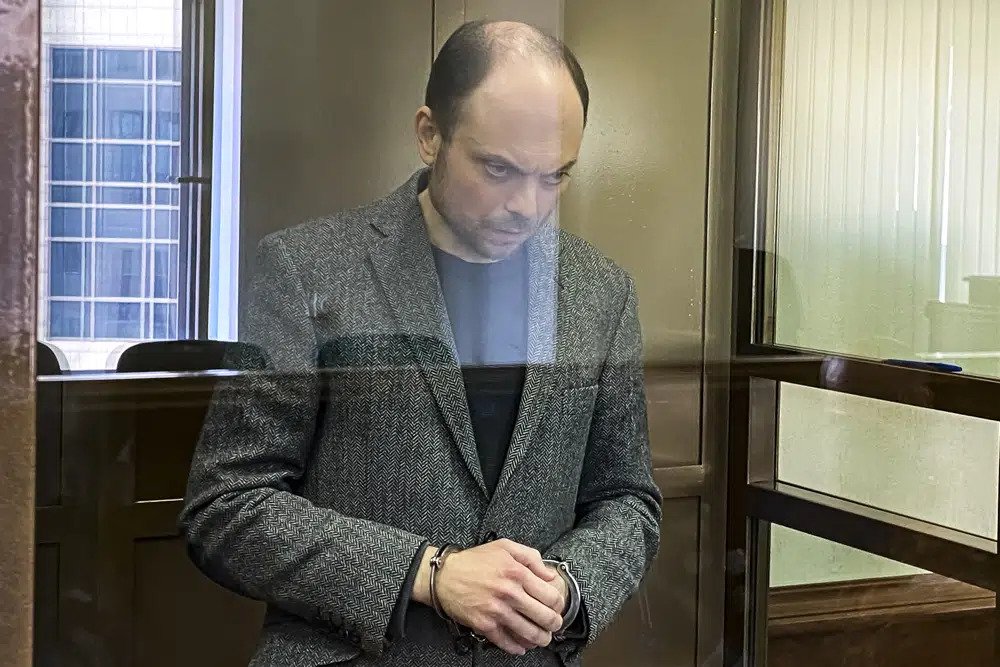
Vladimir Kara-Murza, 41, received the harshest sentence given to a critic of the Kremlin in the 14 months since Russia first invaded Ukraine, the JTA reported. His case has spurred the interest of human rights organizations as well as prominent Jewish activists who have thrown their support behind him. The AP reported that they have denounced the verdict and demanded his release.
The AP reported that Amnesty International denounced Kara-Murza’s sentence as “yet another chilling example of the systematic repression of civil society, which has broadened and accelerated under the Kremlin since Russia’s invasion of Ukraine last year.” The group declared Kara-Murza a prisoner of conscience, convicted for his political beliefs, and demanded his immediate and unconditional release.
Memorial, one of Russia’s oldest and most prominent human rights organizations that was named a co-winner of the 2022 Nobel Peace Prize along with human rights defenders from Ukraine and Belarus, also has named Kara-Murza as a political prisoner, the AP reported.
Memorial’s head Yan Rachinsky described the sentence as “monstrous,” according to the AP report. He added that it reflected the authorities’ fear of criticism and “marked a difference between today’s Russia and civilized countries.”
The political activist and journalist, who twice survived poisonings he blamed on Russian authorities, has rejected the charges against him as punishment for standing up to President Vladimir Putin and likened the proceedings to the show trials under Soviet dictator Josef Stalin, according to the AP report.
Former Soviet Jewish dissident Natan Sharansky, who met in the past with Kara-Murza, has also condemned Russia’s treatment of him, according to the JTA report. Sharansky spent nine years in Soviet prison due to his activism, and recently told the Times of Israel that Kara-Murza’s prosecution was “evidence that Russia has returned to Stalinist times.” The JTA also reported that one of the items Kara-Murza has been allowed to keep in prison is a copy of “Fear No Evil,” Sharansky’s 1988 memoir about his time in the gulag.
“Putin’s case against Vladimir Kara-Murza is a case against democracy, human rights and civil society in Russia,” Sharansky tweeted last week, the JTA reported. “All of us who want to see Russia shed its current dictatorial path and the shadow it casts over Europe, must stand with Kara-Murza today.”
Kara-Murza reacted calmly as the judge read the verdict and sentence in a quick monotone, the AP reported. His lawyer, Maria Eismont, later quoted him as telling her: “My self-esteem has risen: I realized that I have done everything right. Twenty-five years is the highest appraisal that I could get for doing what I did and what I believed in, as a citizen, a patriot and a politician.”
The AP also reported that Kara-Murza’s wife, Evgenia, who lives in the U.S. with their three children, tweeted after the verdict: “A quarter of a century is an ‘A+’ for your courage, consistency and honesty in your years-long work. I am infinitely proud of you, my love, and I’m always by your side.”
Kara-Murza’s sentence came after years of tensions between him and Putin’s government that recently culminated in his urging for the West to impose sanctions on Russia as punishment for its war in Ukraine, the JTA reported.
In his 17-minute speech before lawmakers in Arizona in March 2022, Kara-Murza said, “There are millions of people in my country who fundamentally reject and fundamentally disagree with everything that the Putin regime represents and stands for, from the kleptocracy and thievery to the abuses and the repressions and the crimes against humanity that are being committed, “ the AP reported. He was invited to address the law making body by the Phoenix Committee on Foreign Relations.
Arizona state Rep. Marcelino Quiñonez, a Democrat and House Minority Whip, said “It was an absolute honor for me to witness his courage last year when he addressed the House,” the AP reported.
Days after the invasion of Ukraine, Russia adopted a law criminalizing spreading “false information” about its military. The AP reported that authorities have used the law to stifle criticism of what the Kremlin calls its “special military operation.”
Kara-Murza was initially only charged with spreading “false information” about the military, but later the authorities added charges of working with an “undesirable” organization — also a criminal offense — and treason, the AP report said. The sweeping campaign of repression is unprecedented since the Soviet era, effectively criminalizing independent reporting on the conflict and any public criticism of the war.
The AP also reported that another prominent opposition figure, Ilya Yashin, was sentenced to 8½ years in prison last year on charges of spreading false information about the military.
The Raoul Wallenberg Center for Human Rights, a Canada-based consortium of human rights NGOs named after the diplomat who rescued 100,000 Jews during the Holocaust, and where Kara-Murza is a senior fellow, condemned his sentencing on Twitter and called the charges a “sham,” the JTA reported.
“His unlawful imprisonment cannot go unanswered,” the center said in a statement. “We must not relent until Vladimir is free. His wife and children need him free. Russia needs him free. The world needs him free.”
Also in a statement that was released, former Canadian Attorney General Irwin Cotler, who is Jewish, has also come to Kara-Murza’s defense, saying in a statement, “Vladimir’s conviction represents the criminalization of freedom in Putin’s Russia and is a conviction of the country’s corrupt courts,” according to the JTA report.
The AP reported that last month, a Russian court convicted a father over social media posts critical of the war and sentenced him to two years in prison. His 13-year-old daughter, who drew an antiwar sketch at school, was sent to an orphanage. The AP also reported that days later, Russia’s security service arrested Evan Gershkovich, an American reporter for The Wall Street Journal, on espionage charges.
Gershkovich was arrested on espionage charges last month and could face up to 20 years in prison; his detention has been widely condemned by Western officials and organizations as an attack on press freedom, and Jewish groups have rallied to his defense, as was reported by the JTA. Analysts believe Gershkovich was targeted by the Kremlin for his reporting on its invasion of Ukraine.
A recent report by the Russian Supreme Court said that in 2022, courts ordered citizens to pay fines for discrediting the military 4,439 times, for the equivalent of about $1.8 million in total, according to Russia’s independent news site Mediazona, as was reported by the AP.
In a statement at the end of his trial, the AP reported that Kara-Murza said he was jailed for “many years of struggle against Putin’s dictatorship,” his criticism of the war in Ukraine and his long efforts to champion Western sanctions against Russian officials involved in human rights abuses.
“I know that the day will come when the darkness engulfing our country will dissipate,” he told the court in remarks posted on his Twitter account, according to the AP. “This day will come as inevitably as spring comes to replace even the frostiest winter.”
Kara-Murza was an associate of Russian opposition leader and fierce Putin critic Boris Nemtsov, who was assassinated near the Kremlin in 2015, as was reported by the AP. In 2011-12, Kara-Murza and Nemtsov lobbied for passage of the Magnitsky Act in the U.S. The AP reported that the law was in response to the death in prison of Russian lawyer Sergei Magnitsky, who had exposed a tax fraud scheme. The law has enabled Washington to impose sanctions on Russians deemed to be human rights violators.
The judge in Kara-Murza’s trial, Sergei Podoprigorov, was among those sanctioned after ordering Magnitsky’s arrest in 2008, as was reported by the AP. Podoprigorov had petitioned U.S. authorities in 2018 to lift the sanctions against him, according to Kara-Murza’s lawyer, Vadim Prokhorov. The AP reported that during Kara-Murza’s trial, Prokhorov twice asked Podoprigorov to recuse himself, to no avail, Russian media reported.
Kara-Murza had been a friend of the late Arizona Senator John McCain and was a pallbearer at his 2018 funeral, according to the AP report. McCain’s choice of the Russian dissident as a pallbearer was widely seen as a slap at then-President Donald Trump, a fellow Republican who was often criticized by the senator for what he saw as having a cozy relationship with Putin, the report stated. Kara-Murza had worked with McCain on pushing anti-Putin measures through Congress.
The JTA reported that Leon Aron, another Russian-Jewish advocate for Kara-Murza who serves as a senior fellow at the conservative American Enterprise Institute, wrote in Politico that “Only Putin’s death can free my friend Vladimir.” In 2017, Aron had asserted in the Jewish publication Mosaic that Putin was not explicitly anti-Semitic, but warned that he would “almost certainly” begin indulging in anti-Semitism “after an embarrassing military defeat,” the JTA reported.
