



|
Getting your Trinity Audio player ready...
|
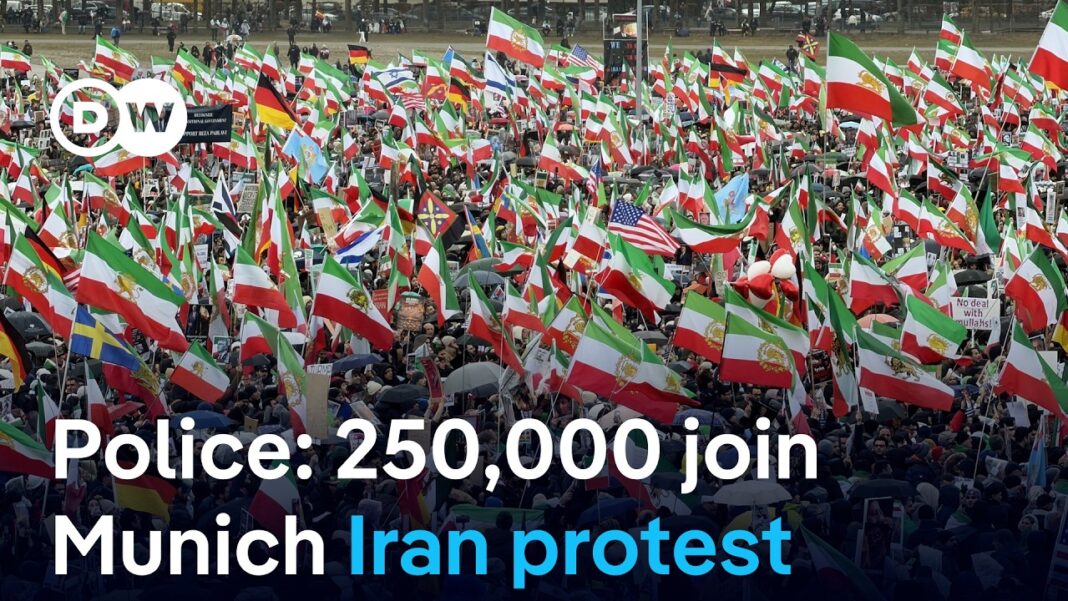
(TJV NEWS) Demonstrators advocating for political change in Iran gathered Saturday on the margins of the Munich Security Conference, one day after President Trump said replacing Iran’s leadership would be the most favorable outcome for the country, which has been shaken by violent unrest.
As the New York Times reported, the rally in Munich was part of a broader wave of coordinated protests organized by Iranian opposition figures abroad.
Earlier this month, Reza Pahlavi — the exiled son of Iran’s former shah — urged supporters to mobilize on Feb. 14 to increase pressure on Tehran. Speaking at the security conference on Friday, he repeated calls for stronger U.S. involvement in Iran, according to the New York Times.
Parallel demonstrations were also held in cities including Melbourne, Athens, Tokyo and London, the New York Times reported.
Diplomatic efforts between Washington and Tehran are expected to continue this week. Nuclear negotiations were scheduled to resume Tuesday in Geneva, two American officials told the New York Times, speaking anonymously because of the sensitivity of the discussions. President Trump has deployed naval forces to the Persian Gulf, signaling readiness for possible military action if talks fail, the New York Times reported.
In Munich, approximately 200,000 people attended the rally, according to Tamara Djukaric, a spokeswoman for local police. Mr. Pahlavi and Senator Lindsey Graham of South Carolina addressed the crowd. Many participants displayed the pre-1979 Iranian flag featuring the lion-and-sun emblem, a symbol associated with the monarchy overthrown during the Islamic Revolution. Some demonstrators carried portraits of Mr. Pahlavi and chanted slogans demanding regime change. Others wore red hats reading “Make Iran Great Again,” echoing President Trump’s well-known campaign slogan.
During remarks to U.S. troops in Fort Bragg, North Carolina, on Friday, President Trump said that replacing Iran’s current leadership would be “the best thing that could happen,” adding that Iran’s rulers had been “talking and talking and talking” for decades.
The overseas rallies followed weeks of protests inside Iran that began in late December over economic grievances and evolved into broader opposition to the country’s clerical leadership. As the New York Times reported, Iranian security forces responded with force, and thousands were killed during the crackdown.
In London, demonstrators carried photos of relatives and friends they said were killed or detained during the unrest. Some staged symbolic reenactments of killings, while others chanted against Iran’s supreme leader, Ayatollah Ali Khamenei. One protester, identified only as Kimia for safety reasons, told the New York Times she was speaking out for those she said had been silenced.
Other demonstrators displayed posters of President Trump or screenshots of his social media posts encouraging Iranians to continue protesting. A London protester, Mania Shojaei, told the New York Times she was frustrated that the United States had not yet taken more decisive action.
In Munich on Saturday, Mr. Pahlavi told reporters that negotiations with Tehran would not succeed and accused Iran’s leadership of stalling for time. As the New York Times reported, he urged governments to cut off Iran’s financial channels, expel diplomats and close embassies. He also directly appealed to President Trump, saying Iranians believed American help was forthcoming.
Mr. Pahlavi, who has sought to position himself as a potential transitional leader, declared that the Islamic Republic should be brought to an end and said diplomatic criticism alone was insufficient.
While he enjoys backing among some opponents of Iran’s government, analysts cited by the New York Times cautioned that it remains unclear how much support he commands inside the country. His father’s rule, which ended in 1979, was marked by close ties to the United States and a security apparatus that detained and tortured dissidents — a legacy critics say complicates his appeal.
During the recent protests in Iran, some demonstrators invoked the monarchy, chanting support for the shah. Others rejected both monarchical and clerical rule, instead calling broadly for an end to authoritarian leadership in any form, the New York Times reported.
