



|
Getting your Trinity Audio player ready...
|
By: Fern Sidman
As the world’s attention remains fractured by overlapping crises, a far more consequential drama is unfolding with a velocity that has startled even seasoned observers of Middle Eastern geopolitics. According to senior officials cited in a report published by Axios and closely followed by World Israel News, the United States is now approaching the prospect of a direct military strike against Iran with what insiders describe as “90% certainty.” The phrase, stark in its candor, captures the gravity of a moment in which contingency planning has hardened into operational readiness and diplomatic patience appears to be nearing exhaustion.
World Israel News, which has monitored the intensifying American military posture across the region, reported on Wednesday that this is no longer a scenario confined to theoretical war-gaming. The outlines of a potential campaign are said to be expansive, sustained, and qualitatively different from the episodic or symbolic strikes that have characterized previous confrontations between Washington and Tehran. Senior officials conveyed to Axios that any operation would likely unfold over weeks rather than days, targeting not merely discrete facilities but the deeper strategic sinews of the Islamic Republic’s military and security architecture.
The specter of such a campaign carries implications that extend far beyond the immediate battlefield. Officials cited in the reporting have described the prospective conflict as potentially existential for the Iranian regime itself, with consequences that could reverberate across the Middle East for years to come. For President Trump, whose remaining years in office would inevitably be defined by the outcome of such a confrontation, the stakes are both geopolitical and profoundly political. The World Israel News report called attention to the fact that a large-scale conflict with Iran would represent the most consequential foreign policy undertaking of Trump’s presidency, eclipsing earlier crises in both scope and risk.
The current trajectory did not emerge in a vacuum. In early January, the administration came perilously close to authorizing military action in the wake of Tehran’s brutal suppression of domestic protests, a crackdown that reportedly claimed thousands of lives. At that juncture, the moral outrage generated by images and reports of mass repression collided with longstanding strategic anxieties about Iran’s regional ambitions and nuclear trajectory. Yet the moment passed without the issuance of orders, giving way instead to what officials described as a dual-track strategy: renewed efforts at nuclear negotiations coupled with a rapid and visible reinforcement of American military capabilities in and around the Middle East.
That dual-track approach was designed to preserve the possibility of a diplomatic off-ramp while ensuring that Tehran would negotiate under the shadow of overwhelming force. The logic was familiar from previous episodes of coercive diplomacy, but the scale of the current military buildup has few modern precedents. Over the past weeks, more than 150 U.S. cargo flights have ferried weapons systems, ammunition, and logistical materiel into the region. Open-source flight tracking data has revealed a striking surge in American military aircraft movements across the continental United States and Europe, a choreography of airlift operations that signals preparations for sustained operations rather than mere deterrent posturing.
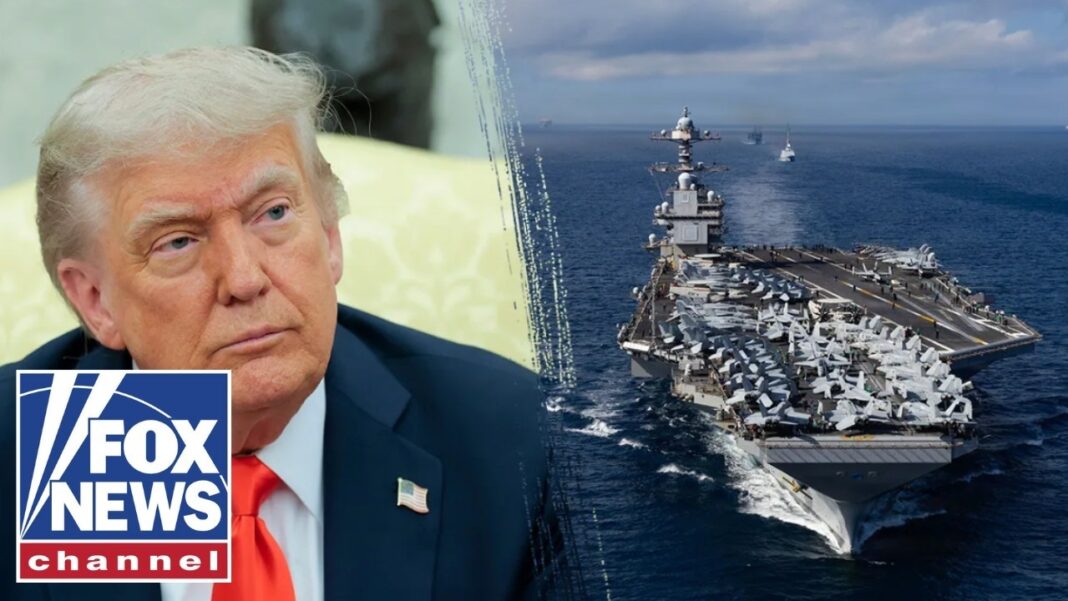
The redeployment of combat aircraft has been equally dramatic. World Israel News reported that more than 50 fighter jets, including advanced F-35 stealth fighters, F-22 air superiority platforms, and multirole F-16s, have been repositioned to bases in the Middle East. This aerial reinforcement has been complemented by the movement of naval power: two U.S. aircraft carriers, one already deployed in theater and another en route, now form the maritime backbone of a posture designed to project overwhelming force across multiple domains. The convergence of air and naval assets, coupled with the logistical pipeline feeding them, suggests preparations for a campaign that would demand sustained operational tempo and resilience.
Despite the continuation of nuclear talks with Iran, officials quoted in the Axios report, and relayed through World Israel News, have expressed deep skepticism that diplomacy will yield a meaningful breakthrough. The talks, in this telling, have taken on an increasingly ritualistic quality, sustained more by inertia than by genuine optimism. One adviser to President Trump, speaking with blunt candor, remarked that “the boss is getting fed up,” an expression that World Israel News interprets as emblematic of growing frustration within the administration. The implication is that patience, long stretched, may finally be reaching its limit.
For many observers, the confrontation with Iran has become a familiar backdrop, a recurring motif in the narrative of Middle Eastern instability. The present moment may be qualitatively different. The accumulation of military assets, the articulation of operational plans extending over weeks, and the language of near-certainty used by senior officials all point to a narrowing window in which diplomatic maneuver may yet avert open conflict. The danger, as articulated in World Israel News’s analysis, lies in the possibility that incremental escalations and reciprocal signaling have generated a momentum of their own, one that could propel the region into a conflict of unprecedented scope before publics fully grasp the proximity of the precipice.
The prospective campaign is described by sources as likely to evolve into a joint U.S.-Israeli operation, significantly larger in scale than previous episodes of coordination between the two allies. World Israel News has long chronicled the depth of strategic alignment between Washington and Jerusalem regarding the Iranian threat, particularly in relation to Tehran’s nuclear ambitions and its sponsorship of proxy militias across the region. A combined campaign would mark a decisive shift from the covert and indirect confrontations that have characterized much of the shadow war between Israel and Iran. It would bring into the open a struggle that has, until now, largely unfolded in the realm of deniability and calibrated ambiguity.
Such a conflict would inevitably reshape regional alignments. Neighboring states, already navigating a delicate balance between public opposition to Iranian hegemony and fears of being drawn into a wider war, would be forced to recalibrate their positions. The ripple effects could destabilize fragile political orders, disrupt energy markets, and exacerbate humanitarian crises in a region already burdened by protracted conflict. For Iran itself, officials suggest, the consequences could be regime-altering, if not regime-ending, raising the specter of internal upheaval layered atop external assault.
Yet even as preparations accelerate, the dual-track strategy persists, at least in formal terms. American officials continue to speak of diplomacy as the preferred avenue, even as the scale and tempo of military movements convey a different message. This tension between rhetoric and readiness is emblematic of a broader ambivalence within the administration: a recognition that war with Iran would be costly and unpredictable, coupled with a conviction that continued acquiescence to Tehran’s strategic advances is untenable.
The psychological dimension of this moment should not be underestimated. The World Israel News report highlighted how repeated cycles of threat and reprieve over the years have fostered a certain complacency among publics, a sense that talk of war with Iran is an enduring feature of the geopolitical landscape rather than an imminent reality. The current convergence of military assets, however, challenges that assumption. The choreography of deployments, the articulation of sustained campaign plans, and the language of near-certainty suggest that this may not be another episode of saber-rattling destined to recede into the familiar rhythms of stalemate.
For President Trump, the approach of such a defining moment poses profound questions about leadership, legacy, and the calculus of risk. The administration’s internal debates are animated by competing imperatives: the desire to avoid entanglement in another prolonged Middle Eastern war, and the conviction that allowing Iran to consolidate its military and nuclear capabilities would pose an intolerable threat to American and allied security. The tension between these imperatives has shaped the administration’s oscillation between engagement and escalation, a pendulum that now appears to be swinging decisively toward the latter.
In the coming days and weeks, the world will be watching closely to discern whether the current trajectory culminates in open conflict or is once again arrested by last-minute diplomacy. The margin for error has narrowed dramatically. The accumulation of forces, the rhetoric of near-certainty, and the evident impatience at the highest levels of the administration together create a volatile mix in which miscalculation could have catastrophic consequences. The present moment, then, is not merely another chapter in the long-running saga of U.S.-Iranian hostility; it is a hinge point upon which the strategic future of the region, and perhaps the stability of the international order, may turn.
