



|
Getting your Trinity Audio player ready...
|
By: Fern Sidman
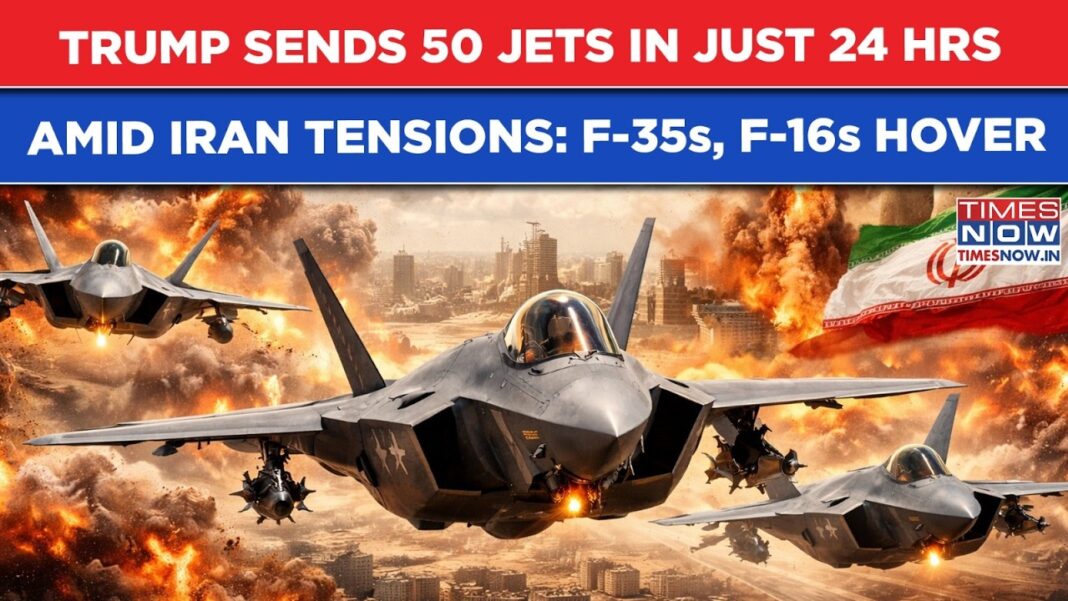
As diplomats convened in Switzerland for a renewed and closely watched round of discussions over Iran’s nuclear ambitions, the skies over the Middle East quietly but unmistakably told another story. According to a report on Tuesday at World Israel News, the United States repositioned more than fifty advanced fighter aircraft into the region within the span of a single day, a rapid redeployment that unfolded in parallel with the second round of U.S.-Iranian nuclear talks. The synchronization of diplomacy and deterrence underscored a familiar yet potent duality in American strategy: engagement at the negotiating table reinforced by unmistakable demonstrations of military readiness.
The scope and velocity of the aerial movements were not the product of speculation but of digital transparency. Open-source flight tracking data, amplified by outlets including the BBC and by specialized social media accounts that monitor military aviation, revealed a sudden surge of U.S. military flights headed toward the Middle East. World Israel News reported that these digital traces showed multiple departures from bases well beyond the region, converging within a compressed time frame toward Middle Eastern destinations that were not publicly disclosed. The effect was less theatrical than resolute, a logistical ballet of steel and kerosene unfolding far above the diplomatic chambers of Europe.
The aircraft identified in these movements represented the apex of American aerial power: stealth-capable F-22 Raptors, fifth-generation F-35 Lightning II fighters, and the versatile, battle-proven F-16s. The presence of these platforms is not incidental. Each aircraft type embodies a distinct strategic purpose, from air superiority and penetration of sophisticated air defenses to multirole flexibility in contested environments. Their collective redeployment suggested not a single, narrow contingency but a broad readiness posture calibrated for multiple scenarios.
Accompanying the fighters were aerial refueling aircraft, a detail that did not escape the attention of analysts following the open-source data. World Israel News reported that the repositioning of tankers is consistent with preparations for long-range operations and sustained aerial presence. Refueling assets extend the operational reach of fighter jets, enabling them to loiter, patrol, and, if required, conduct missions across vast distances without reliance on proximate bases. In strategic terms, the tankers transformed a surge of aircraft into an enduring capability, signaling that the United States was not merely passing through the region but establishing the logistical foundations for prolonged aerial operations.
This airlift of combat power did not occur in isolation. The United States had recently dispatched two warships to the Middle East ahead of the Switzerland talks, marking a complementary naval adjustment to Washington’s regional posture. The sequencing of these deployments, first at sea and then in the air, painted a picture of layered deterrence. Naval platforms project power across maritime corridors, while air assets confer rapid responsiveness and precision reach. Together, they constitute a multidimensional signal, one that can be calibrated up or down as diplomatic circumstances evolve.
The timing of these movements, coinciding with the second round of nuclear talks between American and Iranian officials in Switzerland, inevitably invites interpretation. The World Israel News report framed the juxtaposition as emblematic of a long-standing American approach to negotiations with Tehran: diplomacy backed by force. The United States has repeatedly sought to convey that engagement does not equate to vulnerability, and that the pursuit of an agreement on nuclear issues will not be conducted in a vacuum of strategic preparedness. The redeployment of more than fifty fighter jets within twenty-four hours conveyed urgency, resolve, and an implicit message that Washington’s patience is bounded by the imperatives of security.
A U.S. official, speaking to Axios and cited by World Israel News, confirmed the scale of the redeployment but offered few operational details. The official declined to specify the precise basing locations of the aircraft, the duration of their deployment, or the missions they might undertake. This strategic ambiguity is itself a feature of deterrence. By withholding granular details, Washington preserves flexibility while complicating the calculus of any potential adversary. The absence of specifics also ensures that the deployment functions less as a prelude to imminent action and more as a broad signal of capability and readiness.
The Middle East has long been a theater in which military posture and diplomatic overture intertwine. World Israel News has frequently chronicled how shifts in American force deployment reverberate across regional capitals, from Jerusalem to Riyadh to Tehran. In this context, the sudden influx of U.S. air power during nuclear talks is unlikely to be perceived as coincidental. Rather, it reinforces a regional perception that the United States remains deeply invested in the balance of power, even as it engages in dialogue over arms control and nonproliferation.
Open-source intelligence, once the preserve of specialized analysts, now plays an increasingly visible role in shaping public narratives around such deployments. The flight tracking data that illuminated the movement of U.S. aircraft exemplifies how transparency technologies have altered the information environment. Governments may not disclose the specifics of their deployments, but the digital exhaust of modern military logistics—radar tracks, transponder signals, and satellite imagery—often fills the void. This democratization of strategic awareness complicates efforts to conduct quiet redeployments, transforming logistical maneuvers into public signals.
The redeployment of advanced fighters also carries symbolic resonance. The F-22 and F-35, in particular, are often described as cornerstones of American air dominance, platforms designed to operate in highly contested environments against sophisticated air defenses. Their appearance in the Middle Eastern theater, even absent overt hostilities, serves as a reminder of the technological asymmetries that define the contemporary balance of power. Such deployments are not merely quantitative but qualitative, projecting a level of capability that few regional actors can match.
At the same time, the diplomatic track in Switzerland proceeded with little public disclosure. World Israel News reported that no details were released regarding the substance or outcome of the discussions between U.S. and Iranian officials. This opacity, juxtaposed with the visible movement of military assets, created a striking contrast between the secrecy of negotiation and the visibility of deterrence. The talks themselves, focused on Iran’s nuclear program, have long been fraught with mutual suspicion, historical grievances, and competing narratives of compliance and violation. In such an environment, military signaling often becomes a parallel language, one that communicates resolve where words are withheld.
For Israel and its allies, the redeployment of U.S. forces carries particular significance. World Israel News has repeatedly highlighted Israeli concerns about Iran’s nuclear ambitions and regional activities. The presence of additional American fighter jets and naval assets in the Middle East may be read in Jerusalem as a reassuring indication of Washington’s continued commitment to regional security. Even as diplomatic efforts proceed, the reinforcement of U.S. military posture serves as a hedge against worst-case scenarios, including the collapse of talks or a sudden escalation of tensions.
The broader strategic implications extend beyond the immediate context of nuclear negotiations. The Middle East remains a mosaic of overlapping conflicts, proxy struggles, and great-power competition. The World Israel News report observed that American force movements in the region are often interpreted through multiple lenses: deterrence against Iran, reassurance to allies, signaling to rival powers, and preparation for contingencies that may have little to do with the immediate diplomatic agenda. In this sense, the redeployment of fighter jets and warships functions as a polyvalent signal, legible to different audiences in different ways.
The presence of refueling aircraft, in particular, suggests an emphasis on endurance and reach. Tankers enable fighters to operate over extended ranges and durations, facilitating sustained patrols or rapid responses across the region’s vast airspace. This logistical dimension transforms a numerical deployment into an operational capability, ensuring that the United States can maintain a persistent aerial presence if circumstances demand. In strategic calculus, endurance often matters as much as firepower, conveying the capacity to remain engaged over time rather than merely to surge briefly.
As the talks in Switzerland continued without public resolution, the convergence of diplomacy and deterrence remained the defining feature of the moment. The World Israel News report framed the episode as a contemporary illustration of an enduring principle of statecraft: negotiations are most consequential when underwritten by credible power. The United States, by repositioning more than fifty fighter jets and reinforcing its naval presence, demonstrated that it intends to approach the Iranian nuclear question not solely as a matter of dialogue but as a strategic contest in which preparedness and leverage remain central.
In the end, the redeployment of U.S. forces to the Middle East during the nuclear talks with Iran serves as a vivid reminder that diplomacy in the region is rarely conducted in isolation from military realities. The choreography of jets in the sky and ships at sea forms an unspoken backdrop to conversations in conference rooms thousands of miles away. Whether the talks yield progress or stalemate, the steel wings over the Middle East have already delivered their message: engagement continues, but so does vigilance.
