



|
Getting your Trinity Audio player ready...
|
Missiles, Upheaval and Market Shock: Summary of Last 24 Hours of Operation Epic Fury & Roaring Lion
By: Fern Sidman
The killing of Iran’s Supreme Leader Ayatollah Ali Khamenei in a sweeping joint U.S.–Israeli assault has set in motion a chain reaction of uncertainty that is reverberating far beyond the Middle East. What began as a coordinated military campaign against Iranian military infrastructure has now metastasized into a widening regional confrontation, triggering retaliatory missile barrages, political upheaval inside Iran and economic tremors that have unsettled global markets.
According to a report on Sunday in the Associated Press, the first wave of strikes on Saturday targeted Revolutionary Guard command facilities, missile and drone launch sites, military airfields and air defense systems. Among the earliest and most consequential impacts was a strike near the office complex of Ayatollah Khamenei, the 86-year-old cleric who had ruled Iran since 1989 and wielded ultimate authority over the country’s political and military apparatus. Iranian state media confirmed his death without elaborating on the precise circumstances, while Israeli officials declared that dozens of senior Iranian commanders were killed in the operation.
The Associated Press reported that the attack was the culmination of months of covert coordination between Washington and Jerusalem. Israeli officials said planning had been underway for months, designed to degrade Iran’s military capabilities and eliminate the senior leadership believed to be directing both its nuclear program and regional proxy networks. The United States military described the targets as central to Iran’s ballistic missile and drone infrastructure, asserting that Tehran had accelerated efforts to rebuild its capabilities following previous strikes last June.
The killing of Khamenei represents a seismic rupture in the Islamic Republic’s four-decade-old power structure. As the Associated Press report noted, Iran’s theocracy had already been grappling with mounting domestic dissent following nationwide protests initially sparked by economic grievances and later transformed into broader anti-government demonstrations. Those protests were suppressed with force, but dissatisfaction simmered beneath the surface. Now, with the regime’s paramount authority extinguished in an external assault, Iran faces a volatile transition.
On Sunday, Iran’s provisional governing council convened for the first time. The Associated Press reported that the council is expected to oversee the selection of a new supreme leader, a decision that will shape not only Iran’s internal trajectory but also its posture toward the outside world. The country’s Assembly of Experts, a clerical body charged with appointing and supervising the supreme leader, now confronts the daunting task of preserving continuity amid chaos.
While the political future of Iran hangs in the balance, the immediate military consequences have been devastating. Iranian state media reported that more than 200 people were killed in the strikes.
Retaliation came swiftly. Iran launched waves of missiles and drones targeting Israel and U.S. military installations across the Gulf. The Associated Press reported that three American service members were killed in these retaliatory strikes, marking the first confirmed U.S. combat fatalities in the current escalation. Explosions echoed across Tel Aviv as air defense systems intercepted incoming projectiles, though some impacts proved lethal. Eleven people were killed in Israel, including nine in a strike that hit a synagogue in the central town of Beit Shemesh.
“You have crossed our red line and must pay the price,” Iran’s parliamentary speaker Mohammad Bagher Qalibaf declared in a televised address quoted by the Associated Press. The statement signaled that Tehran intends to pursue sustained retaliation rather than symbolic reprisal.
The violence has spilled into neighboring countries hosting American forces. Iranian missiles and drones were directed toward bases in Gulf states, and the global commercial hub of Dubai was reportedly struck. The Associated Press detailed how the region’s airspace closures stranded hundreds of thousands of travelers, disrupting international aviation corridors that connect Europe, Asia and Africa.
Beyond the immediate theater of war, allied terrorist groups have signaled their own involvement. Two senior Houthi officials in Yemen told the Associated Press that the Iranian-backed movement intends to resume attacks on Red Sea shipping routes and Israeli territory. Such actions threaten to compound the economic shockwaves already rippling through energy and maritime markets.
Indeed, the strategic waterways of the Middle East have become flashpoints of concern. A fifth of the world’s traded oil passes through the Strait of Hormuz. Shipping companies have already suspended traffic through the Suez Canal, according to the Associated Press, as insurers and operators reassess risk in a rapidly deteriorating security environment. Analysts warn that prolonged instability could send oil prices surging and destabilize global supply chains.
In Washington, President Trump framed the operation as both retribution and opportunity. He cited a litany of grievances stretching back to the 1979 revolution that transformed Iran from a U.S. ally into a sworn adversary. Iran’s ballistic missile program and support for regional proxy forces were central to his justification. The Associated Press reported that Trump urged Iranians to “take over” their government once the military campaign concludes, portraying the strikes as a catalyst for regime change.
Yet Trump also left the door ajar for diplomacy. A senior White House official told the Associated Press on Sunday that “new potential leadership” in Iran had indicated openness to talks, and that the president would be “eventually” willing to negotiate. For now, however, the official emphasized that the military operation “continues unabated.”
The scale of American military involvement underscores the gravity of the moment. The Associated Press report noted that the Trump administration had built up one of the largest concentrations of U.S. warships and aircraft in the Middle East in decades prior to the strike. Trump pledged that “heavy and pinpoint bombing” would continue through the week or longer, warning Tehran against further escalation.
Inside Iran, the human toll is compounded by fear and uncertainty. Witnesses in Tehran told the Associated Press that the streets were largely deserted as residents sheltered from continuing airstrikes. Communication disruptions and state-imposed information controls have made it difficult to ascertain the full extent of civilian casualties.
Globally, reactions have ranged from jubilation to condemnation. Some governments have backed the U.S.–Israeli action, while others have called for immediate de-escalation and renewed negotiations. The Associated Press reported that at least 22 people were killed in Pakistan when protesters attempting to storm the U.S. Consulate in Karachi clashed with police and paramilitary forces. The unrest illustrates how the conflict’s aftershocks are igniting passions far beyond Iran’s borders.
Within Israel, the public braces for continued missile barrages. Emergency services remain on high alert, and air-raid sirens punctuate daily life. In Gulf capitals, governments have bolstered security around diplomatic and energy infrastructure.
The geopolitical calculus is fraught with peril. Analysts cited by the Associated Press caution that removing Khamenei does not necessarily dismantle the ideological and institutional architecture of the Islamic Republic. The Islamic Revolutionary Guard Corps retains formidable capabilities, and its influence may even expand in the power vacuum.
At the same time, the prospect of internal fragmentation looms large. If competing factions within Iran’s elite vie for supremacy, the resulting instability could prove as destabilizing as the war itself. The provisional governing council’s deliberations will therefore be scrutinized not only in Tehran but in capitals worldwide.
Financial markets have reacted nervously, with energy futures spiking amid fears of disrupted oil flows. Aviation routes across the Middle East remain partially shuttered, forcing airlines to reroute flights at significant cost. The Associated Press report highlighted the broader economic ramifications, warning that sustained conflict could rattle markets already strained by inflationary pressures.
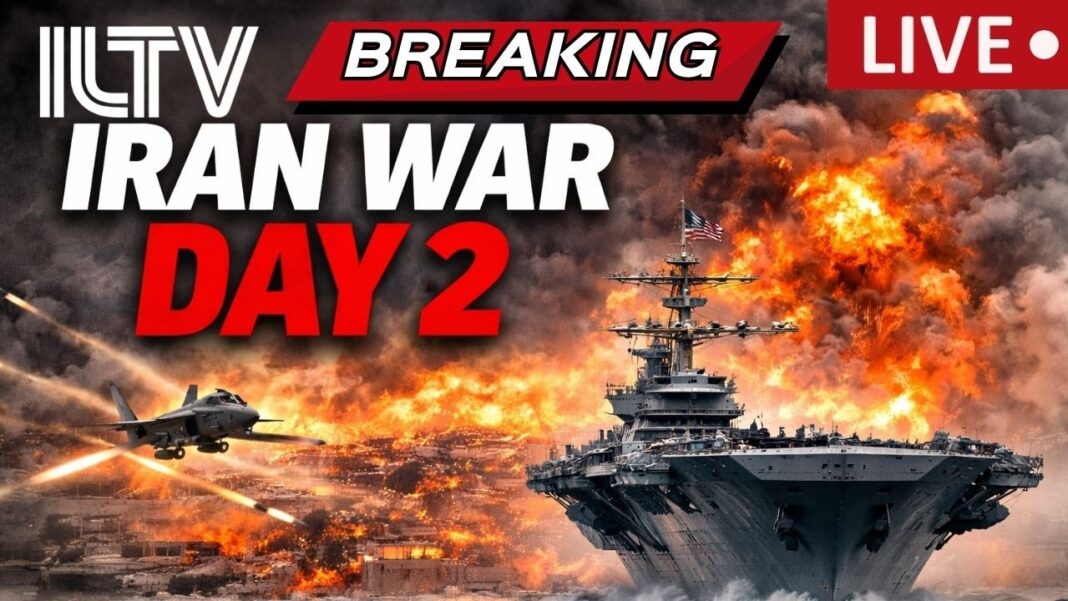
As the second day of fighting unfolded, the contours of a new and dangerous chapter in Middle Eastern history began to emerge. The assassination of a supreme leader, the exchange of missiles across multiple borders and the specter of regime change combine to create a moment of profound transformation.
Whether this transformation leads to greater stability or deeper turmoil remains uncertain. What is clear is that the conflict’s reverberations are global in scope and historic in consequence. The coming days will determine whether diplomacy can reassert itself or whether the region — and perhaps the world — is poised for a protracted and perilous confrontation.
