



|
Getting your Trinity Audio player ready...
|
Israeli Minister Warns of Escalating Antisemitic Violence in Canada Following Gunfire at Toronto Synagogue
By: Fern Sidman
A late-night shooting at a synagogue in Toronto has ignited fresh international concern over the rising tide of antisemitic violence in Canada, with Israeli officials warning that the incident represents part of a broader and deeply troubling pattern of hostility toward Jewish communities across the country.
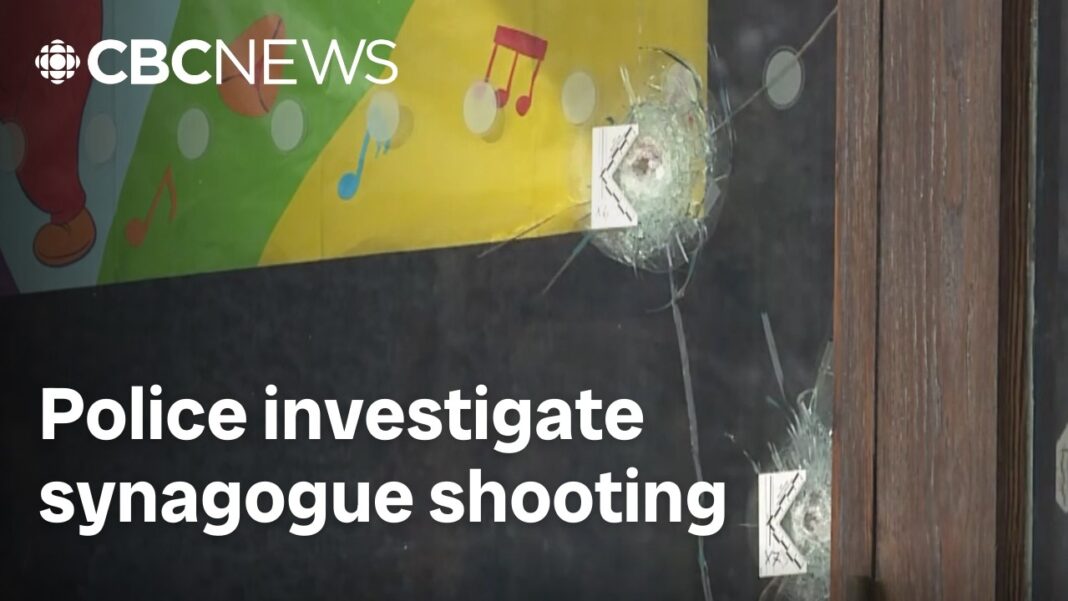
According to a report on Wednesday at The Jewish News Syndicate (JNS), an unidentified individual drove up to a synagogue in the North York area of Toronto shortly before 11:00 p.m. Monday and fired more than a dozen shots at the building’s main glass entrance doors. Although no one was injured in the attack, the brazen nature of the gunfire—directed at a house of worship that had only hours earlier hosted a festive Purim celebration—has shaken members of the local Jewish community and renewed fears about the normalization of antisemitic intimidation.
Israeli officials responded swiftly to the incident. Amichai Chikli, Israel’s Minister of Diaspora Affairs and Combating Antisemitism, said the attack should be understood not as an isolated act of violence but as part of a troubling trajectory of escalating antisemitic incidents throughout Canada.
Speaking in remarks reported by JNS, Chikli stated that the shooting represented yet another manifestation of a dangerous climate that has been allowed to fester despite repeated warnings from security officials and Jewish organizations.
“Canada’s government itself has already acknowledged that the scale and severity of the incidents in Canada were clear warning signs before a disaster,” Chikli said, referencing an earlier letter he sent to Canada’s Minister of Public Safety Gary Anandasangaree.
The Israeli minister revealed that he had sent that urgent communication on Jan. 14, months before the most recent synagogue shooting, in an attempt to draw attention to what he described as an alarming surge in antisemitic activity. According to the JNS report, Chikli’s letter cited internal assessments from Canadian authorities warning that antisemitic incidents had reached unprecedented levels.
Despite those warnings, Chikli argued that Canada’s political leadership has failed to confront the crisis with sufficient urgency.
“Prime Minister Mark Carney continues to turn a blind eye to rampant antisemitism in the country,” Chikli said in comments cited by JNS.
The synagogue targeted in Monday night’s shooting had only recently concluded a Purim celebration—an annual Jewish holiday commemorating the biblical story of Queen Esther and the Jewish people’s deliverance from persecution in ancient Persia. The event had drawn families, children, and community members to the synagogue for an evening of music, costumes, and celebration.
Synagogue leaders said the sudden transition from joy to fear was deeply unsettling.
“It is chilling that this happened just after our Purim evening celebration—a night filled with joy, laughter, and community,” the synagogue’s leadership said in a statement cited by JNS. “To have that joy followed so quickly by violence and intimidation is deeply unsettling.”
Despite the shock, the synagogue emphasized that the community would not allow the attack to undermine its resilience.
“Still, we will not allow this act to define us or drive us apart,” the statement added.
Toronto police have launched an investigation into the shooting. As of Tuesday, authorities had not identified a suspect, though they confirmed that detectives were actively examining the circumstances surrounding the incident.
“Our investigators are actively working to determine the circumstances surrounding the firearm discharge, and we are treating this matter with the utmost seriousness,” police spokeswoman Stephanie Miceli told The Jewish News Syndicate (JNS).
The shooting has reignited debate about the safety of Jewish institutions across Canada, particularly in major urban centers where antisemitic incidents have surged dramatically since the Oct. 7, 2023, Hamas terrorist attack on southern Israel.
In the aftermath of that attack—which left approximately 1,200 Israelis dead and triggered a prolonged war in Gaza—Jewish communities worldwide have reported a dramatic escalation in harassment, threats, and violence.
According to figures cited in the JNS report, antisemitic incidents in Canada have increased by roughly 670 percent since October 2023. Jewish organizations say that trend has manifested in vandalism, intimidation, arson, and violent assaults.
Toronto has emerged as a particularly concerning focal point. Data compiled by the Centre for Israel and Jewish Affairs (CIJA) indicates that Jews are the most frequently targeted group in the city when it comes to hate crimes.
A report released by the Toronto Police Service on May 14, 2025, revealed that although Jewish residents account for less than four percent of the city’s population, anti-Jewish hostility represented 40 percent of all recorded hate crimes and a staggering 81 percent of hate crimes motivated by religious bias.
“These figures represent a systemic failure to deter antisemitic violence,” Chikli said in comments quoted by JNS.
The consequences of that failure, he warned, are already evident in a string of incidents that have shaken Jewish communities across the country.
According to the information provided in the JNS report, Jewish schools in both Montreal and Toronto have been targeted by gunfire in recent months, while synagogues in Montreal and Vancouver have been subjected to arson attacks.
Other incidents have involved direct physical violence against individuals. In August 2025, an elderly Jewish woman was stabbed in Ottawa in what authorities described as an antisemitic assault. Around the same time, an Orthodox Jewish father was reportedly attacked in Montreal while walking with his children.
“These are not random acts,” Chikli said. “They are unmistakable warning signs that antisemitic violence has become normalized.”
The Israeli minister’s warning also referenced developments in other democratic societies where antisemitic violence has surged in recent years.
In his January letter, Chikli drew a comparison between Canada and Australia, noting that Israeli Prime Minister Benjamin Netanyahu had personally warned Australian Prime Minister Anthony Albanese in August 2025 that failure to confront rising antisemitism could lead to catastrophic consequences.
According to the JNS report, Chikli pointed to the subsequent terror attack at Bondi Beach—where fifteen people were murdered—as evidence of what can happen when ideological extremism is allowed to grow unchecked.
“The recent antisemitic terror attack in Bondi Beach tragically illustrates the lethal cost of ignoring early warning signs,” Chikli wrote in the letter.
He warned that Canada now appears to be exhibiting similar indicators. “This path leads to a point of no return,” he cautioned.
Chikli has urged the Canadian government to adopt a far more aggressive strategy to confront antisemitic extremism. His recommendations include strengthening intelligence-gathering capabilities, intensifying monitoring of extremist Islamist networks, and expanding security protection for Jewish institutions.
He has also called for more vigorous enforcement of laws against incitement and hate speech.
One particularly contentious issue involves the large pro-Palestinian demonstrations that have taken place in many Canadian cities since the war in Gaza began. Chikli argued that protests featuring the display of terrorist group symbols or chants encouraging violence contribute to an atmosphere in which antisemitic attacks become more likely.
Allowing demonstrators to wave the flags of Hamas, Hezbollah, or ISIS—or to chant slogans such as “Globalize the Intifada”—sends a dangerous signal, he said.
According to the JNS report, Chikli believes such rhetoric can embolden extremists and foster an environment in which violence against Jews becomes normalized.
“The warning signs are present,” he said. “The trajectory is clear, and the consequences of further delay would be severe.”
Chikli added that Israel stands ready to assist Canada in confronting the surge in antisemitic threats.
As the investigation into the Toronto synagogue shooting continues, Jewish community leaders in Canada are hoping that the incident will serve as a wake-up call for policymakers.
For many members of the community, the attack has reinforced a growing sense of vulnerability.
Yet even amid fear and uncertainty, the message emerging from the synagogue targeted on Monday night was one of resilience. The building’s shattered glass doors may symbolize the threat facing Jewish communities today, but congregants insist that their sense of unity and identity remains unbroken.
As JNS has documented in its reporting on antisemitism around the world, such resilience has long been a defining characteristic of Jewish communities confronting hostility.
Whether Canada’s political leadership will respond decisively to the warnings now being issued remains an open question. But for many observers, the events in Toronto have underscored the urgency of addressing antisemitism before further violence occurs.
