



|
Getting your Trinity Audio player ready...
|
By: Fern Sidman
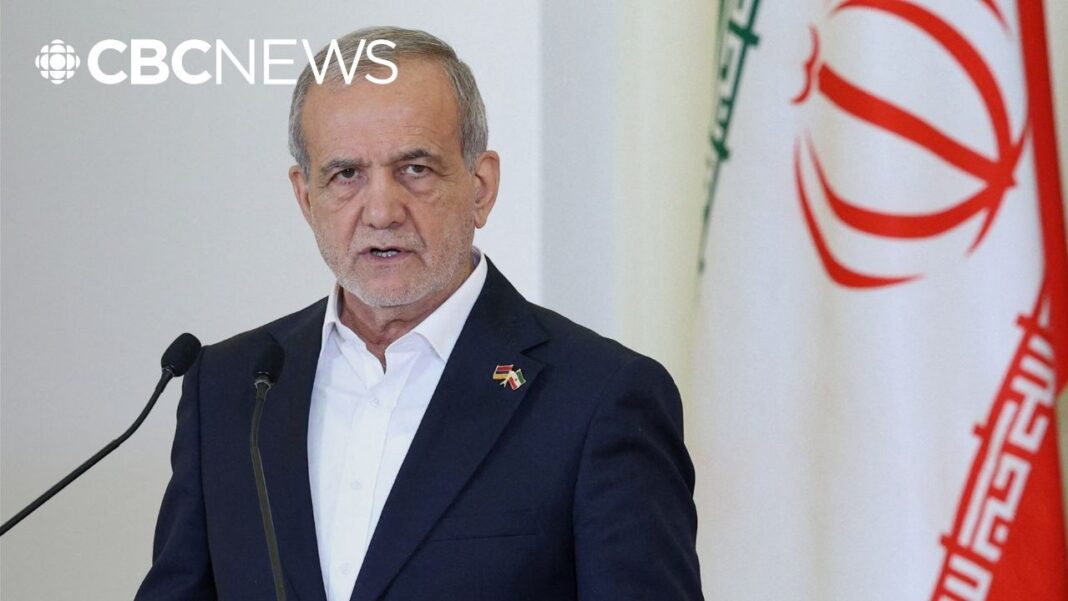
As the widening Middle East conflict entered its second week, Iran’s president delivered a defiant message rejecting calls from the United States for the country’s unconditional surrender, even as he offered an unexpected apology to neighboring Gulf states affected by Iranian missile and drone attacks. The remarks, broadcast in a prerecorded address on Iranian state television, came amid continuing airstrikes, retaliatory missile launches, and mounting fears that the war between Iran, Israel, and the United States could escalate into a broader regional confrontation.
According to a report on Saturday in The Guardian of the UK, Iranian President Masoud Pezeshkian dismissed President Donald Trump’s demand that Tehran capitulate entirely to American and Israeli military pressure, calling such expectations nothing more than a “dream.” At the same time, Pezeshkian acknowledged the impact of Iranian military actions on neighboring countries and issued a rare apology to governments across the Gulf region whose territories have been struck during the intensifying conflict.
The dual message—one of defiance toward Washington and contrition toward regional neighbors—illustrates the increasingly complex diplomatic posture Tehran has adopted as the war continues to reshape geopolitical dynamics across the Middle East.
In his address, Pezeshkian sought to rally the Iranian public while sending a firm signal to Washington that Iran would not yield under military pressure. According to The Guardian report, the Iranian president declared that the country’s adversaries “must take their dream of the Iranian people’s unconditional surrender to their graves,” underscoring Tehran’s refusal to accept the terms laid out by President Trump.
Trump had issued his demand just hours earlier, insisting that only Iran’s complete submission would bring an end to the ongoing war. The American president’s statement reflected the administration’s increasingly aggressive stance as U.S. and Israeli forces continue a coordinated military campaign targeting Iran’s military infrastructure, missile facilities, and command centers.
The conflict, now entering its eighth day at the time of Pezeshkian’s address, has already inflicted significant damage on Iran’s defense capabilities. U.S. and Israeli officials cited by The Guardian claim that roughly 60 percent of Iran’s missile launchers have been destroyed and that nearly 80 percent of the country’s air defense systems have been neutralized, giving Israel effective aerial dominance over Iranian airspace.
Despite those setbacks, Pezeshkian made clear that Tehran intends to continue resisting what it views as foreign aggression.
In an unexpected departure from Iran’s typically uncompromising rhetoric, Pezeshkian also extended an apology to neighboring Gulf countries affected by Iranian attacks.
According to the information provided in The Guardian report, the Iranian president said he was “personally apologizing” to regional states that had been impacted by Iranian strikes in recent days. The apology appeared designed to calm tensions with Gulf Arab governments, many of which have found themselves caught in the crossfire as Iranian missiles and drones targeted U.S. military installations hosted on their territory.
Over the past week, Bahrain, Kuwait, Qatar, Saudi Arabia, and the United Arab Emirates have all reported incoming projectiles or drone incursions linked to Iran’s retaliatory operations. The attacks were largely directed at American bases and infrastructure located in those countries, though some strikes caused damage to civilian areas.
Pezeshkian told viewers that Iran’s temporary leadership council had authorized the suspension of attacks against neighboring states unless those countries themselves initiated hostilities against Iran. The statement suggested Tehran might be attempting to prevent further deterioration of relations with Gulf governments while continuing to confront Israel and the United States.
However, it remains unclear whether Pezeshkian’s remarks reflect a genuine policy shift or merely a rhetorical effort to ease diplomatic pressure.
Despite the conciliatory tone toward regional neighbors, military operations across the region continued unabated. Video footage circulated on social media and later obtained by international media outlets reportedly showed a drone strike near the property of Dubai International Airport, one of the world’s busiest transportation hubs.
According to the information contained in The Guardian report, authorities in the United Arab Emirates said their air defense systems intercepted 15 ballistic missiles and 119 drones in a single day, highlighting the extraordinary scale of the conflict’s aerial dimension.
Saudi Arabia also reported intercepting a ballistic missile aimed at an airbase near Riyadh that hosts U.S. military personnel. Meanwhile, explosions were reported in several Gulf cities, including Dubai and Manama, underscoring the war’s expanding geographic footprint.
Israel, for its part, intensified its aerial campaign against Iran. Military officials announced that roughly 80 Israeli fighter jets conducted a pre-dawn blitz against Iranian targets, striking key facilities in and around Tehran.
Israeli aircraft targeted a military academy, an underground command center, and a missile storage complex, as was reported by The Guardian. The attack also ignited fires at Mehrabad International Airport, one of Tehran’s primary aviation hubs, sending towering columns of smoke into the sky.
President Trump responded swiftly to Pezeshkian’s speech, dismissing the Iranian leader’s apology as evidence that Tehran was already buckling under pressure from American and Israeli forces.
Posting on his Truth Social platform, Trump warned that Iran faced “complete destruction” if it failed to surrender. He argued that Iran’s outreach to neighboring countries demonstrated that the ongoing military campaign was achieving its intended strategic objectives.
“If Iran does not surrender,” Trump wrote, “it will be hit very hard.”
The president also claimed that Iran had effectively apologized to its neighbors because of what he described as the relentless pressure exerted by American and Israeli military operations.
Trump’s rhetoric reflects the administration’s broader strategy of maintaining maximum pressure on Tehran while pursuing the war’s stated objectives: dismantling Iran’s missile capabilities, crippling its military infrastructure, and preventing the country from acquiring nuclear weapons.
Despite the dramatic developments, Western officials remain uncertain about how to interpret Pezeshkian’s remarks. Several diplomats told The Guardian that it would be premature to view the apology as a sign that Tehran is seeking an exit from the conflict.
One Western official described the speech as “one data point, no more,” cautioning that Iran’s leadership remains fragmented following the death of Supreme Leader Ayatollah Ali Khamenei during the initial phase of the war.
That leadership vacuum has added another layer of uncertainty to an already volatile situation.
The killing of Khamenei during the early days of the conflict has triggered a power struggle within Iran’s political establishment. Hardline clerics have called for the rapid selection of a new supreme leader to guide the country during the crisis.
According to The Guardian report, Mojtaba Khamenei, the late leader’s son, is widely considered one of the most influential figures within Iran’s ruling elite and maintains close ties to the Islamic Revolutionary Guard Corps. However, the prospect of dynastic succession remains controversial within Iran’s revolutionary system, which historically rejected hereditary leadership.
The absence of a clear successor has complicated Tehran’s decision-making process as the country confronts one of the most severe military crises in its modern history.
The conflict has already produced devastating humanitarian consequences. Iran’s health ministry reports that at least 926 civilians have been killed and approximately 6,000 wounded during Israeli and American airstrikes.
Meanwhile, Israeli operations in Lebanon—where the Iran-backed Hezbollah organization is based—have resulted in hundreds of additional casualties. According to figures cited by The Guardian, Lebanon’s health ministry reports that at least 339 people have been killed in Israeli strikes.
The Norwegian Refugee Council estimates that roughly 300,000 Lebanese residents have fled their homes amid the bombardment, adding to the region’s growing displacement crisis.
Beyond the immediate human toll, the war has also disrupted global economic systems. Oil shipments through the Strait of Hormuz—a critical maritime corridor responsible for a significant portion of the world’s energy supply—have been severely affected after Iran’s Revolutionary Guards reportedly struck a tanker flying the flag of the Marshall Islands.
The closure of the strait has contributed to sharp volatility in global oil markets, while international air travel has been severely disrupted as airlines reroute flights to avoid the increasingly dangerous airspace over the Middle East.
As the war enters its second week, the prospects for a diplomatic resolution remain uncertain. Pezeshkian’s speech suggested that Iran is attempting to balance two competing priorities: resisting American demands while preventing further alienation of neighboring states.
However, the continued exchange of strikes between Iran, Israel, and the United States indicates that the conflict is far from winding down.
According to The Guardian report, Western governments are closely monitoring Tehran’s messaging for signs that Iranian leaders may be searching for an off-ramp. Yet for now, both sides appear determined to continue the confrontation.
With military operations intensifying, global energy markets destabilized, and millions of civilians caught in the crossfire, the war has already reshaped the geopolitical landscape of the Middle East.
Whether Pezeshkian’s apology signals the first step toward de-escalation—or merely a tactical maneuver amid a widening regional war—remains an open question. What is clear, however, is that the stakes for the region and the world have rarely been higher.
