



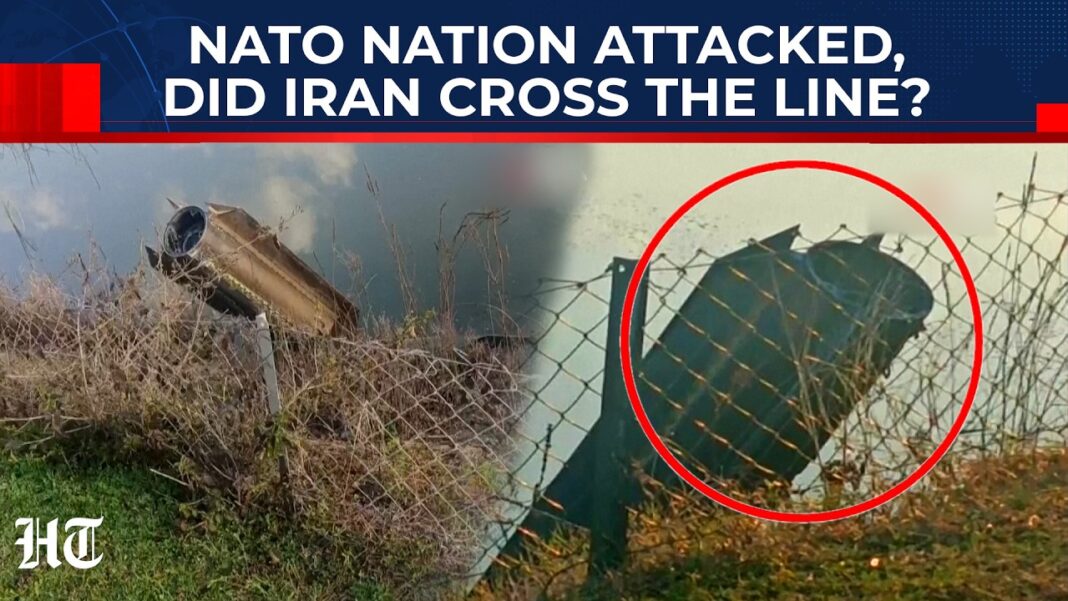
The widening Middle East war took an unexpected turn on Wednesday when Turkey intercepted an Iranian ballistic missile headed toward its airspace, marking a dramatic expansion of Tehran’s retaliation against joint US-Israeli strikes and signaling that the conflict is no longer confined to its original protagonists. According to report on Wednesday by The Algemeiner, the episode underscores a striking miscalculation by the Iranian regime — one that is increasingly isolating Tehran rather than pressuring Washington and Jerusalem to stand down.
The Turkish government confirmed that NATO-integrated air defenses destroyed the missile after it was detected over Iraq and Syria and determined to be on a trajectory toward Turkish territory. For Ankara, a majority-Sunni nation and NATO member that shares a 310-mile border with Iran, the incident represented an alarming escalation. Only two days earlier, Turkish President Recep Tayyip Erdoğan had called for “an end to the bloodbath,” characterizing the US-Israeli campaign launched over the weekend as “illegal.” Yet Tehran’s actions have now placed Turkey squarely within the arc of its retaliatory fire.
As The Algemeiner report detailed, Iran’s response to the US-Israeli strikes — which killed Supreme Leader Ayatollah Ali Khamenei and several senior officials — has extended far beyond Israeli targets. In a sweeping wave of missile and drone attacks, Tehran has struck at American-aligned nations across the Gulf, including Qatar, Bahrain, Jordan, Kuwait, Saudi Arabia, and the United Arab Emirates. The pattern suggests a calculated attempt to internationalize the conflict and generate diplomatic pressure on Washington by destabilizing the broader region.
Iran’s interim national security chief, Ali Larijani, insisted over the weekend that the Islamic Republic was “not seeking to attack” regional states and was acting solely in self-defense against American bases. Yet, subsequent strikes have hit civilian infrastructure — including power facilities and hotels — fueling outrage across the Arab world and beyond.
The scale of the campaign is striking. New figures released Wednesday by Israel’s Institute for National Security Studies (INSS) reveal that Iran has concentrated far more firepower on Gulf neighbors than on Israel during the war’s opening phase. Over the first four days, Iran launched approximately 200 missiles and 100 drones at Israel across 123 attack waves. In contrast, it targeted Gulf states with roughly 500 missiles and an astonishing 2,000 drones — more than double the missile count and twenty times the number of drones directed at Israel.
This disproportionate targeting reflects a deliberate strategy: to raise the economic and political costs of the war by threatening oil infrastructure and destabilizing energy markets. Michael Eisenstadt, a military analyst at the Washington Institute for Near East Policy and a former US Army officer, described the approach as an effort to apply “graduated pressure” by catalyzing opposition to the conflict in the United States and allied capitals.
By disrupting energy supplies and driving up prices, Tehran appears to hope that domestic constituencies in Western countries will demand a ceasefire. However, nearly every expert cited by The Algemeiner characterized the strategy as a profound blunder. Rather than fracturing the coalition arrayed against it, Iran’s assault on Gulf states has galvanized regional opposition.
Six Gulf Cooperation Council (GCC) states and Jordan issued a joint condemnation, labeling Iran’s attacks “indiscriminate and reckless” and reaffirming each nation’s right to self-defense. Jeremy Issacharoff, a former Israeli ambassador and arms control specialist, told The Algemeiner that Tehran’s actions have been counterproductive, turning states that had maintained nuanced or even cautiously positive ties into outright adversaries.
“Attacking countries like Qatar that were pretty much positively inclined towards them was a huge mistake,” Issacharoff said. “They’ve created more enemies.”
Issacharoff emphasized that Iran’s worldview remains anchored in hostility toward Zionism and the existence of a Jewish state, viewing Israel as an illegitimate entity within what it considers the Islamic world. Yet beneath that ideological fervor lies a broader strategic ambition: regional hegemony. “In the end, they were looking to be much more in control of the region, and of the Arab world as a whole,” he told The Algemeiner.
Ironically, the region had already been drifting in the opposite direction. Years of Iranian-backed proxy warfare — particularly Hezbollah’s missile campaigns against Israel — had quietly fostered security cooperation among Arab states, Israel, and the United States. Though much of this coordination has remained discreet, Issacharoff noted that it has deepened significantly in recent years.
“It’s discreet, but it’s happening,” he said, suggesting that Tehran’s latest attacks could accelerate that process, potentially expanding cooperation beyond military coordination into a broader framework for regional stability.
Former US Central Command communications director Joe Buccino went further, describing Iran’s decision as a “stunning strategic miscalculation” that could “set the Gulf states on [a] path toward normalization with Israel.” Speaking to Fox News, Buccino argued that shared threat perception often catalyzes diplomatic realignment.
Abbas Dahouk, a retired US Army colonel who previously served as a senior military adviser for Middle Eastern Affairs at the State Department, echoed this assessment in comments reported by The Algemeiner. He traced the evolution of regional coordination to Israel’s 2021 inclusion in CENTCOM — a move he characterized as transformative. The integration compelled militaries that had once avoided overt ties with Israel to “quietly mature counter-Iran plans over years of joint exercises and coordination.”
That groundwork is now visible in the operational scale of the current response. Dahouk told The Jerusalem Post that the coalition can deploy “hundreds of aircraft” simultaneously, conducting refueling operations, precision strikes on concealed targets, and countermeasures against Iran’s missile and drone networks. The scope of coordination, he suggested, leaves Gulf states little room for neutrality.
“The region must view the Iranian regime as a common threat alongside the United States and Israel,” Dahouk said. “At this moment, they have little alternative.”
Former US General Jack Keane reinforced this view, telling Fox News that Iran’s strategy had “backfired.” Keane noted that Gulf states are defending themselves robustly and are increasingly frustrated with Tehran’s aggression. Several GCC nations, he said, are preparing for combat contingencies.
Even within the Arab world, commentary has grown sharply critical. Emirati analyst Mohammad Al Ali wrote in Gulf News that Iran’s most significant achievement in the conflict has been to unite the region and much of the international community against it, erecting what he described as a “vast wall of isolation” around the regime.
The diplomatic fallout extends beyond the Middle East. Iran’s strikes have triggered alarm in Europe, prompting France, Greece, and Britain to deploy defensive military assets to the Mediterranean. European Union foreign policy chief Kaja Kallas lambasted Tehran for indiscriminately attacking its neighbors, accusing the regime of seeking to “sow chaos and set the region on fire.”
Polish Foreign Minister Radosław Sikorski expressed similar outrage after learning of the ballistic missile headed toward Turkish airspace. “Iran is broadening the war to countries that did not attack it,” he said. “There is a well-known saying: it’s worse than a crime, it’s a mistake.”
As The Algemeiner has reported, the war’s trajectory now appears shaped less by Iran’s intended leverage than by its unintended consequences. By targeting a wide swath of American allies — and even a NATO member — Tehran has inadvertently reinforced the perception of itself as a destabilizing force whose ambitions extend beyond immediate grievances.
In attempting to ignite regional pressure on Washington, the Islamic Republic may instead have cemented a broader alignment against its own ambitions. The interception over Turkey symbolized more than a defensive success; it illustrated the widening coalition determined to prevent Iran from reshaping the regional order through force.
Whether Tehran recalibrates or doubles down remains uncertain. The immediate effect of Iran’s retaliatory expansion has been to consolidate rather than fracture opposition — an outcome that could reshape the strategic landscape of the Middle East for years to come.
