



|
Getting your Trinity Audio player ready...
|
Edited by: Fern Sidman
Hezbollah, the powerful Iranian backed Lebanese terror group, has unveiled a complex and extensive network of underground tunnels in a video that serves as a stark warning to Israel. Dubbed the “Missile City,” this vast subterranean infrastructure is designed to house and launch missiles, potentially changing the dynamics of any future conflict in the region, as was reported on Friday by the US edition of The Sun of the UK.
The video, released by Hezbollah, offers a rare and unnerving glimpse into the group’s hidden capabilities, revealing a labyrinth of tunnels and underground roads that could significantly alter the strategic landscape of the Middle East.
Recent reports and investigations have unveiled a complex network of Hamas-operated weapons production facilities in the Gaza Strip. The Sun reported that according to statements from the Israel Defense Forces (IDF), these sites are not merely assembly points for weaponry but are integral parts of a sophisticated operation designed to produce and distribute long-range missiles and other munitions.
The primary workshops identified by the IDF are said to be located along and beneath the Salah a-Din main highway, a crucial infrastructure route in Gaza. As per the information provided in The Sun report, this highway was previously declared a humanitarian route by the IDF to assist civilians fleeing northern Gaza. However, its dual use as a site for weapons production complicates its role in the conflict.
These workshops are reportedly equipped with an array of metal tubes, components, and shell casings. The information in The Sun report also said that evidence from satellite imagery and on-the-ground reports suggests that long metal racks, possibly for storing missiles, and an elevator leading down into an underground tunnel system characterize these sites.
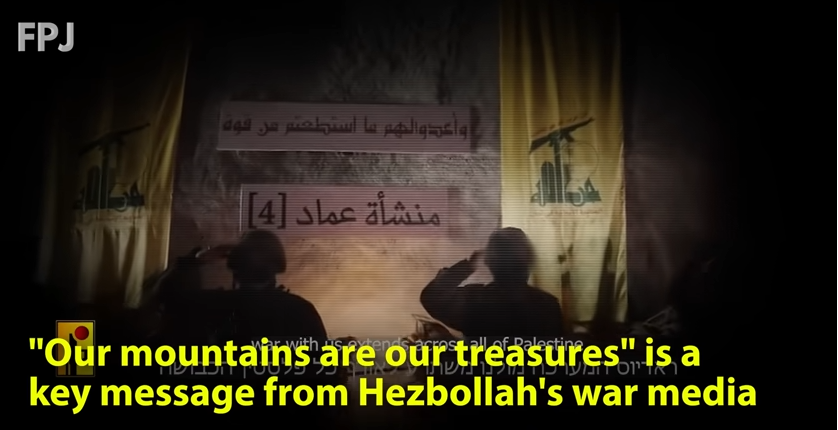
The video, produced with a clear intent to intimidate, showcases a sprawling underground network, complete with wide roads capable of accommodating large trucks laden with missiles, as was indicated in The Sun report. The footage begins with drone shots that capture the sheer scale of this underground world—a vast, shadowy maze where Hezbollah’s military assets are concealed.
As the video progresses, it becomes apparent that these tunnels are not merely passages but are part of a larger, more sophisticated military installation. The walls of the tunnels are adorned with posters of Hezbollah leaders and fallen soldiers, serving both as propaganda and a grim reminder of the group’s militant ideology. Detailed in The Sun report was that the heavily armed fighters, some on motorbikes, navigate through the tunnels, which are lined with advanced military technology and computers.
Hezbollah’s video provides a glimpse of the group’s missile arsenal, which includes both precision-guided and non-precision missiles. The narrator, speaking with a tone of defiance, emphasizes that these missiles are strategically positioned and ready to be launched at targets across Israel, The Sun report explained.
The video’s narrator makes it clear that Hezbollah’s missile capabilities are not confined to a single area. “War with us extends across all of Palestine,” he declares, highlighting the group’s ability to strike from the northernmost point of Israel, Qiryat Shemona, to the southern city of Eilat, near the Red Sea, according to the information in The Sun report. This statement highlights Hezbollah’s claim that it can target virtually any location within Israel’s borders, effectively putting the entire country within its crosshairs.
According to the IDF, these weapon production sites are not only sophisticated but also strategically positioned. Many of these workshops are allegedly situated along and beneath the Salah a-Din highway, a key thoroughfare that has become central to the conflict. According to the report in The Sun, this highway was initially declared by the IDF as a humanitarian route, intended to facilitate the safe passage of Palestinian civilians fleeing the conflict in northern Gaza. However, it has now been revealed that this area is also being used by Hamas for terrorist purposes, which further complicates the humanitarian situation.
The IDF claims that the workshops are connected through an intricate network of underground tunnels. These tunnels are used to transport the weapons produced in these workshops to various fighting units scattered throughout the Gaza Strip. The Sun also reported that this underground network not only facilitates the movement of weaponry but also provides a hidden, fortified environment where these weapons can be stored and managed away from the prying eyes of surveillance.
The variety of weaponry reportedly produced in these workshops is vast. The IDF has identified that Hamas is not only manufacturing long-range missiles but is also creating replicas and adaptations of standard military weapons, such as mortar shells, as was indicated in The Sun report. These modifications and reproductions indicate a level of technical sophistication that allows Hamas to maximize the impact of its arsenal against Israeli targets.
One of the most alarming discoveries is the scale of these operations. A variety of metal tubes, shell casings, and other components were found stacked in an overground workshop area, showcasing the extensive production capabilities within these facilities. The IDF has described one particular site as the largest Hamas weapons production site uncovered to date. This site featured long metal racks holding assembled missiles, with an elevator system leading down into the tunnel network. The report in The Sun noted that according to IDF spokesman Rear Admiral Daniel Hagari, this elevator system is crucial to the operation, as it allows the safe containment and movement of rockets within the tunnel system, further enhancing Hamas’ ability to launch attacks without exposing its operations to counterattacks.
The revelation of Hezbollah’s underground “Missile City” has profound strategic implications for Israel. For years, Hezbollah has been building up its military capabilities with the backing of Iran, and the existence of this tunnel network suggests that the group has been preparing for a protracted conflict with Israel. The tunnels provide Hezbollah with a significant tactical advantage, as they allow the group to protect its missile arsenal from Israeli airstrikes, which have been a cornerstone of Israel’s strategy in countering Hezbollah’s military buildup.
Moreover, the tunnels’ ability to facilitate the rapid movement and deployment of missiles means that Hezbollah can launch attacks with little warning, complicating Israel’s efforts to preemptively neutralize the threat. The group’s claim that it possesses precision-guided missiles also raises the stakes, as these weapons could be used to target critical infrastructure and military installations with a high degree of accuracy.
Hezbollah is not the only Iranian terrorist proxy group in the region to employ underground networks as part of its military strategy. Hamas, the Islamist terror group that controls the Gaza Strip, has also developed an extensive network of tunnels, some of which are used to manufacture and store rockets, as was indicated in The Sun report. Israeli forces have discovered these facilities beneath civilian areas, often protected by human shields, further complicating military operations against them.
The use of tunnels by both Hezbollah and Hamas highlights a broader trend among terror groups in the Middle East, who have turned to underground infrastructure as a means of offsetting Israel’s technological superiority. These tunnels not only protect their weapons and fighters but also enable them to conduct surprise attacks, thereby prolonging conflicts and increasing the cost of war for Israel
The current state of heightened alert comes in the wake of a series of events that have dramatically reshaped the geopolitical landscape of the Middle East. The conflict reached a critical turning point in October of last year when Hamas launched a brutal and unprecedented ambush on Israeli soil. This attack marked the beginning of a new and volatile phase of conflict, one that has seen Israel commit to a prolonged and intense military campaign aimed at dismantling Hamas’ infrastructure in the Gaza Strip.
Over the course of nearly ten months, Israel has conducted extensive airstrikes and ground operations in Gaza, resulting in the deaths of tens of thousands of people, many of whom were civilians. The Sun reported that this campaign has drawn international attention and condemnation, but Israel remains steadfast in its goal to obliterate Hamas, viewing it as a necessary step to ensure the security of its citizens.
The recent assassination of key terrorist figures by Israel has only added fuel to the fire. The Sun report pointed out that in late July, Israel carried out an airstrike in Beirut, resulting in the death of Hezbollah commander Fuad Shukr. Shukr was a high-ranking figure within the organization, and his death has sparked a strong reaction from Hezbollah’s leadership. Hassan Nasrallah, the group’s leader, has vowed to launch a “strong” retaliatory strike against Israel in response.
Israel is now preparing for what it sees as an inevitable retaliatory attack from Hezbollah. This expectation is further compounded by the recent assassination of Hamas commander, Ismail Haniyeh in Tehran on July 31, which has prompted Iran itself to vow revenge. The possibility of coordinated strikes from Hezbollah and other Iranian proxies is a scenario that Israel’s defense forces are taking seriously.
The situation has also prompted international concern. The United States has issued warnings to its citizens in Lebanon, urging them to leave the country as soon as possible. This advisory highlights the potential for significant violence in the event of an Israeli-Hezbollah confrontation. Similarly, British troops are reportedly on standby in the region, prepared to conduct military-grade evacuation operations if necessary.
