



|
Getting your Trinity Audio player ready...
|
By: Carl Schwartzbaum
For decades, the sunlit arc of Mexico’s Pacific coast has served as a refuge for American tourists seeking respite from the rigors of daily life, a place where the rhythms of surf and hospitality promise a temporary suspension of anxiety. On Sunday, that illusion of sanctuary was violently punctured. What unfolded on Sunday across Puerto Vallarta and the broader state of Jalisco was not merely an episode of criminal unrest but a tableau of retaliatory terror, ignited in the wake of the reported elimination of Nemesio Oseguera Cervantes—known as “El Mencho,” the leader of the Jalisco New Generation Cartel.
⚡️ #Mexico is in chaos.
After the killing of the country’s most powerful drug lord, the cartel reportedly declared war on the government and threatened to target civilians.
Reports say the airport in #Guadalajara has been completely overrun (video).
Cars are burning in the… pic.twitter.com/CHLt2LzqAe
— The Jewish Voice (@TJVNEWS) February 22, 2026
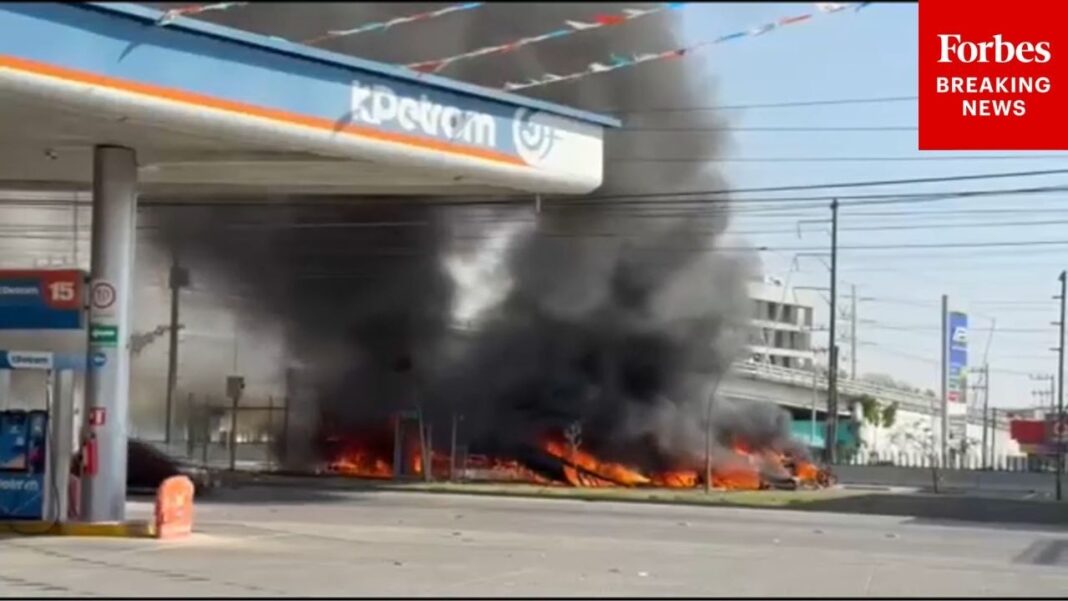
In the hours that followed, scenes of chaos emerged from one of Mexico’s most frequented resort regions, with armed cartel gunmen reportedly seizing control of roadways, surrounding resorts, and sending shockwaves through Guadalajara’s international airport. The transformation of a vacation idyll into a war zone has left American citizens in the region grappling with an acute sense of vulnerability, their lives abruptly recalibrated by the calculus of survival.
The violence was described by witnesses and circulated in drone footage of the aftermath as a descent into urban warfare. Heavily armed men moved with impunity through thoroughfares, and the normally bustling corridors of transit and tourism were reduced to arenas of fear. Reports indicated that the cartels stormed the airport in Guadalajara, one of Mexico’s busiest gateways, and shut down surrounding roads.
In Puerto Vallarta, tourists were urged to shelter in place as armed gunmen reportedly positioned themselves near resorts, effectively holding swathes of the region hostage to their retaliatory campaign. The immediacy of the threat prompted stark warnings to American citizens: remain indoors, seek secure shelter, and avoid all movement. The language of these advisories was unambiguous. This was not a moment for prudence alone; it was a moment of existential peril.
The New York Post, in dramatic footage obtained on Sunday, captured the raw panic at Guadalajara International Airport as travelers fled for their lives. Dozens of passengers, luggage in tow, poured through terminal doors while others cowered behind counters, seeking whatever cover could be improvised amid the uncertainty.
⚡️ Reports say Nemesio Oseguera Cervantes (“El Mencho”), head of the Jalisco New Generation Cartel, has been killed.
Cartel retaliation has sparked chaos across Mexico — roadblocks, burning vehicles, and airport disruptions reported. Details of the operation remain limited.… pic.twitter.com/4q9hZd2jeb
— The Jewish Voice (@TJVNEWS) February 22, 2026
The imagery was stark: a modern international hub, emblem of connectivity and global mobility, transformed into a space of primal fear. Tourists and locals alike hunkered down as the specter of cartel vengeance loomed, their movements governed by the instinctual imperative to avoid detection and harm. The Post reported that the mayhem radiated outward from the airport, seeding fear across Puerto Vallarta and throughout Jalisco, closing businesses and forcing visitors to remain confined within their hotels. In an extraordinary measure reflective of the severity of the moment, Jalisco officials ordered schools closed for Monday, an acknowledgment that the violence had spilled into the rhythms of civic life.
At the heart of this eruption lies the figure of Nemesio “El Mencho” Oseguera Cervantes, whose reported elimination by Mexican army forces appears to have triggered a coordinated backlash by cartel operatives. The calculus of such retaliation is brutally familiar within the ecosystem of organized crime: an attack on leadership is answered with a demonstration of force designed to reassert territorial control, intimidate rivals, and signal resilience.
Yet the collateral impact of this ritualized violence fell not upon rival factions alone but upon civilians—tourists, airport workers, local families—whose lives were abruptly conscripted into the theater of narco-politics. The closing of businesses and the paralysis of transportation infrastructure underscored how swiftly criminal reprisals can metastasize into broad societal disruption.
Amid the cacophony of reports, official narratives struggled to impose order upon chaos. The Pacific Airport Group issued a statement asserting that the Mexican National Guard had been dispatched to Guadalajara airport and that no incidents had taken place there, attributing reports of violence to “panic among passengers.” This attempt to reassure, however, sat uneasily alongside the footage of terrified travelers and the cascading closures across the region.
The dissonance between official assurances and the lived experience of those on the ground speaks to a recurrent challenge in moments of crisis: the gap between institutional messaging and the visceral reality of fear. When gunmen are reported to be shutting down roads and surrounding resorts, and when video circulates of crowds fleeing terminals, the semantics of “panic” offer scant comfort to those whose sense of safety has already been shattered.
For American citizens in Mexico, particularly in Puerto Vallarta where many vacation and even own property, the crisis raises urgent questions about contingency planning and state responsibility. As of the latest reports, there was no word from the US State Department on whether evacuations would be facilitated, especially given claims that the Guadalajara airport had been taken over by armed cartel gunmen.
The absence of immediate guidance has amplified anxiety among expatriates and tourists alike, who find themselves navigating a volatile environment with limited official direction. In the absence of coordinated evacuation efforts, the admonition to shelter in place becomes both a survival strategy and a reminder of the fragility of consular protections when violence escalates rapidly.
The episode also casts a harsh light on the broader dynamics of cartel power in Mexico. The ability of organized criminal groups to mobilize swiftly, seize strategic infrastructure, and impose a climate of terror across an entire state underscores the persistent challenge faced by Mexican authorities in asserting durable control. Even when high-profile figures are neutralized, the retaliatory capacity of these organizations reveals a structural resilience that transcends individual leadership. The consequences are borne not only by the immediate targets of violence but by the wider population, whose economic lifelines—tourism, commerce, education—are abruptly severed in the name of criminal spectacle.
For Puerto Vallarta, a city whose identity is intimately tied to the promise of safety and leisure, the incursion of cartel violence represents a reputational wound as well as a human tragedy. The spectacle of armed men near resorts and the confinement of tourists to their hotels erodes the foundational premise upon which the local economy depends. The long-term ramifications may extend beyond the immediate crisis, shaping perceptions among would-be visitors and investors who must now reckon with the volatility that can erupt even in spaces curated as havens of tranquility.
In the immediate term, the priority remains the safety of civilians caught in the crosscurrents of this upheaval. The exhortation to Americans to remain indoors and seek shelter is a grim testament to how quickly the geography of leisure can be reconfigured into a map of danger. As night falls over Jalisco and Puerto Vallarta, the cityscape that once glowed with the promise of hospitality now flickers with uncertainty. The absence of clear evacuation protocols compounds the sense of abandonment felt by those trapped between armed reprisals and institutional inertia.
This crisis, unfolding in real time, serves as a sobering reminder that the boundaries between zones of conflict and zones of leisure are more permeable than often assumed. The global circulation of tourists, capital, and images can obscure the latent tensions that persist beneath the surface of even the most carefully marketed destinations. When those tensions erupt, the resulting shock reverberates not only through local communities but through the transnational networks of travelers who suddenly find themselves implicated in a struggle far removed from the brochures and itineraries that brought them there.
As authorities seek to reassert control and restore a semblance of order, the scars of this episode will linger in memory and in the collective psyche of those who witnessed paradise under siege. The drone footage of smoldering streets, the videos of panicked travelers, the shuttered businesses and silent classrooms together compose a tableau of a region momentarily overwhelmed by forces that defy the narratives of safety upon which its prosperity depends.
Whether this violence marks a transient convulsion or a portent of deeper instability remains uncertain. What is clear is that, for now, the Pacific resort of Puerto Vallarta and the state of Jalisco have been thrust into a grim spotlight, their vulnerability laid bare in the aftermath of a cartel leader’s fall and the retaliatory storm that followed.
