



|
Getting your Trinity Audio player ready...
|
By: Fern Sidman
In a significant escalation of its ongoing military campaign, Israel has launched a sweeping series of coordinated airstrikes targeting key components of Iran’s military and intelligence infrastructure in and around Tehran. The operation, carried out overnight by the Israeli Air Force, marks one of the most expansive and strategically focused assaults on Iranian assets to date, signaling a deepening effort to degrade the operational capabilities of what Israeli officials describe as a hostile and destabilizing regime.
According to a report on Sunday by Israel National News, the strikes were conducted on the basis of precise intelligence gathered by the Israel Defense Forces. The targets included a range of facilities associated with weapons production, storage, training, and command functions—components that collectively form the backbone of Iran’s military apparatus.
The scale and scope of the operation underscore a deliberate and methodical approach. Israel National News reported that the strikes were not limited to a single category of target but instead encompassed multiple layers of Iran’s defense and security infrastructure. This multi-pronged strategy appears designed to disrupt both the immediate operational capabilities and the longer-term strategic planning of Iranian forces.
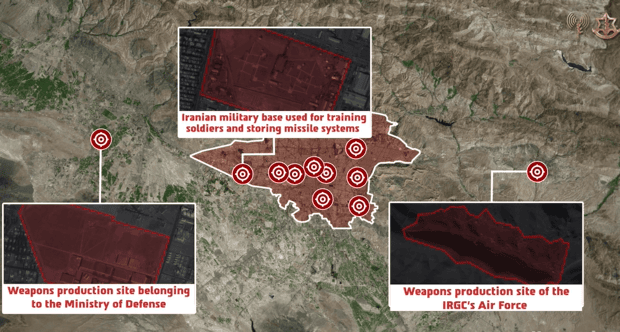
Among the key targets was a military base used for the training of soldiers and the storage of missile systems intended to engage aerial threats. The destruction or degradation of such a facility carries implications not only for Iran’s defensive posture but also for its ability to project power in contested airspace.
In addition, Israeli aircraft struck a weapons production and storage facility operated by Iran’s Ministry of Defense. Facilities of this nature are critical nodes in the supply chain that sustains military operations, enabling the manufacture and distribution of armaments across various units and theaters.
Israel National News emphasized that the targeting of such infrastructure reflects an intent to undermine the logistical foundations of Iran’s military capabilities, thereby reducing its capacity to sustain prolonged conflict.
Particularly noteworthy is the inclusion of a weapons production site linked to the air force division of the Islamic Revolutionary Guard Corps. This entity, widely regarded as a central pillar of Iran’s military and ideological framework, plays a pivotal role in both domestic security and external operations.
By targeting facilities associated with this force, Israel appears to be directing its efforts toward some of the most strategically significant elements of Iran’s military structure. Israel National News has reported that such strikes are intended to weaken the operational reach of the organization, which has been implicated in a range of activities across the region.
The focus on production sites suggests a recognition that disrupting the creation of military assets can be as impactful as neutralizing existing stockpiles. In this sense, the operation represents an attempt to address both current and future threats.
Beyond conventional military installations, the operation extended to intelligence and internal security facilities. Israeli forces reportedly struck an additional headquarters of Iran’s Ministry of Intelligence, as well as an emergency command center used by internal security forces.
These targets highlight the broader scope of the campaign, which encompasses not only military capabilities but also the mechanisms through which the Iranian state maintains control and coordination. The report at Israel National News noted that such facilities are integral to the regime’s ability to gather information, manage crises, and respond to both internal and external challenges.
The inclusion of these sites suggests an effort to disrupt command-and-control functions, potentially complicating Iran’s ability to organize and execute coordinated responses.
The Israeli military has characterized the strikes as part of a defined operational phase aimed at “further degrading the core systems and foundations” of Iran’s governing structure. This language, as reported by Israel National News, indicates a strategic framework that extends beyond immediate tactical gains.
Rather than isolated actions, the strikes appear to be components of a broader campaign designed to systematically weaken Iran’s military and institutional capacities. The emphasis on “core systems” suggests a focus on foundational elements—those that enable the regime to function effectively across multiple domains.
Israel National News has highlighted that this approach aligns with previously stated objectives, including the dismantling of weapons programs and the reduction of Iran’s ability to project power beyond its borders.
The intensification of Israeli operations carries significant implications for the broader regional landscape. By targeting sites in and around Tehran, Israel has demonstrated a willingness to extend its reach deep into Iranian territory, a development that may influence calculations on all sides.
The potential for retaliation remains a central concern. Iran’s response—whether immediate or delayed—could shape the trajectory of the conflict and determine whether it remains contained or escalates further. Israel National News has underscored the importance of monitoring subsequent developments, particularly in light of the interconnected nature of regional alliances and rivalries.
At the same time, the strikes may alter perceptions of deterrence. Demonstrating the capability and willingness to conduct such operations could influence the strategic calculus of both state and non-state actors, potentially reshaping the balance of power.
A notable feature of the operation is the apparent reliance on detailed intelligence. The ability to identify and target specific facilities—ranging from production sites to command centers—suggests a high degree of situational awareness and planning.
Israel National News has reported that such precision is essential in minimizing unintended consequences while maximizing operational effectiveness. In densely populated areas, the distinction between military and civilian infrastructure can be complex, making accurate intelligence a critical factor in executing targeted strikes.
The integration of intelligence and airpower reflects a broader trend in modern warfare, where information plays a central role in shaping outcomes.
As the conflict continues to evolve, the latest strikes represent a significant milestone in an ongoing campaign. The emphasis on infrastructure and institutional targets suggests a shift toward more comprehensive and sustained operations.
The Israel National News report noted that the progression of the campaign may involve additional phases, each building on the outcomes of previous actions. This layered approach allows for adaptation based on changing conditions and emerging intelligence.
The overnight strikes near Tehran mark a defining moment in the current phase of the conflict, illustrating both the scale and ambition of Israel’s military strategy. By targeting a wide array of facilities integral to Iran’s military and security apparatus, the operation seeks to achieve effects that extend beyond the immediate destruction of physical assets.
As the Israel National News report noted, the situation remains fluid, with each development contributing to a complex and rapidly shifting landscape. The ultimate impact of these strikes—on Iran’s capabilities, on regional stability, and on the broader trajectory of the conflict—will unfold in the days and weeks ahead.
What is clear, however, is that the stakes have risen considerably. In a contest defined by both overt action and strategic calculation, the latest operation underscores the intensity of the confrontation and the determination of the actors involved to shape its outcome.
