



|
Getting your Trinity Audio player ready...
|
By: Fern Sidman
Lebanon finds itself at a critical crossroads, one that merges domestic politics, regional conflict, and global diplomacy. On one side, the Lebanese government — for the first time in years — is seriously debating the disarmament of Hezbollah, the country’s most powerful non-state armed terror group. On the other, Hezbollah’s leadership is issuing stark warnings that any Israeli attempt at a wide-scale offensive will trigger massive missile strikes into Israeli territory.
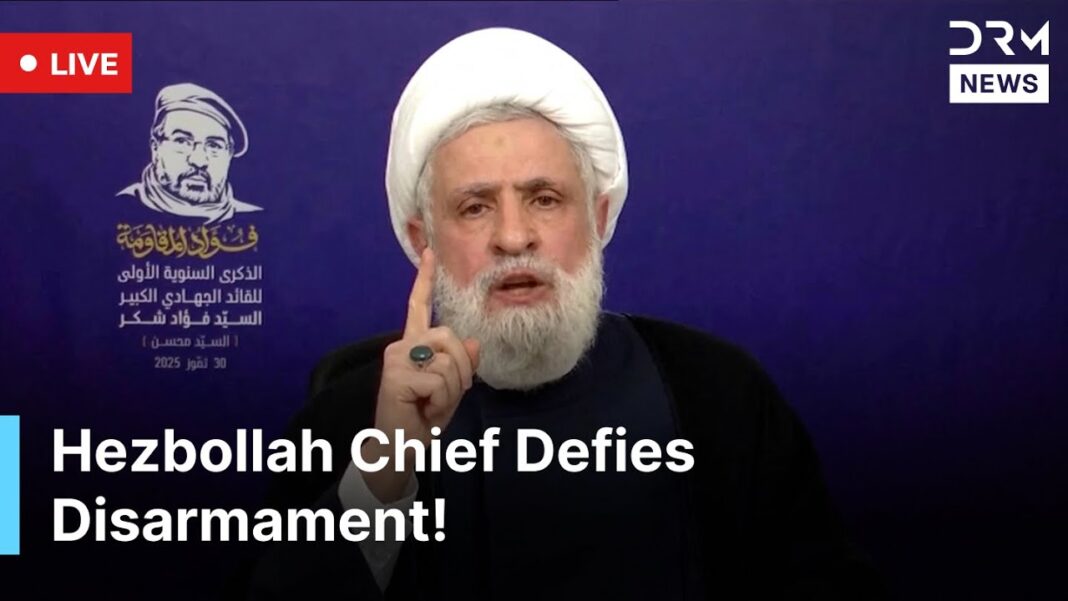
According to combined media sources, the latest flashpoint came as Hezbollah’s Deputy Secretary-General Naim Qassem delivered a fiery address marking 40 days since the elimination of Saeed Izadi, the commander of the Palestine branch of Iran’s Quds Force. His message was unmistakable: Hezbollah will not disarm, and any Israeli escalation would be met with devastating consequences.
Qassem declared that if Israel launched a large-scale offensive, “all the security they have built up over eight months will vanish in an hour.” He invoked Hezbollah’s core doctrine of the “triangle” — the resistance, the Lebanese army, and the people — presenting the group as inseparable from Lebanon’s defense.
According to combined media sources, Qassem went further, warning that “the resistance will remain on the ground and will win together with the people and the army.” He underscored Hezbollah’s resilience by citing its heavy losses in earlier conflicts — 5,000 dead and 13,000 wounded — while insisting that the organization remains strong, disciplined, and determined to maintain control of southern Lebanon.
The speech also signaled Hezbollah’s refusal to accept new agreements beyond what was signed in November during temporary ceasefire understandings. For Qassem, the issue was not Hezbollah’s weapons but what he framed as “Israeli aggression.” Only if that were resolved, he argued, could the question of arms even be considered.
At nearly the same time, the Lebanese government was engaged in a tense four-hour cabinet meeting on the question of disarming Hezbollah. Prime Minister Nawaf Salam confirmed afterward that discussions would continue later in the week, specifically on an American-proposed document calling for the consolidation of all weapons under state authority.
According to sources, Lebanon’s army has been instructed to produce a plan by month’s end to implement the proposal by the end of the year. Such a plan would, for the first time, legally mandate Hezbollah’s disarmament and transfer control of weapons to the state.
But the political reality quickly undercut the effort. Ministers from Hezbollah and the allied Amal Movement walked out before the meeting concluded, rejecting the language of the decision. Their withdrawal highlighted the contradiction at the heart of Lebanon’s politics: the state is attempting to legislate the disarmament of an organization that is itself embedded in government.
For Israel, Hezbollah’s warnings cannot be dismissed as bluster. The group is widely regarded as one of the most heavily armed non-state actors in the world, with an arsenal of some 150,000 rockets and missiles, including precision-guided systems capable of striking deep into Israeli territory.
Israeli officials have for weeks debated the prospect of launching a wide-scale offensive against Hezbollah if the group refuses to disarm or continues escalating its cross-border attacks. The calculation is shaped by Israel’s bitter memory of the 2006 Lebanon War, in which Hezbollah demonstrated its ability to withstand Israel’s air and ground assault while firing thousands of rockets into northern Israel.
Since the October 7, 2023 Hamas-led attack on southern Israel, Hezbollah has opened a second front along the Lebanese border, engaging in regular exchanges of fire with the Israel Defense Forces (IDF). While these clashes have remained limited, Israeli officials are weighing whether to expand operations before Hezbollah’s arsenal becomes an even greater strategic threat.
Qassem’s speech was calibrated to deter such action. Notably, he normalized the ongoing low-level clashes but warned against any major escalation. According to combined sources, this suggests Hezbollah is willing to tolerate the current “contained conflict” while maintaining a deterrent posture against all-out war.
The United States has long played a mediating role in Lebanon’s complex political landscape, balancing support for the Lebanese Armed Forces (LAF) with efforts to contain Hezbollah’s influence. Washington has repeatedly pushed for the disarmament of non-state militias in Lebanon, consistent with UN Security Council Resolution 1559, which calls for the dismantling of all Lebanese and non-Lebanese militias.
The current disarmament initiative stems from a U.S.-backed document being discussed in Beirut. American diplomats have pressed for a timetable under which the Lebanese army would assume full responsibility for the country’s defense, thereby reducing Iran’s influence through Hezbollah.
Yet Washington faces a dilemma. Hezbollah is not only a military force but also a political party with seats in parliament and representation in cabinet. Attempting to weaken its armed wing risks destabilizing Lebanon’s fragile political balance — a prospect that could plunge the country into renewed civil strife.
To understand the stakes, one must trace Hezbollah’s trajectory. Founded in the early 1980s with Iranian backing, Hezbollah emerged as a resistance movement against Israeli operations in southern Lebanon during the Lebanese Civil War. Over decades, it evolved into both a political party and a paramilitary force, effectively creating a “state within a state.”
Hezbollah’s military credibility was cemented in 2000, when Israel withdrew from southern Lebanon, an event the group portrayed as its victory. Its stature grew further after the 2006 war, despite Lebanon suffering massive destruction. Since then, Hezbollah has entrenched itself across Lebanon’s institutions while expanding its regional role, fighting in Syria alongside Iranian and regime forces.
The group’s arsenal, funded and supplied largely by Iran, has become a central feature of Israel’s security calculations. Israeli defense officials consistently warn that Hezbollah represents the single greatest conventional threat along its borders, far exceeding even Hamas in capability.
The Lebanese government’s debate over disarmament reflects the country’s long-standing paradox: a sovereign state that does not fully control its territory. The Lebanese Armed Forces, though respected internationally, remain underfunded and outgunned compared to Hezbollah’s paramilitary strength.
Previous attempts to integrate Hezbollah’s weapons into the state arsenal have failed. The group argues that its arms are necessary to defend Lebanon against Israel, while critics contend that Hezbollah’s independent military structure undermines the state’s authority and perpetuates conflict.
Prime Minister Salam’s insistence that the army draft a plan for disarmament represents a bold step, but one unlikely to succeed without Hezbollah’s cooperation. The group’s walkout from the cabinet session underscores the difficulty of imposing such decisions in a consensual political system where Hezbollah and its allies hold veto power.
The timing of these developments is particularly significant given the broader regional context. Iran, Hezbollah’s patron, continues to expand its influence across the Middle East through proxy forces in Iraq, Syria, Yemen, and Gaza. For Tehran, Hezbollah remains its most effective deterrent against Israeli or Western actions.
Hezbollah’s threats are not only aimed at Israel but also at shaping the regional balance of power. By projecting strength, the group reassures its base and signals to Iran that it remains a dependable ally. At the same time, Hezbollah’s integration into Lebanese politics ensures that any attempt to disarm it will trigger a national crisis.
For Israel, the stakes are equally high. Allowing Hezbollah to continue consolidating power and expanding its arsenal could leave Israel vulnerable to a multi-front war. Yet launching a large-scale offensive risks international backlash and the potential for catastrophic casualties on both sides.
The Lebanese government’s debate also touches on questions of sovereignty and international law. UN Security Council Resolution 1701, which ended the 2006 war, called for the disarmament of all armed groups in Lebanon except the state. Yet nearly two decades later, Hezbollah remains heavily armed and entrenched.
The American-backed disarmament document represents the most ambitious attempt to enforce these principles in years. But its chances of success remain uncertain, given Hezbollah’s refusal to comply and the government’s fractured political landscape.
What lies ahead is uncertain. Lebanon’s next cabinet meeting will again take up the disarmament proposal, but Hezbollah’s walkout makes clear that the group will resist any attempt to curtail its arsenal. Meanwhile, Israel continues to weigh the possibility of a large-scale offensive, calculating the risks and potential benefits of striking Hezbollah now versus later.
Qassem’s threats are designed to buy time, deterring Israel from escalation while Lebanon’s political process unfolds. Yet the very act of threatening Israel with missile barrages underscores the volatility of the situation — and the ease with which a spark could ignite a wider war.
Lebanon stands at a historic juncture. Its government is attempting to reassert state sovereignty over weapons, while Hezbollah insists that its arsenal is essential for national defense. Israel faces the constant threat of missile fire, while the United States pushes for disarmament to weaken Iran’s regional influence.
The convergence of these forces creates both an opportunity and a danger. Should Lebanon succeed in asserting state control, it could mark the beginning of a new era of sovereignty and stability. But if Hezbollah prevails, the status quo of dual authority will persist, leaving Lebanon trapped between domestic paralysis and regional confrontation.
For now, the threat is clear. As Naim Qassem warned: if Israel escalates, “missiles will fall.” Whether this threat deters war or hastens it may well determine Lebanon’s future — and the stability of the Middle East.

If Hezbollah attacks in this way, the IDF must exterminate everything in its path. Nothing should be left – nothing. This policy should be supported by the Chief Rabbis and alike – in public. Nothing less will do. Remember Rabbis – God is watching.