



|
Getting your Trinity Audio player ready...
|
By: Fern Sidman
In the quiet pre-dawn hours of Tuesday morning, gunfire shattered the stillness outside the United States Consulate in downtown Toronto, sending shockwaves through Canada’s largest city and intensifying concerns about rising political violence and antisemitic hostility in the region. Authorities confirmed that multiple shots were fired at the diplomatic facility located along University Avenue, a prominent boulevard in the city’s civic core, though miraculously no injuries were reported.
According to a report by The Associated Press, Toronto police responded to what they described as a “firearm discharge” at approximately 5:29 a.m. local time. Investigators arriving at the scene discovered visible damage to the consulate’s entrance, including what appeared to be bullet marks embedded in a glass door at the main entryway of the building.
The attack occurred at one of the most symbolically significant intersections in Toronto. The consulate stands along University Avenue, a broad and heavily trafficked thoroughfare that stretches toward the Ontario Legislative Building. Nearby landmarks include Toronto’s City Hall and several major hospitals, making the area a focal point of the city’s civic life.
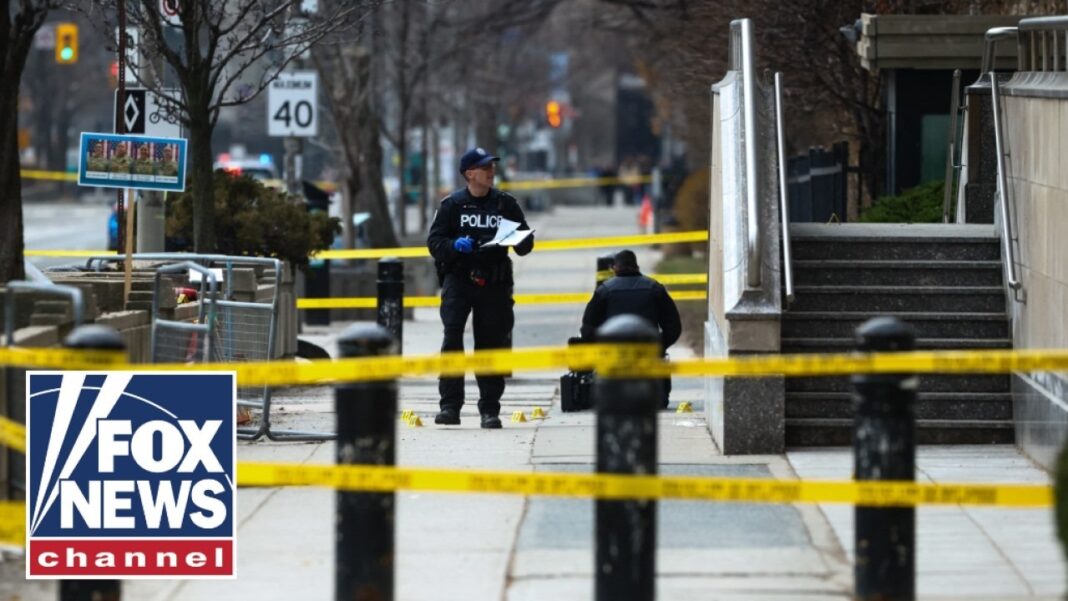
Television footage captured later in the morning revealed a heavy police presence surrounding the building. As daylight broke, officers cordoned off sections of the street while forensic investigators meticulously documented the damage. According to accounts reported by The Associated Press, specialists arrived in a large forensic van and began photographing the stone façade of the consulate as well as the damaged entrance.
Authorities have not yet publicly identified a suspect or disclosed a motive for the shooting. However, the incident has occurred at a time of heightened tensions surrounding the ongoing war involving Iran, the United States, and Israel—a conflict that has triggered demonstrations around the world.
The consulate itself has become a frequent site of protests in recent weeks. Demonstrators both supporting and opposing American and Israeli military actions have gathered outside the building, reflecting the deep international divisions over the war.
Police confirmed that surveillance cameras mounted around the consulate complex may prove critical to the investigation. According to the AP report, multiple cameras positioned around the perimeter of the facility could provide investigators with footage that may help identify whoever carried out the attack.
Although the gunfire caused no casualties, Canadian officials quickly condemned the incident as an act of intimidation directed at a key diplomatic partner.
Ontario Premier Doug Ford issued a statement shortly after the shooting was reported, describing the incident as “an absolutely unacceptable act of violence and intimidation aimed at our American friends and neighbors.”
Ford’s statement emphasized the importance of maintaining public safety and diplomatic security, warning that such acts threaten the principles of peaceful international cooperation.
“Everyone at all levels of government and across Canada needs to make clear that there is zero tolerance for this sort of intimidating and dangerous behavior,” he said.
The attack has also reignited concerns about a broader pattern of violence that has recently unsettled Toronto’s Jewish community. Only days before the consulate shooting, two synagogues in the greater Toronto area were struck by gunfire in separate incidents that remain under investigation.
Toronto Mayor Olivia Chow drew a direct connection between the events while speaking to reporters on Tuesday morning.
“The U.S. consulate was shot at. This comes after shootings at synagogues,” Chow said. “This cannot stand.”
The mayor stressed that the Jewish community must be able to live and worship without fear of violence or intimidation. Her remarks echoed growing alarm among Jewish organizations and security experts who have warned of a troubling rise in antisemitic incidents since the outbreak of the Israel–Hamas war.
“As we have seen too many times, antisemitic incidents spike when international incidents rise,” Chow said. “It is never acceptable to target the Jewish community.”
In response to the escalating security concerns, Toronto authorities have increased police patrols near both the American and Israeli consulates in the city. Mayor Chow confirmed that additional officers have been deployed to safeguard diplomatic facilities as well as Jewish institutions.
The proximity of the consulate to other important government buildings makes the attack particularly concerning for security officials. University Avenue is not only a major transportation corridor but also a symbolic axis of public administration in Toronto, connecting the city’s financial district to provincial government institutions.
For investigators, the key challenge now lies in determining whether the gunfire was an isolated act of vandalism, a politically motivated attack, or part of a broader pattern of intimidation connected to global events.
The AP reported that the early-morning timing of the shooting meant that the area was largely empty at the time, likely preventing any injuries. However, the fact that a diplomatic facility was targeted has elevated the incident to a matter of national security concern.
Diplomatic missions are protected under international law, and attacks on such facilities are taken extremely seriously by host governments. Security experts note that even relatively minor acts of violence against consulates or embassies can carry significant geopolitical implications.
The United States government has not yet issued a detailed statement about the shooting, but American diplomatic missions around the world typically coordinate closely with host-country authorities in the aftermath of such incidents.
The shooting comes against a backdrop of heightened global tension following the military confrontation between Iran and a U.S.-Israel alliance. Protests tied to the conflict have erupted in numerous cities worldwide, including Toronto.
According to the AP report, demonstrations outside the U.S. consulate have taken place throughout the week, with activists expressing both support for and opposition to the military campaign against Iran.
While protests are common outside diplomatic missions, security experts caution that emotionally charged demonstrations can sometimes create an environment in which isolated individuals resort to acts of violence.
Authorities have not indicated whether the suspect responsible for Tuesday’s shooting had any connection to the protests.
For many residents of Toronto, the incident has reinforced a sense of unease that has grown over the past several days. The shootings at synagogues and now the attack on the U.S. consulate have fueled concerns about whether political tensions abroad are spilling into acts of violence at home.
Community leaders have urged calm while also calling for vigilance.
Jewish organizations in Toronto have repeatedly emphasized that threats against synagogues and other institutions must be treated with the utmost seriousness. In recent years, many Jewish congregations across North America have already implemented enhanced security measures, including surveillance systems, controlled access points, and coordination with law enforcement agencies.
The attack on the consulate underscores the reality that diplomatic sites may also become targets during periods of geopolitical conflict.
Security analysts interviewed by the AP noted that the symbolic value of such locations often makes them attractive targets for individuals seeking to send a political message.
At the same time, officials have cautioned against drawing premature conclusions before the investigation is complete.
Toronto police have urged anyone with information about the incident to contact investigators. Authorities are also reviewing surveillance footage from nearby buildings and traffic cameras in an effort to reconstruct the events leading up to the shooting.
For now, the consulate itself remains open, though access to the surrounding area has been temporarily restricted as forensic teams continue their work.
The images of bullet marks in the consulate’s glass entrance serve as a stark reminder of how international conflicts can reverberate far beyond the regions where they originate.
As the investigation continues, Toronto’s leaders have sought to reassure residents that law enforcement is treating the matter with urgency.
Yet the broader questions raised by the incident—about rising antisemitism, escalating political tensions, and the security of diplomatic institutions—are likely to remain at the forefront of public debate in the days ahead.
For a city that prides itself on multicultural harmony and civic stability, the events of Tuesday morning represent a troubling moment.
Whether the shooting proves to be an isolated act or part of a deeper pattern of unrest, the message from authorities has been unequivocal: violence and intimidation have no place in Toronto.
