



|
Getting your Trinity Audio player ready...
|
‘Dirty Jew, I’ll Kill You’: Brutal Attack in Paris Suburb Becomes Flashpoint in France’s Battle Against Surging Antisemitism
By: Fern Sidman
A shocking antisemitic assault in the Paris suburb of Yerres on Saturday morning has shaken France’s Jewish community and reignited urgent calls for stronger protections against the rising tide of hate. The victim, 67-year-old Gilles Cohen, a visibly observant Jew wearing a kippa, was violently beaten by an assailant shouting antisemitic slurs as he returned from the mikveh.
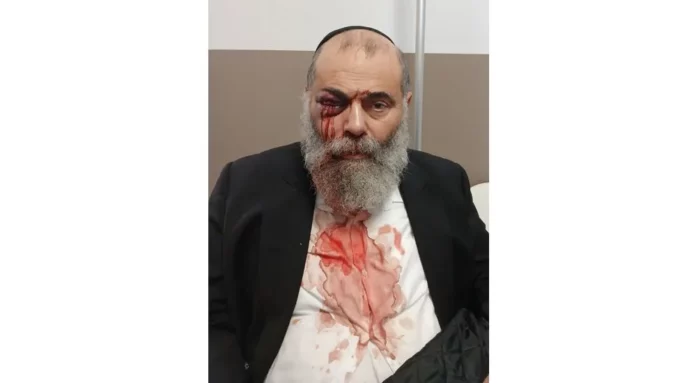
According to police reports cited in a report that appeared on Sunday at World Israel News (WIN), the attacker screamed, “Dirty Jew, I’m going to kill you!” while assaulting Cohen. Witnesses said the attacker also searched him in an apparent attempt to steal money and the keys to the local synagogue — a detail that has alarmed community leaders, who fear the assault was not only an act of hatred but also a potential prelude to a larger attack.
The incident occurred in broad daylight, a fact that has further rattled locals who believed their town to be relatively safe from antisemitic violence. Passersby intervened to stop the attack before more serious harm could occur, a moment of civic courage that likely spared Cohen’s life.
Cohen was taken to a nearby hospital with significant injuries, including a swollen eye and other trauma. Doctors issued him a medical certificate for 15 days of total incapacity to work — a legal designation that underscores the severity of his injuries. He was discharged later that evening but remains under medical supervision.
Despite his ordeal, Cohen reportedly attended Sunday morning services, a gesture of resilience that community members described as both courageous and symbolic. WIN highlighted this as a powerful act of faith and defiance in the face of intimidation.
The Évry prosecutor’s office quickly confirmed that an investigation has been opened into the attack, with charges including:
Attempted violent theft resulting in more than eight days of incapacity for work.
Religious-based aggravation of the crime.
Death threats motivated by religion.
The case has been assigned to Essonne’s territorial crime unit, which is now working to identify and apprehend the suspect. As of Sunday evening, however, no arrests had been made — a delay that has only added to the community’s frustration and fear.
Local Jewish leaders and educators have spoken out in shock at the attack. Mendel Gourevitch, director of the Yeshiva in nearby Brunoy and a close friend of Cohen, told reporters that “everyone is worried, especially parents of students at the school. This kind of violence is unprecedented here.”
The assault has left many parents fearful about the safety of their children attending Jewish institutions. Although antisemitic incidents have become disturbingly common in France, Gourevitch’s emphasis that this level of violence is “unprecedented” in Yerres highlights how even towns with small, tightly-knit Jewish populations are no longer immune.
Rabbi Michel Serfaty of Ris-Orangis echoed this sentiment but struck a cautious note, warning against allowing fear to dominate. “All I can do is express sympathy,” he said. “But we must be careful not to feed fear or panic.”
The attack has also drawn condemnation from across the political spectrum. Antoine Léaument, a French lawmaker representing Essonne’s 10th district, posted on X (formerly Twitter): “The slurs used during this attack leave no doubt about its antisemitic nature. The perpetrator must be found and tried.”
The Israeli Embassy in France released a strong statement as well, describing the incident as “a most serious act, which fits into the disturbing context of the continuing rise in antisemitism in France.” The embassy wished Cohen a speedy recovery and voiced confidence that French authorities would act swiftly to deliver justice.
The report at World Israel News noted that this was not the first time the embassy has issued warnings about the deterioration of safety conditions for French Jews, especially since the outbreak of the Israel-Hamas war last year.
The Representative Council of French Jewish Institutions (CRIF), the country’s main Jewish umbrella organization, placed the incident within the broader context of a dangerous rise in antisemitic incidents. Yonathan Arfi, CRIF president, pointed out that attacks on Jewish individuals, including rabbis in other French cities, have surged in recent months.
“No one will uproot the Jews from France,” Arfi declared. “But it is high time to uproot the antisemitism festering in society, using a conflict 3,000 kilometers away as a pretext.”
WIN has documented the steady escalation of hostility faced by Jewish communities in Europe since the October 7 Hamas-led massacre in southern Israel, reporting that French Jews have been especially targeted in incidents ranging from graffiti and verbal abuse to violent assaults and attempted arson attacks on synagogues.
For many in France’s Jewish community, the assault in Yerres embodies both the ongoing threat and the steadfast determination of Jews to resist intimidation. Cohen’s choice to attend services the very next morning, despite his injuries, has been described by friends as a testament to the enduring spirit of French Jewry.
Yet, this resilience cannot mask the growing sense of vulnerability. Parents are increasingly uneasy about sending children to Jewish schools, elderly Jews fear displaying outward symbols of faith, and communal institutions face mounting security costs.
WIN reported that many Jewish leaders are calling for a stronger police presence near synagogues and schools, as well as tougher sentences for hate crimes.
The Yerres assault comes at a time when antisemitism has become a defining test for the French Republic’s commitment to its principles of liberté, égalité, fraternité. Successive governments have pledged to protect Jewish citizens, but critics argue that the state has failed to stem the tide of hatred.
France, home to Europe’s largest Jewish population, has long struggled with balancing freedom of expression and the need to protect vulnerable minorities. The recent spike in antisemitic incidents is testing this balance once again.
In recent years, French authorities have implemented a series of initiatives, including dedicated prosecutors for hate crimes, educational campaigns, and increased police patrols. Yet, as the WIN report pointed out, the persistence of violent incidents raises questions about the effectiveness of these measures.
The attack on Gilles Cohen shines a proverbial spotlight on the urgent need for stronger protections and a more forceful societal response to antisemitism. It is not only Jewish leaders who are sounding the alarm; lawmakers, educators, and international observers are increasingly acknowledging the crisis.
But beyond legal and political measures lies a deeper challenge: changing the cultural climate that allows antisemitism to fester. As Rabbi Serfaty observed, it is crucial not only to prevent panic but also to foster resilience and solidarity across French society.
For Cohen, the assault is a personal tragedy, yet his quiet act of returning to synagogue services sends a powerful message — one that reflects the determination of Jews in France to maintain their faith and traditions despite intimidation.
The violent antisemitic assault in Yerres has become more than a local incident; it has become a symbol of the broader struggle facing French Jews. It highlights the intersection of physical danger, political tension, and societal failure to uproot deep-seated prejudice.
As World Israel News reported, the assault adds to an already alarming pattern of attacks that have left Jewish communities across Europe questioning their safety. While condemnation has been swift, the true test will be in whether French authorities can turn rhetoric into meaningful action — both in prosecuting the perpetrator of this crime and in ensuring that Jews across the country can live without fear.
Until then, the sight of Gilles Cohen walking into synagogue with visible injuries but unbroken spirit will stand as a poignant reminder of resilience in the face of hate — and a call to action for a nation that must decide whether it will finally confront antisemitism with the urgency it demands.
