



|
Getting your Trinity Audio player ready...
|
By: Fern Sidman
The language of remembrance carries a gravity that transcends the ceremonial. It is not merely a gesture toward the past, but a declaration of historical truth, moral clarity, and collective responsibility. When that language falters, the consequences reverberate far beyond the moment of error. This reality came sharply into focus in Canada earlier this year, when the country’s military was compelled to retract a Holocaust Remembrance Day message that failed to identify Jews as the primary victims of the Nazi genocide. The episode, as reported by United With Israel on Wednesday, has prompted both a reckoning within Canada’s armed forces and a broader conversation about the fragility of historical memory in an era of resurgent antisemitism and waning public literacy about the Shoah.
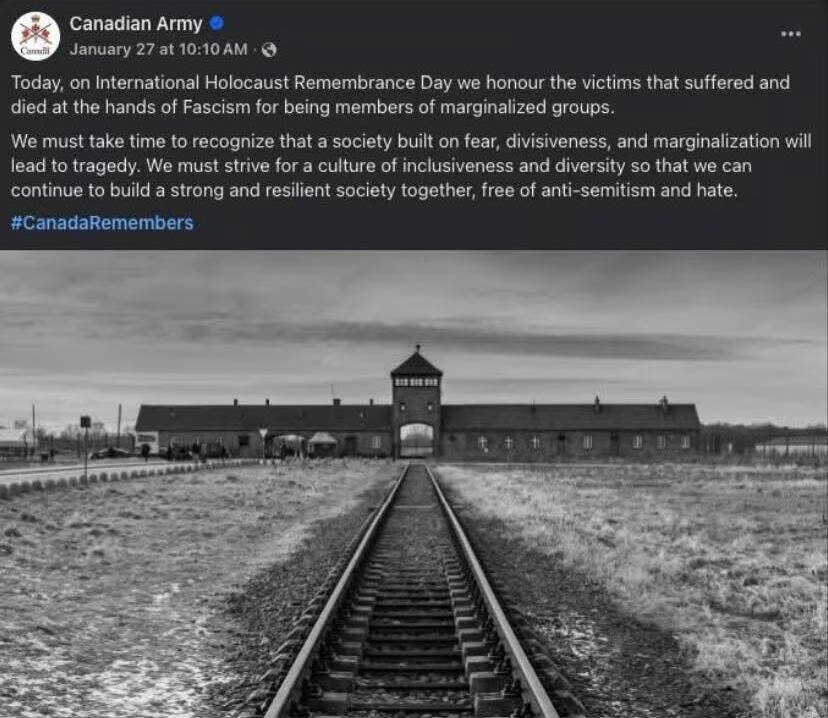
The controversy centered on a social media post published on January 27 to mark International Holocaust Remembrance Day. The message referred to those who “suffered and died at the hands of fascism for being members of marginalized groups” and urged a society free of antisemitism and hatred. While the language gestured toward universal values, its formulation omitted explicit reference to the Jews who were the central, primary, and intended victims of the Holocaust. The post was removed after officials recognized the gravity of the omission, and the Canadian Army subsequently acknowledged that the wording failed to reflect “the historical reality of the Holocaust, specifically the genocide of six million Jews.” United With Israel reported that the military expressed regret and apologized for the hurt caused, conceding that the message did not meet the moral and historical standards demanded by such a commemoration.
For Jewish organizations, historians, and educators, the error was not a matter of semantics but of substance. The United With Israel report highlighted the response of pro-Israel media watchdog HonestReporting, which argued that removing the post, while necessary, was insufficient. The organization called for a clear and unequivocal apology to Jewish Canadians, emphasizing that commemoration without specificity risks diluting the singular historical crime of the Holocaust. The insistence on precision was echoed by voices within Canada’s Jewish community, who warned that generalizing the Holocaust into a broader narrative of “marginalized groups” obscures the genocidal intent that distinguished the Nazi project from other forms of persecution.
Dara Solomon, executive director of the Toronto Holocaust Museum, articulated this concern with particular force. In remarks cited by United With Israel, she noted that omitting Jews from a Holocaust commemoration dishonors the memory of the six million Jewish victims and undermines the educational mission of remembrance, especially at a time when antisemitism is again on the rise and knowledge of the Holocaust is demonstrably declining among younger generations. For institutions entrusted with public commemoration, such omissions are not neutral; they shape the contours of collective memory and influence how future generations understand the moral lessons of the twentieth century’s darkest chapter.
Simon Wolle, chief executive of B’nai Brith Canada, underscored the psychological and communal ramifications of such erasures. United With Israel reported that Wolle stressed the necessity of explicitly recognizing the Jewish victims of the Shoah, warning that failure to do so deepens the trauma of a community still living with the Holocaust’s legacy. Remembrance, in this view, is not a generic invocation of suffering but a precise act of historical fidelity. To blur that specificity is to risk turning commemoration into abstraction, severed from the concrete realities of genocide.
The Canadian Army’s response has been to revise its internal review procedures for historically and culturally sensitive content. According to the information provided in the United With Israel report, military officials acknowledged that the post had been reviewed internally but without consultation with Jewish community representatives prior to publication. In the aftermath of the controversy, the armed forces pledged to implement enhanced safeguards, including more rigorous senior-level review and consultation mechanisms. They also met with staff from the Office of the Chaplain General to inform changes aimed at preventing similar errors in the future. These steps, while procedural in nature, reflect a recognition that remembrance is not merely a matter of institutional messaging but of ethical stewardship.
Yet the episode raises questions that extend beyond the particulars of one ill-considered post. The United With Israel report situated the controversy within a broader global pattern in which Holocaust remembrance is increasingly subject to dilution, distortion, or politicization. As the living witnesses to the Shoah pass from the world, the burden of memory shifts ever more heavily onto institutions, educators, and public officials. In this context, errors of omission carry a heightened risk: they signal not only a lapse in historical knowledge but a potential erosion of the moral frameworks that undergird postwar commitments to combating antisemitism and defending human dignity.
The formulation of the original message—emphasizing “marginalized groups” under fascism—reflects a broader contemporary tendency to universalize historical trauma in ways that, while well-intentioned, can flatten the specificity of genocidal crimes. Such universalization, when detached from historical particularity, risks transforming the Holocaust into a generic symbol of oppression rather than a concrete historical event with identifiable perpetrators, victims, and ideological underpinnings. The danger of this approach lies in its potential to weaken the clarity with which societies recognize and confront antisemitism, both past and present.
The Canadian military’s acknowledgment that the Holocaust was the genocide of six million Jews is therefore more than a corrective footnote; it is an affirmation of historical truth that carries contemporary resonance. The United With Israel report emphasized that precision in remembrance is inseparable from vigilance against present-day antisemitism. When institutions falter in naming the Jewish victims of the Holocaust, they inadvertently contribute to a cultural environment in which antisemitism can be minimized, relativized, or obscured. In an era marked by spikes in anti-Jewish incidents across the West, such lapses are not merely symbolic but potentially consequential.
The episode also invites reflection on the responsibilities of state institutions in shaping public memory. Armed forces, as embodiments of national authority and guardianship, occupy a particular moral space in the public imagination. Their commemorative practices signal the values a nation seeks to uphold. When military institutions engage in remembrance, they do so not only as participants in civic ritual but as custodians of a historical narrative that informs national identity and ethical orientation. Errors in this domain therefore resonate with particular force, prompting scrutiny not only of procedural safeguards but of the deeper institutional cultures that produce such missteps.
To its credit, the Canadian Army has acknowledged the error and committed to reforms. The work of remembrance cannot be reduced to procedural compliance. It requires sustained engagement with historical scholarship, meaningful consultation with affected communities, and a willingness to confront uncomfortable truths about the persistence of prejudice. The consultation mechanisms now being implemented represent a step toward greater accountability, but their efficacy will depend on whether they foster genuine dialogue rather than perfunctory box-ticking.
The controversy also serves as a cautionary tale for institutions beyond Canada’s borders. The dilution of Holocaust specificity is not an isolated phenomenon but part of a broader trend in which historical memory is refracted through contemporary ideological lenses. In some cases, this refracting process leads to the instrumentalization of Holocaust narratives in political debates that bear little relation to the historical realities of Nazi genocide. In others, it produces a sanitized universalism that obscures the particular antisemitic ideologies that animated the Shoah. Both tendencies undermine the educational and moral purposes of remembrance.
At its core, Holocaust Remembrance Day is an invitation to confront the abyss of human cruelty and to reaffirm commitments to justice, truth, and the protection of vulnerable communities. United With Israel has consistently maintained that such remembrance must be anchored in historical accuracy, not as an exercise in pedantry but as a safeguard against the erosion of moral clarity. The Canadian military’s misstep, and its subsequent efforts to correct course, illustrate both the fragility of collective memory and the possibility of institutional learning.
As antisemitism resurges in new guises and old forms, the stakes of remembrance grow ever higher. The episode underscores that memory is not self-sustaining; it requires vigilant cultivation. For Canada’s armed forces, the lesson is clear: commemorative language must be crafted with the same care and deliberation as any other exercise of public authority. For the broader international community, the incident stands as a reminder that the integrity of Holocaust remembrance is a litmus test of our collective commitment to historical truth and moral responsibility.
