



|
Getting your Trinity Audio player ready...
|
By: Ariella Haviv
The history of warfare, brutal as it is, has nevertheless been governed by certain boundaries—lines that distinguish legitimate military action from the deliberate targeting of civilians. Those lines are imperfect and often tragically crossed, but they exist for a reason: without them, war devolves into little more than organized terror.
In the ongoing Middle Eastern conflict surrounding Operation Epic Fury, the joint U.S.–Israeli campaign aimed at dismantling Iran’s nuclear and missile infrastructure, those moral boundaries are once again being tested. Among the most troubling developments of the war has been Iran’s deployment of missile-delivered cluster munitions against Israeli population centers, a tactic that represents not merely an escalation in firepower but a profound violation of the principles that are supposed to govern armed conflict.
The use of cluster munitions is itself controversial, but the issue at stake here is not merely the weapon. It is the manner in which the weapon is used—and the target against which it is deployed.
In Iran’s case, the evidence increasingly suggests that these munitions are being deliberately configured and launched in ways that maximize harm to civilians rather than military objectives. That distinction matters. It matters morally, strategically, and legally.
Cluster munitions are designed to disperse multiple smaller explosive devices—known as submunitions or bomblets—over a defined area. Their purpose is typically to attack area targets, such as concentrations of equipment, vehicles, or aircraft.
In traditional military doctrine, these weapons are used against targets such as airfields and runways, aircraft parked on tarmacs, logistical depots, vehicle formations and lightly armored military infrastructure.
A classic example of this kind of weapon is the D-variant Tomahawk cruise missile, which can release a cluster of bomblets over a specific military objective.
When used in such a context, the submunitions are released at relatively low altitude directly over the target area, ensuring that the explosive pattern is concentrated where the intended military objective lies.
This is how cluster munitions have historically been used by major military powers such as the United States and Israel when they have employed them at all. The goal in these scenarios is clear: to neutralize military assets clustered in a specific location.
The weapon is not designed to scatter explosives across civilian neighborhoods.
Iran’s cluster munitions, however, appear to function differently. Rather than releasing their submunitions at low altitude directly above a defined military objective, Iranian missiles reportedly eject bomblets while still at high altitude, allowing them to spread across a far wider area. The result is not a concentrated strike on a military facility.
It is a broad dispersion of explosives over urban environments. In practical terms, this means bomblets can fall across streets, residential buildings, schools, and public spaces. The weapon becomes indiscriminate. And when indiscriminate weapons are used deliberately against cities, the line between warfare and terrorism begins to vanish.
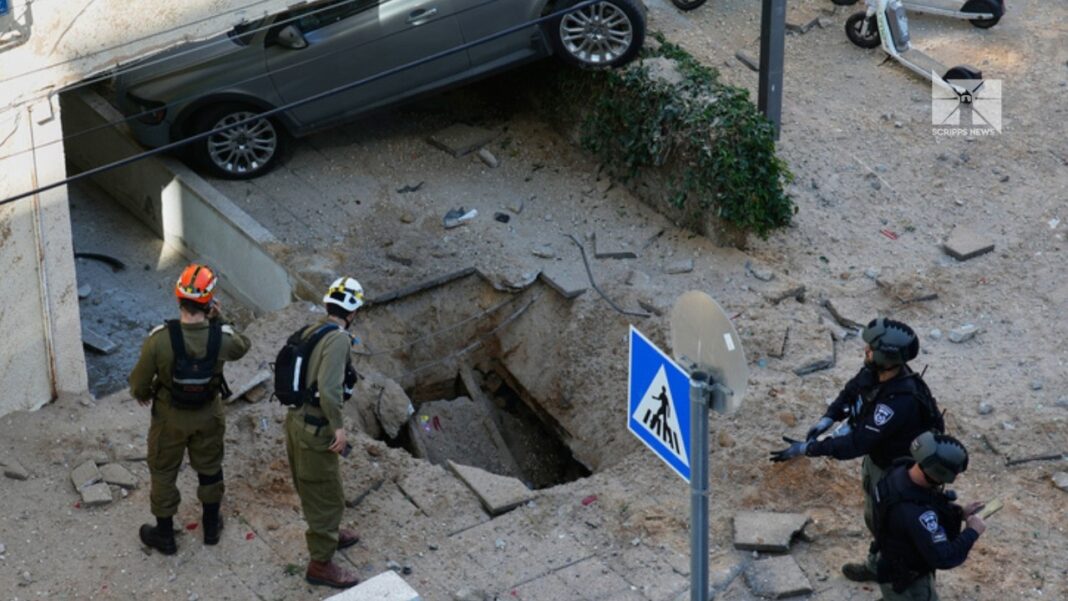
During the current war, several incidents have illustrated the devastating consequences of these tactics. In one recent attack reported during the ongoing conflict, an Iranian missile carrying cluster submunitions struck central Israel, scattering explosive bomblets across multiple neighborhoods.
Fragments and unexploded devices were discovered in areas including Tel Aviv suburbs and densely populated residential districts, forcing emergency responders to comb through streets and buildings to locate the dangerous remnants. Several civilians were injured by shrapnel and debris, including elderly residents who were struck by shattered glass and flying fragments after submunitions detonated near apartment blocks.
Elsewhere, emergency services reported fires and structural damage after bomblets struck buildings and vehicles. Perhaps most alarming were the reports that unexploded bomblets remained scattered across urban terrain, posing a continuing threat to civilians even after the immediate attack had ended.
Police bomb squads were forced to conduct painstaking sweeps through neighborhoods to locate and neutralize the devices. These are precisely the types of hazards that cluster munitions critics have warned about for decades.
But in the Israeli case, the danger is compounded by the fact that the bomblets are being intentionally dispersed over civilian population centers rather than military installations.
The strategic logic behind such tactics is grimly familiar.
Cluster munitions used in this manner are not primarily intended to destroy military hardware. Instead, they serve as instruments of psychological warfare. Their purpose is to spread fear.
When submunitions fall unpredictably across a city, residents cannot know where the next explosion might occur. Streets become dangerous, sidewalks uncertain, and the simple act of leaving one’s home becomes fraught with risk.
Even after the immediate detonations have ended, unexploded bomblets may remain hidden among rubble or debris. Children, pedestrians, and emergency responders can become victims hours or even days later.
In effect, entire neighborhoods become temporary minefields. This is not warfare in the conventional sense. It is terror delivered from the sky.
It must be said clearly: cluster munitions themselves are not inherently immoral when used properly against military objectives. Many weapons of war are capable of terrible destruction. What matters is how they are used and against whom.
A cluster weapon deployed against aircraft parked on an airfield is fundamentally different from one dispersed over apartment blocks. The first targets military assets. The second targets civilians.
That distinction lies at the heart of international humanitarian law, which requires combatants to distinguish between military objectives and civilian populations.
Iran’s deployment of cluster munitions over Israeli cities represents a stark violation of this principle.
Both Israel and the United States have faced intense scrutiny for their military operations over the years, including debates about the use of cluster weapons.
Yet their operational doctrine has generally adhered to the classic model of cluster deployment—releasing submunitions directly over defined battlefield targets.
In those scenarios, the weapons are intended to destroy equipment or infrastructure that contributes to an enemy’s military capability.
They are not meant to scatter explosives across residential neighborhoods. The difference between these two approaches is not merely technical. It is moral.
Iran’s use of cluster munitions against Israeli cities also reflects a broader strategy that has long characterized the tactics of Tehran and its regional proxies. Rather than focusing solely on military targets, Iranian strategy frequently emphasizes asymmetric warfare, including attacks on civilian populations designed to weaken public morale.
Hezbollah rocket barrages, Hamas missile attacks, and now Iranian cluster munitions share a common characteristic: their intended impact on civilian life. The objective is not merely to win battles but to impose psychological and societal costs on the opposing population.
In this sense, the cluster munition attacks on Israeli cities represent a continuation of a strategy that prioritizes intimidation over military necessity.
The use of such weapons should provoke unequivocal condemnation.
Too often, discussions about Middle Eastern conflicts become entangled in political biases and geopolitical rivalries. But the deliberate targeting of civilian areas with wide-area explosive weapons should be universally recognized as unacceptable.
The principles governing armed conflict exist precisely to prevent such tactics from becoming normalized. If those principles are abandoned, the consequences will extend far beyond a single conflict. They will shape the future conduct of warfare itself.
History has shown that when the international community fails to confront tactics that endanger civilians, those tactics spread. Weapons designed for battlefield use are repurposed for terror. Cities become targets. Civilian lives become bargaining chips in geopolitical struggles. Iran’s cluster munition attacks against Israel represent precisely such a moment.
They demand not only condemnation but clarity. Because when explosives rain down across neighborhoods, the victims are not soldiers. They are families. They are children. And they are the innocent people who should never have been part of the battlefield at all.
