



|
Getting your Trinity Audio player ready...
|
By: Fern Sidman
More than three decades after the devastating bombing of the Argentine Israelite Mutual Association (AMIA) Jewish community center in Buenos Aires, Argentine prosecutors have renewed their push for justice in one of the deadliest terrorist attacks in Latin American history. In a dramatic legal development that has reverberated far beyond Argentina’s borders, the lead prosecutor overseeing the case has requested the indictment of ten Iranian and Lebanese nationals suspected of orchestrating and carrying out the 1994 attack.
According to a report that appeared on Friday in The Algemeiner, Argentine prosecutor Sebastián Basso on Wednesday formally urged the country’s judiciary to move forward with charges against the individuals and initiate a trial in absentia—a step made possible by recent legal reforms. The move represents the latest chapter in a long and often contentious investigation into the bombing that killed 85 people and injured more than 300 others at the Jewish community center in Buenos Aires.
The suspects named in Basso’s request include several former Iranian officials and Lebanese nationals believed to be linked to the Iran-backed terrorist organization Hezbollah. Among the most prominent figures on the list is Ahmad Vahidi, a senior Iranian military official who was recently appointed as the new commander of Iran’s Islamic Revolutionary Guard Corps (IRGC).
Vahidi’s appointment occurred just days after the death of the previous IRGC commander, Mohammad Pakpour, who was reportedly killed during recent U.S.-Israeli military strikes targeting Iran’s military leadership. As The Algemeiner has reported, Vahidi’s name has long appeared in connection with the AMIA bombing investigation.
At the time of the attack in 1994, Vahidi commanded the Quds Force, an elite branch of the IRGC responsible for conducting Iran’s covert operations abroad and overseeing the regime’s network of militant proxy groups. Argentine investigators have alleged that the Quds Force played a central role in planning and coordinating the bombing.
President Javier Milei’s administration reinforced this assessment earlier this year by formally designating the Quds Force as a foreign terrorist organization. The designation came in January as Argentina’s Jewish community commemorated the eleventh anniversary of the death of prosecutor Alberto Nisman, the man who had led the original investigation into the AMIA attack.
In remarks cited by The Algemeiner, Basso explained that his request for indictments aims to accelerate a long-delayed judicial process and present the evidence accumulated during three decades of investigation.
“What I asked was for authorities to move swiftly against the ten defendants so a trial in absentia can be held as soon as possible and the public can see the evidence the Argentine state has compiled over the past thirty years,” Basso said in an interview with the Argentine news outlet Radio Mitre.
The decision to pursue a trial in absentia represents a significant shift in Argentina’s legal approach to the case. For many years, the investigation was effectively stalled because suspects remained outside the country and could not be extradited. However, a legal reform enacted earlier this year removed the requirement that defendants be physically present in court.
This change has opened the door for Argentine prosecutors to move forward with proceedings even if the accused individuals remain abroad. The suspects named in the indictment are already subject to international arrest warrants issued by Argentina and Interpol red notices calling for their detention.
Despite those measures, neither Iran nor Lebanon has cooperated with extradition requests, leaving the suspects beyond the reach of Argentine authorities.
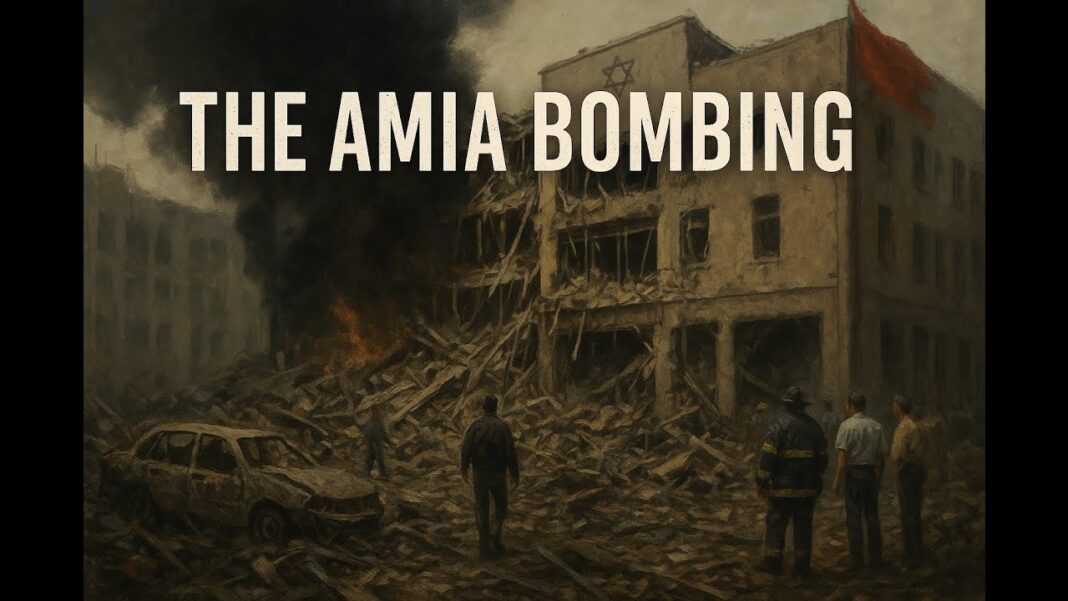
The AMIA bombing itself occurred on July 18, 1994, when a powerful truck bomb detonated outside the Jewish community center in Buenos Aires. The explosion leveled much of the building and caused widespread destruction in the surrounding neighborhood. It remains the deadliest terrorist attack in Argentina’s history.
Investigators have long concluded that Hezbollah carried out the attack under the direction of Iran’s leadership. According to evidence presented by Argentine prosecutors, senior Iranian officials allegedly approved the operation during a meeting in Tehran before Hezbollah operatives executed the bombing.
“It was them who carried out the attack,” Basso said in comments reported by The Algemeiner. “They are puppets of Iran and both the masterminds and perpetrators behind the bombing.”
The prosecutor added that new information obtained from Iranian dissidents has helped investigators reconstruct key aspects of the plot.
According to the information contained in The Algemeiner report, Argentine authorities established contact in 2025 with a group of defectors who provided inside knowledge about the workings of the Iranian regime and the structure of Hezbollah.
“That was vital for us,” Basso explained, “because it allowed us to reconstruct what happened in Iran, understand how the regime works, and how Hezbollah was created and sustained.”
These revelations have strengthened Argentina’s longstanding claim that the bombing was not merely the work of a militant group but rather a state-sponsored act of terrorism.
The investigation into the AMIA attack has been marked by controversy, political intrigue, and tragedy. For many years, critics accused Argentine authorities of mishandling evidence, manipulating witnesses, and allowing the case to become entangled in political disputes.
One of the most dramatic episodes occurred in 2015 when Alberto Nisman, the original prosecutor who had charged Iranian officials with orchestrating the bombing, was found dead in his apartment just days after accusing Argentina’s then-president Cristina Fernández de Kirchner of attempting to cover up the crime.
Nisman had alleged that Kirchner’s government sought to shield the Iranian suspects from prosecution in exchange for favorable trade agreements involving Iranian oil. His death shocked the country and sparked massive public demonstrations demanding accountability.
Although the circumstances surrounding Nisman’s death remain under investigation, many Argentines continue to believe that he was murdered because of his work on the AMIA case.
As The Algemeiner report noted, the controversy surrounding Nisman’s death deepened public distrust in the investigation and complicated efforts to pursue justice for the victims.
The alleged cover-up at the center of Nisman’s accusations was linked to a controversial memorandum of understanding signed in 2013 between Argentina and Iran. The agreement purportedly aimed to establish a joint commission to investigate the bombing but was widely criticized as a mechanism that could allow Iranian suspects to evade prosecution.
The agreement was ultimately declared unconstitutional by Argentine courts, but the political fallout from the episode continues to reverberate in the country’s domestic politics.
President Javier Milei has taken a markedly different stance from previous administrations. Since taking office in 2023, Milei has openly characterized Iran as an enemy of Argentina and has pledged to strengthen ties with Israel and the country’s Jewish community.
Milei’s government has adopted a more confrontational posture toward Tehran and has emphasized the need to hold those responsible for the AMIA bombing accountable.
This renewed commitment has been welcomed by Jewish organizations in Argentina, which have spent decades advocating for justice in the case.
Yet the geopolitical context surrounding the investigation has changed dramatically in recent weeks. Several senior Iranian officials linked to the case have been killed during the ongoing U.S.-Israeli military campaign against Iran’s leadership.
Among them was Iran’s Supreme Leader Ayatollah Ali Khamenei, whom Basso had previously sought to indict over his alleged involvement in the AMIA bombing.
Last year, Basso requested that federal judge Daniel Rafecas issue arrest warrants for Khamenei, marking a significant departure from Argentina’s earlier position that the Iranian leader enjoyed diplomatic immunity.
Khamenei’s death during the recent strikes has now added another complex dimension to the case.
Despite these developments, the central challenge facing Argentine authorities remains unchanged: bringing the perpetrators of the AMIA bombing to justice after more than thirty years.
For the families of the victims and the broader Jewish community in Argentina—the largest in Latin America—the pursuit of accountability has become both a legal struggle and a moral imperative.
As The Algemeiner report noted, the AMIA bombing stands not only as a national tragedy but also as a stark reminder of the global reach of terrorism.
Whether the upcoming trial in absentia will finally provide a measure of closure remains uncertain. Yet for many observers, the latest move by Argentine prosecutors represents the most significant step toward justice since the investigation first began.
After decades of unanswered questions, political controversy, and international intrigue, the world may soon witness a courtroom reckoning for one of the most devastating acts of terrorism in Argentina’s history.
