



|
Getting your Trinity Audio player ready...
|
By: Fern Sidman
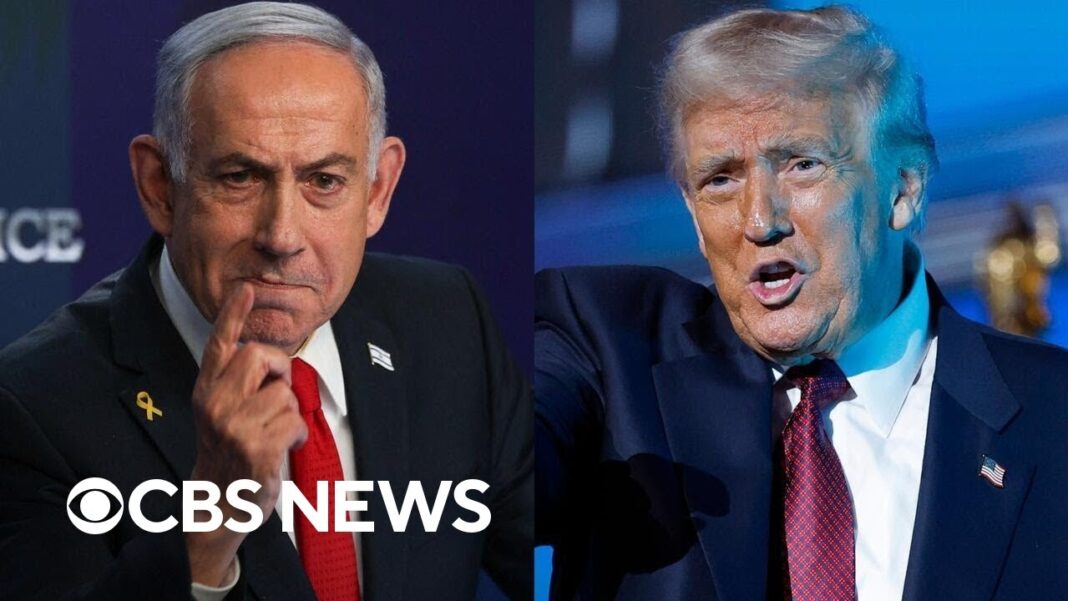
A previously undisclosed phone call between Prime Minister Benjamin Netanyahu and US President Donald Trump on February 23 emerged as a decisive turning point in the chain of events that culminated days later in a dramatic strike on Tehran and the assassination of Iran’s Supreme Leader, Ayatollah Ali Khamenei. According to a detailed report published Tuesday by Axios and cited by Israel National News, the conversation — conducted from the White House Situation Room — crystallized intelligence assessments and strategic calculations that had been months in the making.
Israel National News, referencing the Axios account, reported that Netanyahu phoned Trump to relay sensitive intelligence indicating that Khamenei and his most senior advisers were scheduled to convene at a single location in Tehran on the morning of February 28. Three sources briefed on the call told Axios that Netanyahu conveyed the extraordinary possibility that the Iranian leader and his inner circle could be eliminated in a single, precisely executed airstrike.
The call, which had not been previously reported, is described as pivotal — the moment when actionable intelligence converged with political will. The Israel National News report emphasized that both leaders viewed the opportunity as rare and fleeting. The prospect of incapacitating the core of the Iranian regime in one operation was seen as an intelligence windfall unlikely to present itself again.
At the time of the call, President Trump had already been weighing the prospect of military action against Iran, according to US officials cited in the Axios report. However, while the strategic logic for striking had been under discussion for months, the timing had not yet been fixed. The February 23 intelligence briefing altered that calculus. The new information injected urgency into deliberations and provided a tangible target whose elimination could fundamentally alter the regional balance of power.
Israel National News reported that coordination between Washington and Jerusalem had intensified over the preceding two months. Trump and Netanyahu met twice in person and spoke by telephone approximately 15 times during that period, underscoring the depth of alignment between the two administrations on Iran policy. The February 23 conversation was thus not an isolated event but rather the culmination of sustained strategic dialogue.
In the days following the call, the CIA undertook an immediate review of the Israeli intelligence at Trump’s direction. According to US officials cited by Axios, the agency’s preliminary findings corroborated the Israeli assessment that Khamenei and senior regime figures were indeed planning to gather at the specified location. That confirmation accelerated operational planning.
Yet the president’s decision-making process reflected a blend of urgency and caution. The day after the February 23 call, Trump delivered his State of the Union address. Israel National News, citing Axios, noted that Trump made a deliberate choice not to emphasize Iran heavily in the speech. Officials described this as a calculated move designed to avoid alerting Khamenei and prompting the Iranian leader to alter his schedule before the strike could be executed. The speech’s relative silence on Iran, therefore, was not indicative of inaction but rather of strategic concealment.
By Thursday, intelligence verification had reached what US officials described as a conclusive threshold. The CIA confirmed that the Iranian leadership would indeed be assembled in one location. “Confirmed that these people were all going to be together, and we needed to take advantage of it,” one source told Axios, a quotation prominently cited by Israel National News in its coverage.
Simultaneously, diplomatic channels were faltering. That same day, Trump’s envoys Jared Kushner and Steve Witkoff phoned from Geneva after hours of negotiations with Iranian officials. According to the Axios account, the envoys delivered a bleak assessment of the talks, concluding that diplomacy had reached a dead end. The convergence of verified intelligence and collapsing negotiations removed remaining barriers to military action.
On Friday at 3:38 p.m. EST, President Trump gave the final authorization for the strike. Eleven hours later, bombs fell on Tehran. Khamenei was killed, and the conflict that followed reshaped the geopolitical landscape of the Middle East.
The Israel National News report highlighted that the timeline had not always been so compressed. According to one Israeli official cited in the Axios report, Trump had originally considered striking earlier in January. Netanyahu reportedly requested a delay at that time, seeking optimal conditions for operational success and international positioning. The February strike, therefore, was described as “fully coordinated,” reflecting mutual understanding and joint strategic planning.
The original plan contemplated a strike in late March or early April. Such a schedule would have allowed the US administration more time to build public and congressional support. However, the intelligence about the February 28 meeting — combined with concerns voiced by Netanyahu that Iranian opposition figures in hiding could face imminent danger — prompted a reassessment. According to a US official quoted by Axios, Netanyahu urged a faster timetable. The accelerated schedule left limited opportunity to shape a public narrative in advance.
Despite suggestions that Netanyahu pressed aggressively for immediate action, Israeli Ambassador to Washington Yechiel Leiter rejected claims of undue influence. Israel National News quoted Leiter as emphasizing the depth of strategic consensus between the two countries. “Over the past year, we have worked more closely than ever with our partners in the United States regarding Iran, and we see eye to eye on the danger Iran poses to Israel, to the United States, and to the free world,” he told Axios.
Leiter further underscored President Trump’s autonomy, noting that “anyone who knows President Trump understands that he is a strong leader who cannot be steered.” The Israel National News report presented this as a rebuttal to narratives portraying the United States as having been driven into action by Israeli insistence.
The unfolding of events, as reconstructed from the Axios report, illustrates the intricate interplay of intelligence, diplomacy, and leadership judgment. The February 23 phone call was not merely a tactical update but a strategic inflection point. It translated months of intelligence monitoring into a concrete operational window.
The fact that the call was conducted from the White House Situation Room further underscores its gravity. That setting — synonymous with crisis decision-making — suggests that the administration recognized the magnitude of what was under consideration. This was not a spontaneous decision but the culmination of deliberations involving the highest levels of both governments.
The strike’s aftermath has already altered regional dynamics. The removal of Khamenei eliminated a central figure of Iran’s theocratic leadership, triggering political shockwaves within the Islamic Republic and intensifying military exchanges across multiple fronts. The broader implications for Iran’s nuclear program, its proxy networks, and its internal stability remain subjects of intense analysis.
Yet at the heart of the episode lies a single conversation — a phone call between two leaders confronting what they perceived as a narrowing window of opportunity. As Israel National News repeatedly noted in its reporting, the alignment between Washington and Jerusalem was decisive. The intelligence provided by Israel, the verification conducted by the CIA, and the final order issued by President Trump collectively shaped a moment that has already entered the annals of modern geopolitical history.
Whether historians ultimately judge the strike as preemptive necessity or escalatory gamble, the February 23 call stands as the fulcrum upon which the decision turned. In the shadowed confines of the Situation Room, intelligence and resolve converged — and within days, the Middle East was transformed.
