



|
Getting your Trinity Audio player ready...
|
By: Fern Sidman
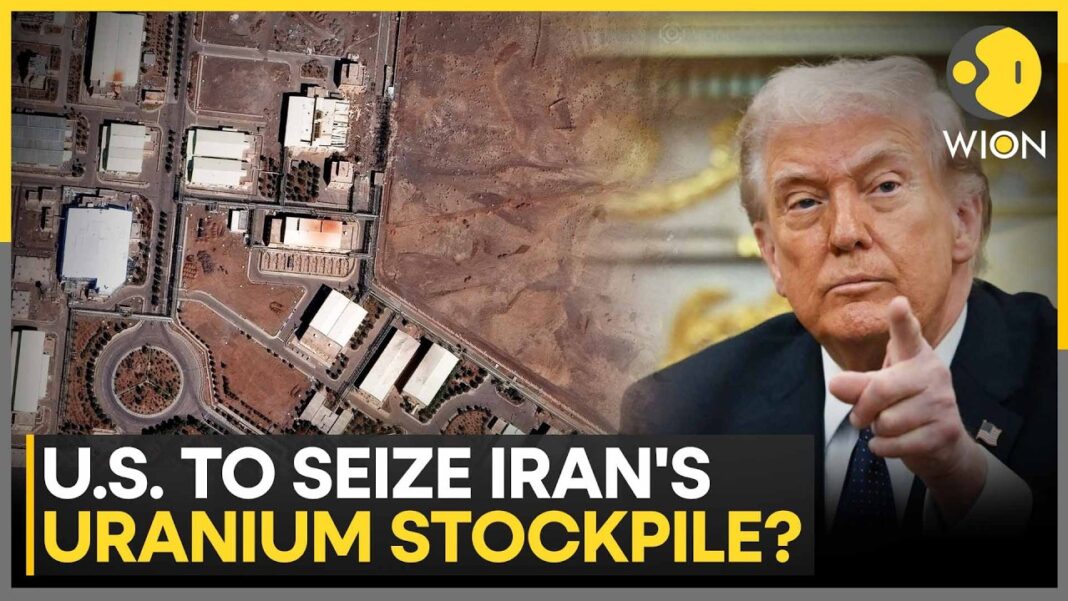
As the war between the United States, Israel, and the Islamic Republic of Iran continues to reshape the strategic landscape of the Middle East, senior officials in Washington and Jerusalem are reportedly examining one of the most audacious military options contemplated during the conflict: deploying special forces deep inside Iranian territory to seize and secure Iran’s remaining stockpile of highly enriched uranium.
According to a report that appeared on Sunday at Israel National News, the proposal has emerged during high-level consultations between American and Israeli defense officials who are assessing the long-term implications of Iran’s nuclear infrastructure after a series of devastating airstrikes earlier this year. The scenario, first detailed in a report by Axios and subsequently discussed by regional analysts, centers on approximately 450 kilograms of uranium enriched to 60 percent purity—a quantity regarded by nuclear experts as dangerously close to weapons-grade material.
Intelligence assessments cited by officials indicate that if Iran were able to further enrich this stockpile to 90 percent purity—the threshold generally considered necessary for nuclear weapons—it could theoretically produce material sufficient for as many as eleven nuclear bombs. The existence of such a stockpile has long been a central concern for Israeli and American policymakers who have repeatedly declared that preventing Tehran from acquiring nuclear weapons capability remains a core strategic objective.
The possibility of physically seizing the uranium, rather than merely destroying nuclear facilities from the air, represents a dramatic escalation in the operational concepts under discussion. As Israel National News has reported in its coverage of the evolving conflict, military planners increasingly believe that neutralizing Iran’s nuclear infrastructure may ultimately require not only aerial bombardment but also direct control over nuclear materials themselves.
The background to this extraordinary proposal lies in the extensive damage inflicted on Iran’s nuclear facilities during the early phases of the current campaign. In June, Israeli and American forces carried out coordinated strikes against several of Iran’s most sensitive nuclear sites, including the Fordow Fuel Enrichment Plant, the Natanz Nuclear Facility, and installations near the city of Isfahan.
According to officials cited in reports referenced by Israel National News, these strikes succeeded in destroying much of the centrifuge infrastructure that Iran had used to enrich uranium. In addition, the bombardment triggered structural collapses that effectively sealed entrances to underground tunnels where nuclear materials had been stored.
While the destruction of these facilities significantly degraded Iran’s ability to continue enrichment operations, it also produced a complicated strategic dilemma. The uranium stockpile itself—already enriched to 60 percent—remains buried beneath the rubble of the damaged complexes. Although the material is currently inaccessible, intelligence officials warn that if Iran were eventually able to recover it, the stockpile could serve as the foundation for rebuilding the country’s nuclear program.
Consequently, military planners are exploring the possibility of dispatching special operations forces to physically secure the uranium and remove it from Iranian control. Such a mission would likely involve elite commando units capable of operating in hostile territory under extremely dangerous conditions.
Officials familiar with the discussions describe the scenario as one of the most complex and perilous operations ever contemplated by Western military forces. Extracting nuclear material from deep within Iranian territory would require navigating a labyrinth of collapsed tunnels, unstable infrastructure, and the persistent threat of Iranian military retaliation.
Moreover, the logistics of transporting such highly radioactive material out of Iran would present additional challenges. Specialized containment systems, radiation protection measures, and rapid evacuation capabilities would all be essential components of the operation.
Military analysts quoted in commentary cited by Israel National News emphasize that such an undertaking would only be considered if the broader military campaign succeeds in severely weakening Iran’s defensive capabilities. The presence of intact Iranian air defenses, missile forces, or ground units could make a commando raid of this magnitude prohibitively risky.
“The assessment is that this type of operation would only be attempted once the Iranian military has been degraded to the point where it can no longer mount an effective response,” one source familiar with the planning reportedly said.
The strategic reasoning behind the proposal reflects longstanding concerns within Israeli defense circles about the limitations of air power alone. While bombing campaigns can damage nuclear facilities and disrupt enrichment activities, they may not fully eliminate the underlying nuclear materials that make weapons production possible.
For this reason, some policymakers believe that physically securing Iran’s uranium stockpile could represent the decisive step needed to ensure that Tehran cannot revive its nuclear ambitions in the future.
President Donald Trump has repeatedly framed the prevention of an Iranian nuclear weapon as one of the central goals of the ongoing military campaign. According to statements referenced by Israel National News, Trump has argued that dismantling Iran’s nuclear capabilities is essential not only for Israel’s security but also for the broader stability of the Middle East.
In recent remarks, Trump emphasized that the war’s ultimate objective is to ensure that Iran is permanently prevented from obtaining nuclear weapons. Within this strategic framework, seizing the enriched uranium itself could represent the final stage of neutralizing the Iranian nuclear program.
At the same time, experts caution that any such mission would carry enormous geopolitical and military risks. Deploying foreign special forces inside Iran would constitute a direct ground operation within the territory of a sovereign state, potentially provoking fierce retaliation and escalating the conflict even further.
The possibility of American or Israeli commandos operating inside Iran could also inflame nationalist sentiment within the country and complicate efforts to stabilize the region after the war.
Nevertheless, the option remains under discussion precisely because of the extraordinary stakes involved. The presence of hundreds of kilograms of highly enriched uranium represents a lingering threat that military planners are reluctant to leave unresolved.
Another factor influencing the debate is the uncertain future of Iran’s political leadership following the recent strikes that targeted senior figures within the regime. The death of key leaders and the weakening of the country’s military infrastructure have raised questions about who might ultimately control Iran’s nuclear materials if the current government collapses.
Under such circumstances, Western officials fear that the uranium stockpile could fall into the hands of rogue actors or terrorist factions seeking to exploit the chaos.
By physically securing the material, American and Israeli forces could theoretically eliminate that risk while simultaneously preventing Iran from rebuilding its nuclear program.
Despite these considerations, officials caution that the proposal remains only one of several options currently under review. Military operations of this magnitude require extensive planning, coordination, and intelligence gathering before they can even be seriously contemplated.
As Israel National News has reported in its ongoing coverage of the war, the broader campaign against Iran continues to evolve rapidly, with new developments emerging almost daily. Airstrikes, missile exchanges, and proxy conflicts across the region have already reshaped the strategic environment in ways that few observers predicted at the outset of the conflict.
Within this fluid context, the possibility of a special forces mission to seize Iran’s enriched uranium illustrates both the scale of the challenge and the extraordinary measures that policymakers may consider in order to address it.
Whether such an operation will ultimately be carried out remains uncertain. What is clear, however, is that the fate of Iran’s nuclear stockpile has become one of the most consequential questions confronting American and Israeli leaders as they navigate the next phase of the conflict.
For now, the uranium remains buried beneath the shattered remnants of Iran’s nuclear facilities—an ominous reminder that even after the bombs fall silent, the struggle to prevent nuclear proliferation may be far from over.
